FANUC vs. KUKA Industrial Robots: The Precision Specialist and the Heavy-Payload Powerhouse
A practical comparison of FANUC and KUKA industrial robots covering controller differences, precision, applications, and what each brand means on the used market. Includes inspection tips for used FANUC and KUKA robots.
Tyche Robotic
5/27/20267 min read
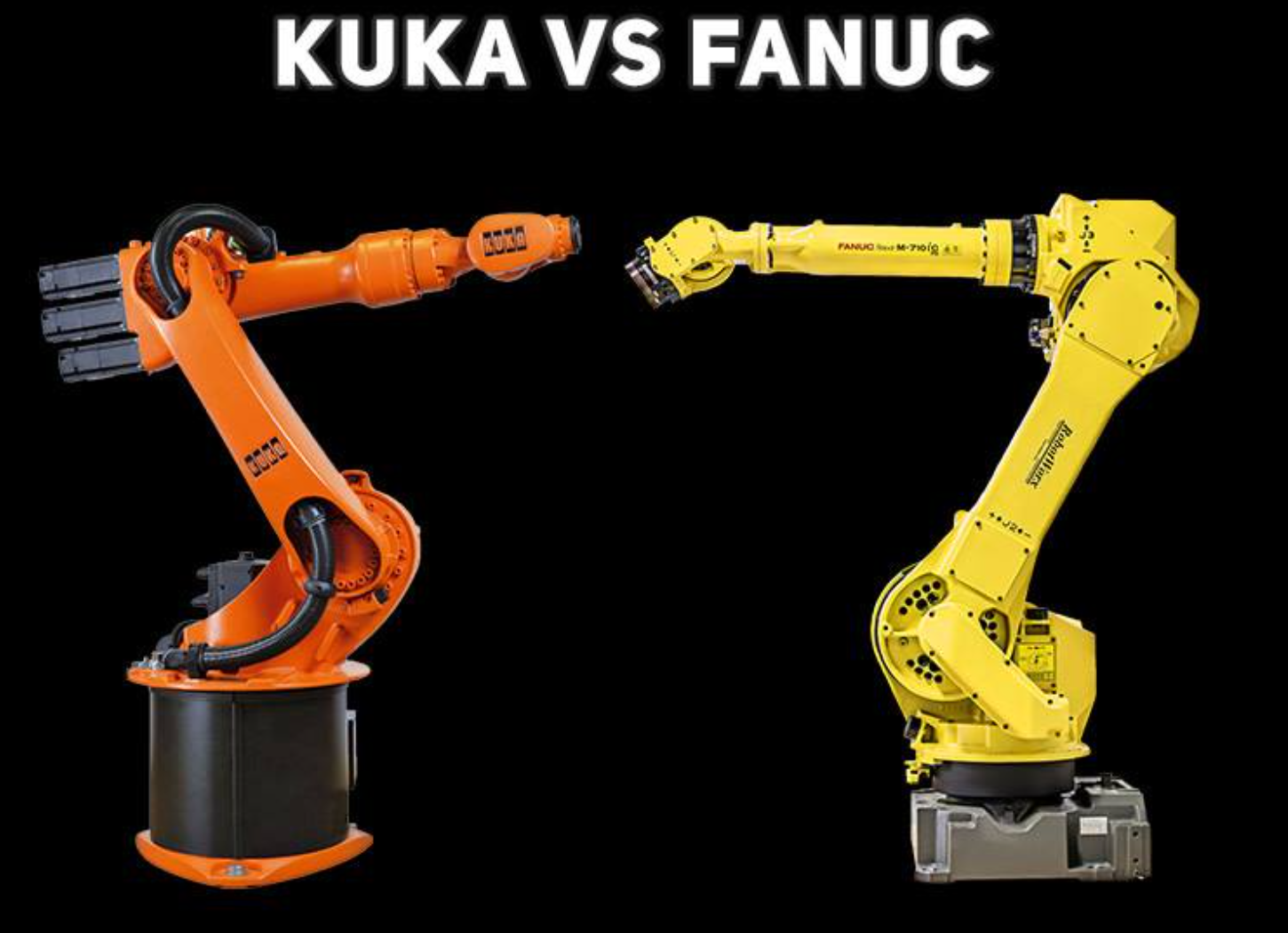
FANUC and KUKA sit on opposite sides of the industrial robot world in a lot of ways. FANUC is a Japanese company that started in CNC controls and built robots that inherited the same obsession with precision and reliability. KUKA is a German company that built the world's first six-axis electromechanical robot in 1973 and never stopped pushing the upper limits of what a robot arm can lift. Together, they account for roughly twenty-three percent of the global industrial robot market, FANUC at around seventeen percent and KUKA at around six percent. FANUC has over one million units installed worldwide, more than any other brand. KUKA was acquired by Midea Group of China and now holds a commanding position in heavy-payload robotics. On the used market, both brands show up in large numbers, but the models that appear, the reasons they were retired, and the buyers who want them are not the same. Understanding where FANUC and KUKA differ is not a matter of one being better than the other. It is about knowing which one fits the job.
The Brands at a Glance
FANUC is the biggest robot builder on the planet by installed base. The product line runs from half a kilogram to twenty-three hundred kilograms, with more than a hundred models covering pretty much any payload and reach a factory could ask for. The company came up through CNC controls, and that heritage shows in the way the robots move and hold position. The yellow paint is practically a shorthand for reliability. The Arc Mate 120iC runs a huge share of the world's robotic arc welding cells. The R-2000iB series is the most common spot welding robot anywhere. The M-20iA handles general material handling and machine tending in factories across every industry.
KUKA is the heavy-lift specialist with a German engineering soul. The product line runs from two to thirteen hundred kilograms. The KR 1000 titan is still one of the highest-payload six-axis industrial robots ever built. KUKA invented the FAMULUS in 1973, the first six-axis electromechanical robot, and the company has been refining heavy-payload motion control ever since. The KR QUANTEC series is the backbone of automotive body shops and heavy fabrication lines. The KR 210 handles spot welding and heavy palletizing in factories worldwide. KUKA was acquired by Midea Group, but the engineering and manufacturing stayed in Germany. ABB owns the precision motion and paint shop corner of the Big Four, and Yaskawa Motoman dominates arc welding and multi-robot coordination. Each of the four found its niche.
Controller Philosophy: R-30iB vs. KRC4/KRC5
The controller is where FANUC and KUKA really split, and on the used market this matters more than most buyers realize. FANUC's R-30iB is a closed, purpose-built system. Safety control, robot control, motion control, logic control, and process control are all deeply integrated in a single box. The hardware and software are designed together, which means the system is incredibly stable. iRVision plugs directly into the controller without a separate PC. The controller does exactly what it was programmed to do, and it does it the same way for years. The downside is that the system is not flexible. If FANUC did not build a feature into the controller, you are not adding it. The closed architecture also means the R-30iB is highly resistant to viruses and cyber threats, which matters in factories where the robot controller sits on a plant network.
KUKA's KRC4 and newer KRC5 run on a Windows-based PC architecture. Safety control, robot control, motion control, logic control, and process control are unified in a single system with a shared database. The open architecture uses standard data protocols, which means third-party sensors, cameras, grippers, and custom software can plug in without extra hardware. For an integrator who wants to build a complex cell with vision, force sensing, and custom peripherals, KUKA's openness is a genuine advantage. The trade-off is that a Windows-based controller needs the same care as any other industrial PC. Software updates, security patches, and the occasional reboot or drive reformat are part of owning a used KUKA. An outdated or unsupported version of Windows sitting on a factory network is a security risk that a closed system like the R-30iB simply does not have.
FANUC has since moved to the R-50iA controller, and KUKA to the KRC5. But on the used market, the R-30iB and the KRC4 are the controllers you will actually run into. The newer hardware is years away from showing up in volume on the secondary market.
Applications: Where Each Brand Earned Its Reputation
FANUC earned its keep in high-volume, high-reliability production. Automotive spot welding is where the brand became the default answer. The R-2000iB series carries weld guns weighing over a hundred kilograms through millions of cycles without losing position. Arc welding is the other pillar. The Arc Mate series, with its slim arm design, reaches into tight spots that bulkier robots cannot access. In precision assembly and pick-and-place, the M-20iA and LR Mate series handle small parts with repeatability measured in hundredths of a millimeter. FANUC's P-series painting robots cover the paint shop with long-reach, explosion-proof arms.
KUKA earned its keep under heavy parts and inside foundries. The KR 1000 titan, with thirteen hundred kilograms of payload, handles lifts that would fold a smaller robot in half. The KR QUANTEC series is the backbone of automotive component assembly, putting together engines, axles, brakes, and steering systems. KUKA's Foundry series, with IP67 and IP65 dual certification and a wrist that withstands one hundred eighty degrees Celsius, is purpose-built for casting and forging environments. In building materials, KUKA robots move stone slabs, glass panels, and precast concrete sections that weigh more than the robot itself.
In general material handling and mid-range palletizing, the two brands compete directly. The choice often comes down to controller preference and local service. ABB owns precision motion and automotive painting, and Yaskawa Motoman dominates arc welding and multi-robot cells. Each brand has its territory.
Precision, Speed, and the Numbers That Matter
The specs are close enough that most applications will not feel the difference, but the differences are there. On the light end, the FANUC M-6iB carries six kilograms over thirteen hundred seventy-three millimeters with repeatability of eight hundredths of a millimeter. The KUKA KR6 matches the payload with comparable reach and precision around one tenth of a millimeter. The FANUC is slightly more precise. In arc welding, the FANUC Arc Mate 120iC handles twelve kilograms over twenty-two hundred seventy millimeters with repeatability of five hundredths of a millimeter. The KUKA KR 16 carries sixteen kilograms over twenty hundred sixteen millimeters with repeatability of six hundredths of a millimeter. The specs are nearly identical. The choice between them usually comes down to controller preference and software ecosystem. On the heavy end, the FANUC R-2000iC series holds repeatability at five hundredths of a millimeter. The KUKA KR 210 R2700 extra carries two hundred ten kilograms over nearly twenty-seven hundred millimeters with repeatability of six hundredths of a millimeter. The KUKA carries more. The FANUC is tighter on precision. For a spot welding or heavy palletizing cell, either robot will do the work. The decision usually tips on whether the buyer values KUKA's higher payload and open controller, or FANUC's tighter precision and bulletproof reliability.
What These Differences Mean on the Used Market
The used market tells the real story. FANUC robots flood the secondary market because automotive spot welding retires them in waves. The R-2000iB and Arc Mate series are everywhere. Parts are easy to find. Every integrator knows the R-30iB. The closed controller architecture means fewer maintenance headaches over the life of the machine, which keeps used FANUC prices stable and slightly premium in many regions.
KUKA heavy-payload robots are a different kind of asset. The KR QUANTEC, KR FORTEC, and KR 1000 titan occupy a weight class where there are very few alternatives. A used KR 210 or KR 1000 titan is not competing against a dozen other models from other brands. It is competing against the cost of buying a new one or not automating the lift at all. That scarcity keeps used KUKA heavy-payload robots in demand, but the Windows-based controller means the buyer inherits the maintenance reality of an industrial PC. Software updates, security patches, and the occasional hard drive reformat are part of the deal.
FANUC's closed R-30iB controller is inherently more resistant to viruses and network threats, which matters in factories where the robot controller lives on the plant network. KUKA's open KRC4 gives integrators flexibility that a closed system cannot match. Neither is universally better. The right choice depends on whether the buyer values stability or flexibility more. Knowing the robot's application history matters as much as knowing the brand. A FANUC from a body shop and a KUKA from a foundry lived completely different lives. A seller who can tell you what the robot did before and provide a loaded test report is worth dealing with. Tyche Robotic and other established used equipment suppliers understand that the robots that hold up best are the ones that were maintained properly and tested honestly, regardless of the name on the arm.
What to Check When Buying a Used FANUC or KUKA
A used FANUC and a used KUKA need different inspection checklists because they fail in different ways. For a FANUC, especially one retired from spot welding, wrist backlash is the first measurement to ask for. The A4, A5, and A6 axes on an R-2000iB absorb the weight of a weld gun through millions of cycles. Backlash data tells you how much reducer life is left. The R-30iB controller battery is next. A dead battery means lost mastering, and re-mastering a heavy robot is not a small task. ArcTool and HandlingTool software licenses need to be verified as installed and transferable. The dress pack on a welding robot deserves extra attention. Welding spatter burns pinholes in cable jackets, and heat exposure hardens the protective tubing over time.
For a KUKA, wrist backlash is equally critical, especially on heavy-payload robots retired from foundry or material handling work. The KRC4 or KRC5 battery needs the same check as the FANUC. KRL software licenses for welding, handling, or foundry packages must be verified as installed and transferable. The Windows operating system on the controller deserves a look. An outdated or unsupported version of Windows connected to a factory network is a security risk that a closed system like the R-30iB does not carry. For KUKA Foundry series robots, inspect every external seal. Heat and chemical exposure harden rubber and silicone. A robot that looks clean on the outside may have moisture damage inside the controller if the seals failed years ago.
For both brands, a loaded test report is the minimum documentation to ask for before writing a check. A video of the specific robot running a test cycle under load is better than any spec sheet. The robot's previous life matters more than its brand. An inspection that does not account for where the robot spent its first career is only half an inspection.
This article was prepared by Tyche Robotic, a supplier of refurbished six-axis industrial robots serving integrators and resellers in Latin America, Southeast Asia, and Europe.
Contact Us
As a professional supplier of used industrial robots, Jiangmen Tyche Robotic Co., Ltd. is committed to providing customers with integrated solutions—from hardware selection and configuration to software programming, debugging, and after‑sales maintenance.
© 2025. All rights reserved.

Mr. Victor Ismael