
What Is FANUC FoundryPro? A Look at How the Big Four Protect Robots in Harsh Environments
A detailed look at FANUC FoundryPro and how ABB Foundry Plus, KUKA Foundry, and Yaskawa XP protect industrial robots in foundry, forging, and steel mill environments. Includes used buying tips for foundry-grade robots.
Tyche Robotic
5/20/20267 min read
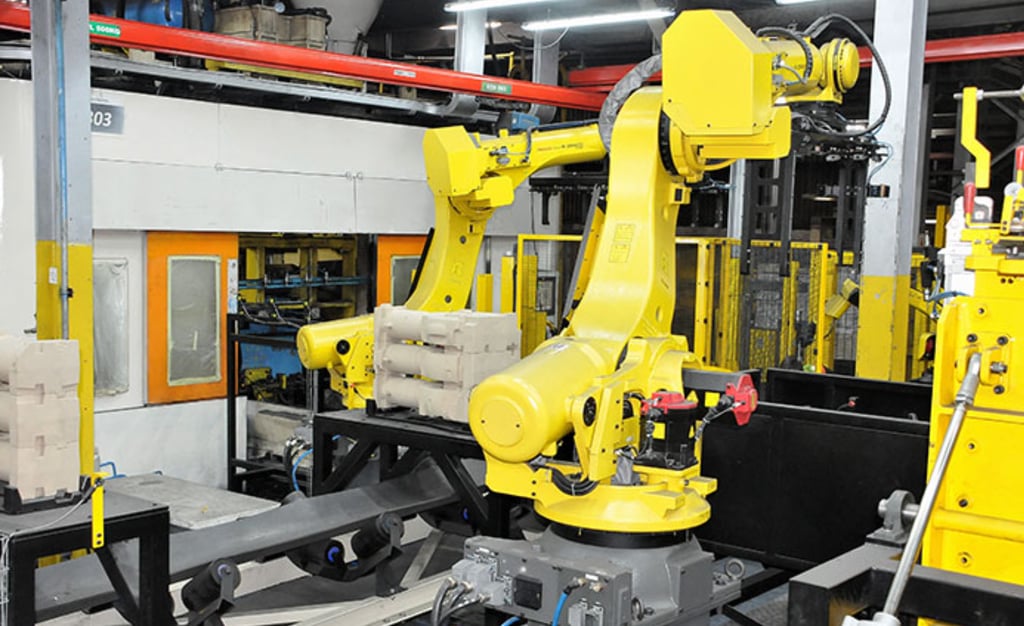
A standard industrial robot dropped into a foundry, a forge shop, or a steel mill will not last long. The heat alone can cook the grease in the joints. Conductive dust works its way past seals and shorts out circuit boards. Cooling water mixed with casting sand turns into a grinding paste that eats mechanical components. The global market for robots in foundry and forging environments sat at roughly four hundred thirty million dollars in 2024 and is projected to pass seven hundred thirty million by 2032. That growth is not coming from factories with clean floors and climate control. It is coming from places where the robot is expected to survive heat, grit, and chemical washdown every single shift. FANUC's answer to this environment is called FoundryPro. But every one of the Big Four has built its own version of a robot that can take a beating and keep cycling. Understanding the differences between those approaches is how a buyer matches the machine to the actual conditions it will face.
What Makes a Foundry-Grade Robot Different
Four things separate a robot built for a foundry from a standard industrial arm. The first is an IP67 rating at minimum. That means the robot is completely dust-tight and can survive temporary immersion in up to one meter of water. In a foundry, dust is not harmless household powder. It is conductive metallic particles that drift into every opening. The second is heat tolerance. A standard robot might be rated for an ambient temperature of forty degrees Celsius. A foundry robot needs to handle fifty-five degrees or more as a baseline, with the ability to withstand much higher temperatures for short bursts when reaching near furnaces or handling hot castings. The third is chemical resistance. Foundries and forge shops use aggressive cooling fluids, die lubricants, and cleaning chemicals that degrade standard seals and coatings in weeks. The fourth is a simplified mechanical design with fewer external failure points. Every belt, pulley, and exposed sensor is a place where heat, dust, and chemical attack can start. The best foundry robots eliminate as many of those as possible.
FANUC FoundryPro: IP67 Protection in Three Sections
FANUC divides the robot into three zones and protects each one differently. The first zone is the J3 arm and the wrist. These are the joints closest to the work, the ones that sit right above a hot casting or inside a spray of die lubricant. FoundryPro applies IP67-rated seals at every joint, with a double oil seal design on the wrist to stop any dust or moisture from following the rotating shaft into the reducer. Stainless steel-coated bolts at the wrist resist corrosion from chemicals that would pit a standard steel fastener. The second zone is the drive train in the upper arm and base. These areas are further from the heat but still exposed to ambient dust and moisture. FoundryPro uses airtight gaskets and epoxy-coated castings to seal the housings. The third zone is the controller connections and the electrical system. Waterproof EE connectors resist moisture ingress. The non-painted surfaces on the robot get an additional clear coating to prevent rust from forming on untreated metal.
The design goes further on certain models. The M-710iC FoundryPro eliminates motors inside the wrist entirely, relocating them to the upper arm housing. Fewer motors in the wrist means fewer seals that can fail at the point closest to the heat and chemicals. The base has a venting design that allows any moisture that does work its way inside to escape rather than pooling and corroding internal components. The R-2000iB/165F FoundryPro and the M-900iB/700 FoundryPro apply this same three-section logic to heavy-payload spot welding and foundry handling applications. The protective approach is consistent across models, scaled up or down depending on the robot's size and payload.
ABB Foundry Plus and Foundry Plus 2
ABB took a two-tier approach to foundry protection. The original Foundry Plus was designed for environments with cooling fluids, lubricants, and metal chips, common in machining and die-casting cells. It provided IP67 protection on the wrist and key joints, with enhanced sealing against liquids and dust. Foundry Plus 2 is the second generation, and it raises the bar. IP66 and IP67 ratings now extend from the base all the way to the wrist. The robot is built to handle high-pressure steam washdown, the kind of aggressive cleaning that happens in food-grade foundries and in automotive casting cells where hygiene and contaminant control matter. The IRB 1200 Foundry Plus 2, the IRB 6640 Foundry Plus, and the IRB 1300 Foundry Plus 2 each apply this protection at different payload levels, from small-part handling up to 235 kilograms.
KUKA Foundry Series
KUKA's Foundry approach centers on the wrist and the materials. The KR QUANTEC Foundry series uses a V2A stainless steel wrist that is inherently more resistant to corrosion than a coated steel component. The entire robot carries IP65 and IP67 dual certification, meaning it is dust-tight and can handle water jets from any direction. The ambient temperature rating goes to fifty-five degrees Celsius, and the wrist can withstand one hundred eighty degrees Celsius for up to ten seconds per minute. That last number matters for robots that reach into furnaces or handle castings that are still glowing. KUKA offers fourteen variants in the KR QUANTEC Foundry line covering payloads from one hundred twenty to three hundred kilograms. Each one carries the same anti-corrosion coating on the castings and specially sealed flanges where the motors mate to the gearboxes, two points where standard robots tend to fail first in a foundry.
Yaskawa Motoman XP and High-Temperature Variants
Yaskawa's approach to foundry protection is more modular than the other three. The standard Motoman robot carries an IP54 rating on the body, which is fine for general manufacturing but not for a foundry. The XP option, which stands for eXtra Protection, upgrades the body to IP65. This is an add-on package rather than a ground-up redesign, which means the base robot remains the same and the protection is layered on. The GP250 high-temperature variant goes further. It carries an IP67 rating and is rated for operation at one hundred eighty degrees Celsius, making it suitable for furnace tending and direct contact with hot castings. The MH900 pairs an IP67-rated wrist with an IP30 body and runs on the DX200 controller, a configuration that suits heavy foundry handling where the body sits further from the heat source but the wrist needs maximum protection. This modular approach lets Yaskawa offer foundry protection across a wide range of payloads without duplicating its entire product line.
Comparing the Big Four Foundry Protection Approaches
No single foundry protection strategy is universally better than the others. Each one grew out of a different engineering philosophy. FANUC divides the robot into three protection zones and applies escalating levels of sealing, useful in environments where the hazard is different at the wrist, the arm, and the base. ABB splits its protection into two tiers and puts the highest-level Foundry Plus 2 on robots that will face steam washdown and aggressive chemical cleaning. KUKA builds its protection around a stainless steel wrist and an unusually high short-burst temperature tolerance, which matters in furnace applications. Yaskawa keeps its approach modular, letting buyers upgrade a standard robot to foundry spec without changing the underlying machine.
The practical question for a buyer is not which brand has the best foundry robot. It is which brand's protection matches the specific hazards in their facility. A forge shop with radiant heat and scale but no washdown does not need the same protection as a die-casting cell with coolant spray and daily chemical cleaning. Understanding the difference is what keeps a robot running for years instead of weeks.
What to Know When Buying a Used Foundry-Grade Robot
Used foundry robots carry a specific wear signature that is different from robots retired from assembly lines or body shops. Heat, dust, and chemical exposure degrade certain components predictably, and those are the ones to inspect first. Seals and gaskets are the front line. Foundry-grade robots use higher-quality seals, but they still age. Heat and chemical exposure cause rubber and silicone to harden, crack, or swell. Check around each joint for grease seepage, which is the first sign a seal has lost its effectiveness. If the robot has a double oil seal design like the FANUC FoundryPro wrist, ask whether both seals were intact at the most recent inspection. Coatings and surface protection tell a story. Epoxy-coated castings and anti-corrosion paints can show wear from chemical attack or thermal cycling. Look for peeling, bubbling, or rust spots, especially on the lower arm and base where moisture collects. Rust on a foundry robot is not just cosmetic. It means moisture has been sitting on unprotected metal long enough to cause damage, and what is visible on the outside often has a counterpart on the inside.
Open the controller cabinet and check for dust ingress. Fine metallic dust from casting and grinding operations is conductive and settles on circuit boards. A layer of dust inside the controller means the cabinet seals have failed or were not maintained. Intermittent electrical faults that are difficult to trace often trace back to this. The wrist motors on models that retain them, such as the R-2000iB FoundryPro, need attention. Heat ages motor winding insulation. Ask for loaded test data showing motor current draw and temperature under rated conditions. If the robot was used in furnace tending, check the wrist backlash carefully. Thermal cycling accelerates wear on reducers, and any play in the final axes will show up as positioning drift when the robot is handling heavy castings. Software licensing is the last item. Foundry-specific software packages for die-casting tending or furnace handling need to be installed, licensed, and transferable. A foundry robot without its application software is just a well-protected arm with no job.
This article was prepared by Tyche Robotic, a supplier of refurbished six-axis industrial robots serving integrators and resellers in Latin America, Southeast Asia, and Europe.


Contact Us
As a professional supplier of used industrial robots, Jiangmen Tyche Robotic Co., Ltd. is committed to providing customers with integrated solutions—from hardware selection and configuration to software programming, debugging, and after‑sales maintenance.
© 2025. All rights reserved.

Mr. Victor Ismael