The FANUC R-2000iB: A Look at One of the Most Common Heavy-Duty Robots on the Used Market
A detailed look at the FANUC R-2000iB series, covering key models like the 210F and 165F, common applications, and what to check when buying a used R-2000iB robot.
Tyche Robotic
5/11/20264 min read
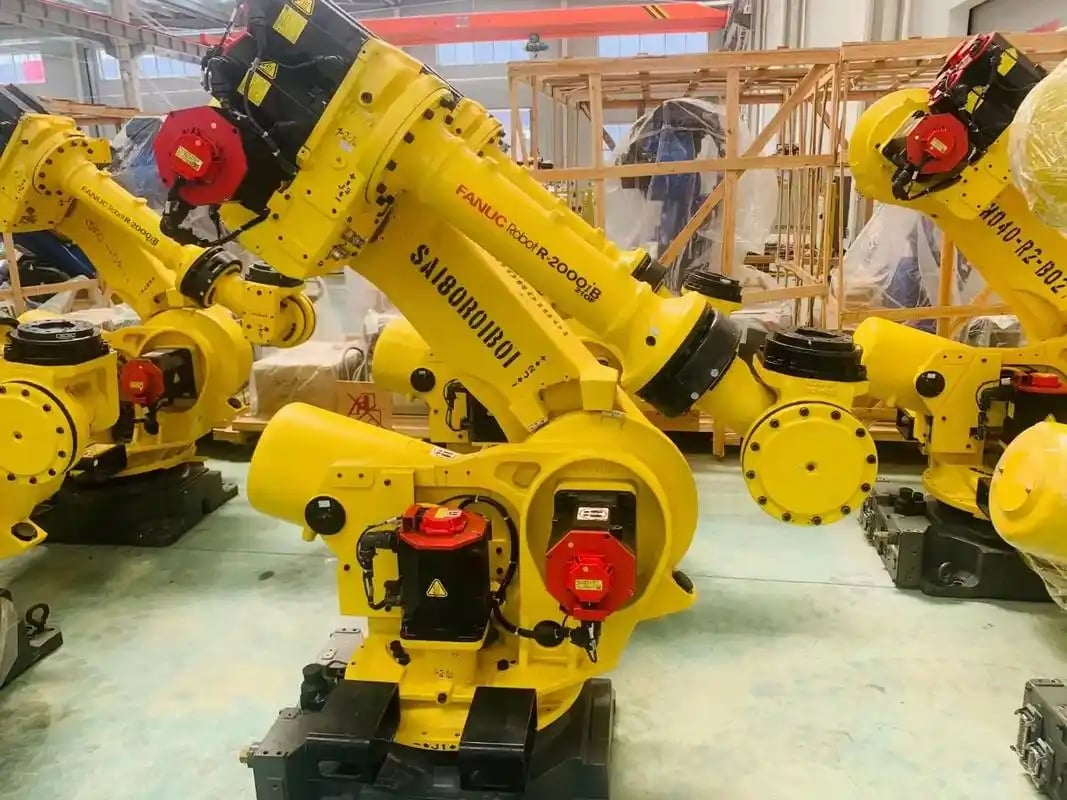
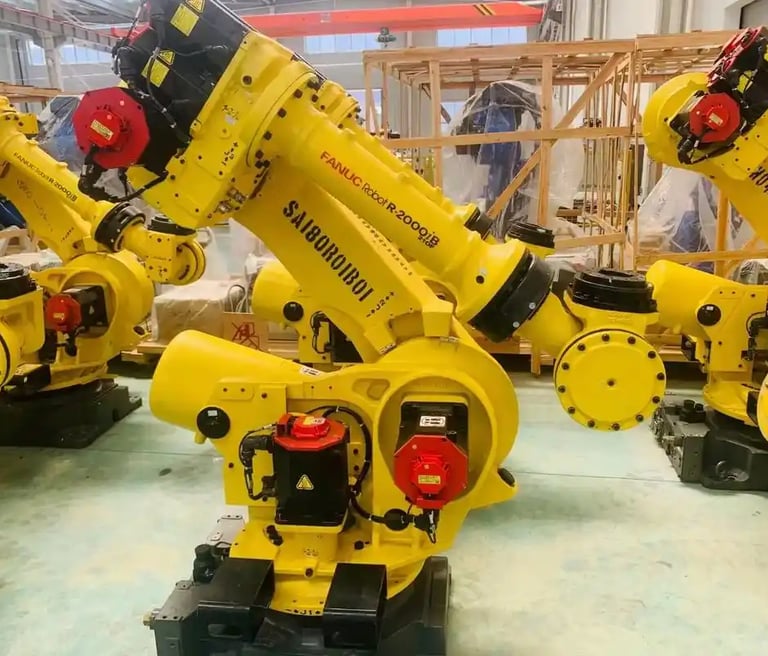
If you spend any time browsing used robot listings, you will see the R-2000iB everywhere. It is one of the most deployed heavy-duty six-axis robots in the world, and a huge number of them are now cycling through the secondary market as automotive plants retool and general manufacturers upgrade their lines. The R-2000iB series sits in a sweet spot. Payloads run from 100 to 250 kilograms. Reach tops out around 3.5 meters. The controller is well understood, the spare parts ecosystem is deep, and the mechanical foundation is tough enough that well-maintained units regularly outlast the production lines they were originally commissioned for. For anyone shopping for a used FANUC robot that can handle serious weight, this series is worth knowing in detail.
What the R-2000iB Brings to the Table
FANUC built the R-2000iB series as a workhorse, and the specs back that up. Payload capacity ranges from 100 kilograms on the lighter models up to 250 kilograms on the heavy end. Reach varies by model, with the R-2000iB/100P stretching out to 3,500 millimeters for long-reach press tending and the 165F and 210F sitting at around 2,655 millimeters. Repeatability is typically plus or minus 0.3 millimeters, which is tight enough for spot welding, material handling, and palletizing, though not intended for high-precision machining tasks. The controller has evolved over the years. Early units shipped with the RJ3iC, then transitioned to the R-30iA and later the R-30iB. The R-30iB adds integrated vision support and faster processing, but all three controllers run the same fundamental motion control architecture. The wrist on the R-2000iB is compact and rigid, which helps the robot work in tight body shop cells. Many units also came optioned with iRVision, FANUC's integrated vision system, a useful feature if your application involves part location or quality inspection.
Key Models in the R-2000iB Family
Not every R-2000iB is the same robot with a different sticker. The model designation tells you what the machine was built to do. The R-2000iB/165F carries 165 kilograms over 2,655 millimeters. It is the general-purpose heavy lifter, common in material handling, machine tending, and palletizing. The R-2000iB/210F steps up to 210 kilograms at the same reach. This is the spot welding workhorse. Open the door of almost any automotive body shop and you will see rows of them swinging weld guns. The R-2000iB/100P takes a different path. Payload drops to 100 kilograms, but reach extends to 3,500 millimeters. This model was designed for press-to-press transfer and long-reach machine tending, where the priority is covering distance, not lifting heavy parts. The R-2000iB/250F pushes payload to 250 kilograms at a standard reach around 2,655 millimeters. Foundries and forge shops use these for handling heavy castings and dies, where every kilogram of payload margin counts. Knowing which model you are looking at makes a real difference during sourcing, because a 165F and a 210F look nearly identical from ten feet away.
Where You Will See R-2000iB Robots at Work
These robots landed in almost every heavy industrial application that needs a six-axis arm with real muscle. Spot welding is where the R-2000iB earned its name. The 210F runs in automotive body shops worldwide, carrying welding transformers and gun assemblies that can weigh over a hundred kilograms, cycling every sixty to ninety seconds for years. Heavy material handling is the second major category. The 165F and 250F move engine blocks, transmission cases, and large castings between machining stations or from casting to finishing. Palletizing cells use the 165F and 210F to stack bagged product, heavy cases, or building materials at the end of a production line. In stamping plants, the R-2000iB/100P slides between multiple presses, picking and placing body panels with its extended reach. Machine tending is another common assignment. The 165F loads and unloads CNC machining centers, freeing operators to manage multiple cells. There are also niche applications like stud welding on automotive seat frames and suspension components, where the robot's stiffness and repeatability produce consistent weld quality.
Buying a Used R-2000iB: What to Check
Used R-2000iB robots are plentiful, but their condition varies widely depending on where they spent their first life. A 210F coming out of an automotive body shop has likely run millions of spot weld cycles. The wrist axes, especially A4, A5, and A6, take the brunt of that duty. Ask for backlash measurements on those joints before buying. Controller condition matters too. RJ3iC and R-30iA controllers are still serviceable, but the backup batteries have a finite life. When those batteries die, the robot loses its mastering data, and re-mastering adds time to your commissioning. Check whether the controller software options you need, such as ArcTool for welding or the external axis package for a track, are installed and licensed. The R-2000iC has been on the market for over 15 years now, which means the R-2000iB is no longer the latest generation. That is not a disadvantage. The mounting footprint and controller interface are largely the same across the iB and iC series, so swapping an iB in as a replacement for an older iA or upgrading to an iC down the line is straightforward. The iB holds its place in the used market because it delivers heavy payload performance at a price point that newer generations have not yet reached.
This guide was prepared by Tyche Robotic, a supplier of refurbished six-axis industrial robots serving integrators and resellers in Latin America, Southeast Asia, and Europe.
Contact Us
As a professional supplier of used industrial robots, Jiangmen Tyche Robotic Co., Ltd. is committed to providing customers with integrated solutions—from hardware selection and configuration to software programming, debugging, and after‑sales maintenance.
© 2025. All rights reserved.

Mr. Victor Ismael