FANUC vs. ABB Industrial Robots: How Two Heavyweights Stack Up for Used Buyers
A practical comparison of FANUC and ABB industrial robots covering controller differences, precision, applications, and what each brand means on the used market. Includes inspection tips for used FANUC and ABB robots.
Tyche Robotic
5/25/20266 min read
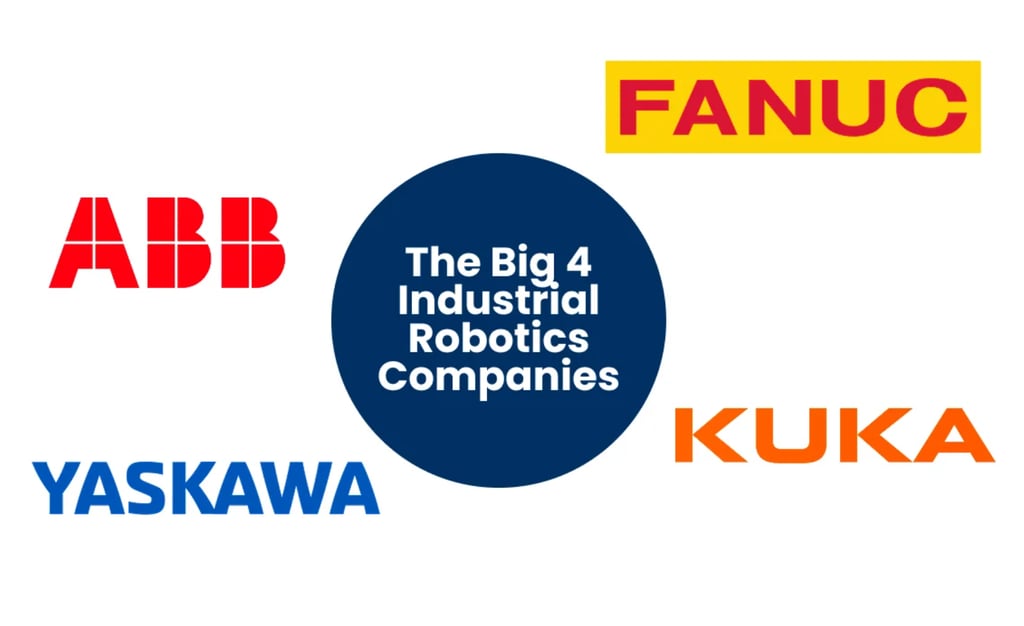
FANUC and ABB are two of the most recognized names in industrial robotics. FANUC has held the top spot in global installed base for years, with over one million units in the field. ABB is right behind, with north of half a million robots installed worldwide. Between them, they account for roughly thirty percent of the global industrial robot market, with FANUC around seventeen percent and ABB around thirteen percent. Walk through almost any factory, anywhere, and the yellow arm in the corner is probably a FANUC, the white one across the aisle an ABB. Both brands show up heavily on the used market because they build machines that outlast the production lines they were commissioned for. But they are not the same machine with a different paint job. They come from different engineering traditions, run on different controllers, and suit different buyers. For someone shopping the used market, understanding where they differ is the difference between buying a robot that fits and one that fights the job.
The Brands at a Glance
FANUC built its reputation on reliability. The robots are famous for running three shifts a day for twenty years and rarely needing anything beyond routine maintenance. The yellow paint job is practically a shorthand for "it just works." ABB built its reputation on motion control and precision. The white robots move differently than the yellow ones. Smoother paths, tighter accuracy at high speeds, and a controller that gives the programmer more room to optimize cycle times. Both companies make robots across the full payload spectrum, from tabletop arms that can fit in a backpack to giants that lift over a ton. KUKA and Yaskawa round out the Big Four, with KUKA owning the heavy-payload and open-controller corner of the market, and Yaskawa dominating arc welding and offering some of the best price-to-performance ratios in the business. But when it comes to general-purpose six-axis robots on the used market, FANUC and ABB are the two names that show up most often.
Controller Philosophy: R-30iB vs. IRC5
The controller is where the two brands really part ways, and it matters more on the used market than most buyers realize. FANUC's R-30iB is a closed, purpose-built system. It is not running Windows. It is not designed to be tinkered with by anyone outside the FANUC ecosystem. The upside is stability. The controller does exactly what it was programmed to do, and it does it the same way for years. iRVision plugs in directly without a separate PC, which simplifies integration for vision-guided applications. The downside is flexibility. If you want to do something FANUC did not anticipate, you are probably out of luck.
ABB's IRC5 is more open. It runs on a modular architecture that gives integrators more room to customize. TrueMove and QuickMove are the two motion-control features that define the ABB experience. TrueMove keeps the programmed path accurate regardless of speed. QuickMove shaves cycle time by optimizing acceleration and deceleration. MultiMove lets a single IRC5 control up to four robots in coordinated motion, which is a big deal in body shops and press lines. RobotStudio lets you simulate the entire cell offline before the robot ever moves.
One thing worth knowing: FANUC has since moved to the R-50iA controller and ABB to OmniCore. Both are genuine generational improvements. But on the used market, the R-30iB and IRC5 are the controllers you will actually encounter. The newer stuff is still years away from hitting the secondary market in volume.
Applications: Where Each Brand Earned Its Reputation
The applications FANUC and ABB robots run are broadly similar, but the corners of the market where each brand dominates are not. FANUC owns the body shop. The R-2000iB series is the most common spot welding robot on the planet, and the Arc Mate series runs a huge share of robotic arc welding cells. If a factory is welding steel, the odds are good that a yellow arm is holding the torch. FANUC's reliability under high-duty, high-force conditions is the reason it got there. ABB owns the paint shop and the precision motion applications. The IRB 5500 paint robots and the IRC5's motion control make ABB the default choice in automotive finishing. In general handling, palletizing, and machine tending, the two brands compete directly, and the choice often comes down to which controller the integrator knows better. KUKA's heavy-payload foundry work and Yaskawa's arc welding dominance fill out the picture, but for the bulk of used six-axis robots in the 100-to-250-kilogram range, the FANUC-versus-ABB decision is the one buyers face most often.
Precision and Speed: A Side-by-Side Look
The difference in precision between FANUC and ABB is not a marketing claim. It is measurable. Take two robots in the same payload class. The FANUC LR Mate 200iD carries seven kilograms over seven hundred seventeen millimeters with repeatability of two hundredths of a millimeter. The ABB IRB 1200 matches the payload and stretches the reach to nine hundred one millimeters with the same repeatability. On paper, the IRB 1200 covers more ground with the same accuracy. Move up to the heavy end, and the gap widens. The FANUC R-2000iB series holds repeatability around three tenths of a millimeter. The ABB IRB 6640 tightens that to around seven hundredths of a millimeter. That is not a small difference. In a spot welding application, both numbers are good enough. In precision machining or laser cutting, the ABB's tighter tolerance matters. The trade-off is that FANUC's heavier, more rigid mechanical structure tends to age well under high-impact loads. An R-2000iB that has run millions of spot welds may still hold its original spec. An ABB that has been pushed to its rated limit for the same number of cycles may show its age differently. Neither is universally better. It depends on what the robot did before and what you need it to do next.
What These Differences Mean on the Used Market
The used market reflects the production world. FANUC robots flood the secondary market because so many of them were built for automotive spot welding, and automotive plants retool on predictable cycles. The R-2000iB series and the Arc Mate series are everywhere. Spare parts are easy to find. Every integrator knows the R-30iB controller. The sheer volume of FANUC robots on the used market keeps pricing transparent and availability high. ABB robots in the heavy payload classes, like the IRB 6640 and IRB 7600, show up regularly from foundry and material handling applications. ABB's paint robots are out there too, but they are less common and tend to hold their value because the paint shop is a smaller, more specialized world. The IRC5 controller is widely understood, though in some regions FANUC's service network is denser. Buyers who prioritize low-cost replacement parts and easy access to service often lean toward FANUC. Buyers who need smoother motion, tighter precision, or better simulation tools often lean toward ABB. If you're looking at both brands in the same payload class, a seller who can give you a loaded test report for either machine is worth dealing with. Tyche Robotic and other established used equipment suppliers understand that a robot with test data behind it is a robot that will run when it lands on your floor.
What to Check When Buying a Used FANUC or ABB
A used FANUC and a used ABB need different inspection checklists because their failure modes are different. For a FANUC, especially one retired from spot welding, wrist backlash is the first thing to measure. The A4, A5, and A6 axes on an R-2000iB absorb the weight of a weld gun through millions of cycles. Backlash data tells you how much life is left in the reducers. The controller battery is next. An R-30iB with a dead battery loses its mastering, and re-mastering a heavy robot is not a quick job. Arc welding robots need the ArcTool software verified as installed, licensed, and transferable. For an ABB, the IRC5 battery is equally critical. ABB's TrueMove and QuickMove functions rely on proper servo tuning and gear condition, so a loaded test report showing path accuracy is more valuable than a static repeatability spec. Foundry Plus or Foundry Prime robots need seal inspection. Heat and chemical exposure harden rubber and silicone. A robot that looks clean on the outside may have moisture damage inside the controller if the seals failed years ago. For both brands, ask for a test log that shows the robot running under load, not just powered on and jogged. A video of the specific robot moving through a test cycle is better than a general spec sheet. The robot's history matters too. A FANUC from a body shop and an ABB from a foundry lived completely different lives, and the inspection should match the life it lived.
This article was prepared by Tyche Robotic, a supplier of refurbished six-axis industrial robots serving integrators and resellers in Latin America, Southeast Asia, and Europe.

Contact Us
As a professional supplier of used industrial robots, Jiangmen Tyche Robotic Co., Ltd. is committed to providing customers with integrated solutions—from hardware selection and configuration to software programming, debugging, and after‑sales maintenance.
© 2025. All rights reserved.

Mr. Victor Ismael