Where Are FANUC Robots Used in Automobile Production?
A practical overview of FANUC robots in car manufacturing. Covers welding, painting, assembly and part transfer, machine tending, and what to check when buying a used automotive FANUC robot.
Tyche Robotic
5/12/20263 min read
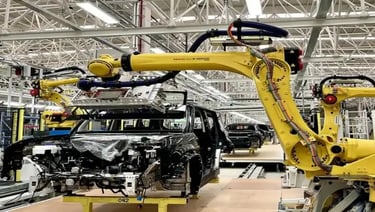
The automotive industry is still the largest single buyer of industrial robots in the world. FANUC alone has over one million units installed globally, and a big share of those machines are bolted to the floor of a car plant somewhere. Walk through any major assembly facility anywhere, and the yellow arms you see are there for a reason. FANUC built its name in automotive, and the model range shows it, covering everything from lightweight machines that handle small fasteners to heavy lifters that move entire vehicle bodies between stations. Understanding where these robots fit in the automotive process helps you see why so many of them show up on the used market when plants retool.
Welding: The Backbone of the Body Shop
Spot welding is where FANUC earned its reputation. In body shops around the world, the R-2000iB series carries welding guns that can weigh over a hundred kilograms, hitting the same weld points shift after shift. The R-2000iB/210F with the R-30iB controller remains one of the most recognized configurations on any automotive line. Arc welding handles the thinner components that spot welding cannot reach. Exhaust systems, suspension subframes, seat frames, and brackets all come together under FANUC Arc Mate robots. The Arc Mate 120iC is the workhorse here, running on components that demand tighter path accuracy than a spot welder ever needs. Together, spot and arc welding account for roughly sixty percent of all FANUC robots in automotive. That is not a coincidence. It is the core application.
Painting and Sealing
Painting a car body is one of the most demanding finishing operations in manufacturing. Film thickness has to be consistent across complex curved surfaces. FANUC painting robots are built for this. Long-reach, explosion-proof, and tuned for smooth continuous motion, they apply primer, basecoat, and clearcoat with the kind of repeatability that keeps a paint shop running without rework. In the same area of the plant, sealing robots apply structural adhesive to body panels and lay a precise bead of urethane around the windshield opening. These applications depend on path accuracy and consistent travel speed, two things FANUC robots deliver. A painting or sealing robot coming out of an automotive plant has usually been maintained to a high standard, because downtime in the paint shop is expensive in a way that other departments are not.
Assembly and Part Transfer
The general assembly line is where a car finally comes together, and FANUC robots handle a surprising range of tasks here. On the fast, light end, delta-style M-2ia robots place small fasteners and clips at speeds no human can match. For mid-weight assembly, M-710iC robots lift instrument panels, glass, and seats into place with fifty to seventy kilograms of payload. On the heavy end, M-900iA series robots move entire vehicle bodies between conveyors or handle large castings around the plant. These are the unsung heroes of the transfer line, running day and night with six hundred kilograms or more in their grip. Part transfer is not flashy work, but it is the kind of relentless, heavy material movement that makes a just-in-time assembly plant function.
Machine Tending and Material Removal
Not every robot in a car plant welds or paints. A lot of them load and unload machines. In engine and transmission plants, FANUC R-2000iC robots move raw castings into CNC machining centers and pull finished components out. The reach is moderate, the payload is heavy, and the cycle has to match the machine tool's pace without falling behind. In foundries attached to automotive operations, robots pour molten metal, extract castings, and trim flash. The M-20ia and similar models handle deburring and deflashing with force-sensing technology that keeps the tool pressure consistent as the part geometry changes. These are tough, repetitive jobs that take a physical toll on equipment, which is worth remembering if you are evaluating a used robot that spent its life feeding a machining line.
What a Used Buyer Should Look For
A used FANUC robot coming out of automotive production is not a mystery. What it did and how hard it worked can usually be traced. Robots retired from body shops have the most cycle wear. A spot welding R-2000iB has run millions of high-force cycles, and the wrist axes absorb most of that energy. Backlash measurements on A4, A5, and A6 are essential before purchase. Robots from paint shops tend to be in better mechanical condition but are less common on the used market. Robots from assembly and press lines fall somewhere in the middle. They may have high cycle counts but have not been subjected to the same mechanical abuse as a spot welder. Across all applications, check the controller battery condition. A dead battery on an R-30iB or R-30iA means lost mastering data, which adds commissioning time. Also confirm that the required software options are installed, licensed, and transferable. Automotive-spec robots often carry welding, sealing, or vision software that the next owner will want to use.
This guide was prepared by Tyche Robotic, a supplier of refurbished six-axis industrial robots serving integrators and resellers in Latin America, Southeast Asia, and Europe.
Contact Us
As a professional supplier of used industrial robots, Jiangmen Tyche Robotic Co., Ltd. is committed to providing customers with integrated solutions—from hardware selection and configuration to software programming, debugging, and after‑sales maintenance.
© 2025. All rights reserved.

Mr. Victor Ismael