What Can a FANUC M-710iC Do? A Look at the Models, Applications, and What to Check When Buying One
A detailed look at the FANUC M-710iC series, covering eight models, IP67 and FoundryPro protection, applications from foundry to welding, real-world case studies, and what to check when buying a used M-710iC.
Tyche Robotic
5/15/20266 min read
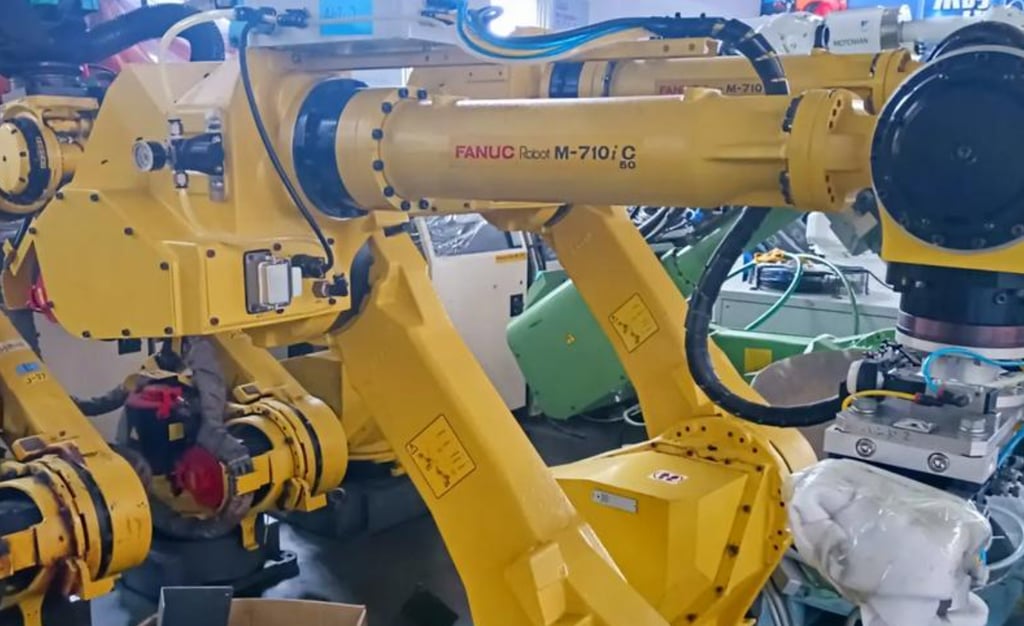
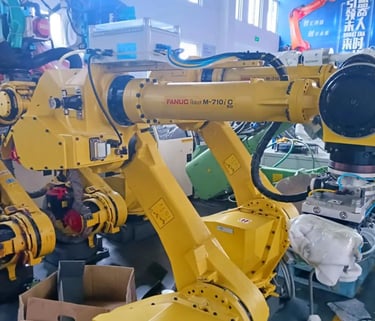
The FANUC M-710iC sits in a part of the robot market that does not get as much attention as the heavy hitters or the small precision machines, but it probably should. With payloads spanning twelve to seventy kilograms across eight distinct models, this series covers everything from long-reach welding to compact machine tending to foundry-duty material handling. It is not as common on the used market as the R-2000iB, because the M-710iC was never the backbone of an automotive body shop. But that is part of what makes it worth a closer look. The machines that do show up tend to come from a wider mix of industries and often carry less brutal cycle wear. Understanding the differences between the eight models, what each one was built to do, and what to inspect before buying turns a used M-710iC from a generic mid-payload robot into a machine that fits a specific job.
The M-710iC Family: Eight Models, Different Strengths
The M-710iC lineup is built around a common mechanical platform, but the reach and payload combinations push different models toward different jobs. The M-710iC/12L sits at one end of the spectrum. Twelve kilograms of payload and over three point one meters of horizontal reach make it the long-reach specialist. A hollow upper arm routes cables internally, which matters when the robot is running arc welding on large fabrications where the torch lead needs protection through tight maneuvers. The M-710iC/20L extends that same long-reach concept to twenty kilograms, covering bigger weldments and heavier tooling at roughly three point one meters. The M-710iC/20M shortens the reach to just under two point six meters and raises the speed on the J4 and J6 axes. This is the model built for compact welding cells and sealing applications where the robot needs to move fast in a confined space.
The M-710iC/50 is the workhorse of the family. Fifty kilograms of payload, just over two meters of reach, and a rigid mechanical structure that handles the side loads generated during grinding and polishing. It is the most common M-710iC variant on the used market. The M-710iC/70 pushes payload to seventy kilograms at the same reach, covering heavier casting handling and machine tending where every kilogram of margin counts. The M-710iC/50S takes the fifty-kilogram payload and compresses the reach to under one point four meters, built for tight spaces where a standard M-710iC simply does not fit. Think of the 12L as the one that reaches farthest, the 50S as the one that squeezes into the tightest spot, and the 70 as the one that lifts the most.
What Makes the M-710iC Stand Out
Three things separate the M-710iC from other mid-payload robots. The first is IP67 protection across the entire arm. That is not a special option on a few joints. It is standard. The robot can withstand temporary immersion in up to one meter of water for thirty minutes, and the FoundryPro option extends that protection to handle the heat, dust, and abrasive conditions of casting and grinding environments. The second is the mechanical drivetrain. Every axis runs on RV reducers with no belts, chains, or pulleys. That eliminates a whole category of maintenance items and failure points. The third is the wrist design. The J4, J5, and J6 motors are mounted in the upper arm housing, not in the wrist itself. The wrist is hollow for cable routing, narrow enough to reach past clamps and fixtures without interference, and lighter because it is not carrying motor mass at the tool end.
Where You Will See M-710iC Robots at Work
In foundries and die casting, the M-710iC/50 and /70 with the FoundryPro package load raw castings into trim presses and unload finished parts. The environment is hot, dirty, and hard on seals, which is exactly why the IP67 rating and FoundryPro option exist. In grinding and polishing, the /50's rigid arm pairs with FANUC's force sensor to maintain constant pressure on a grinding wheel as it follows the contours of a casting. The robot feels the surface rather than just tracking a programmed path, which is the difference between a clean finish and a gouged part. A shop called American Cap & Stamping runs an M-710iC/50 in a fast die-change environment where the robot lubricates hot dies and transfers parts between presses, a job that would be punishing for a human operator and destructive for a robot without the right environmental protection. In welding, the /12L and /20L handle large fabrications where the long reach lets the robot access seams that a standard-arm welder cannot. D&S Manufacturing, a fabricator in Wisconsin, brought in an M-710iC/12L to weld large assemblies that were hard to staff. The robot cut welding time by two-thirds and solved a labor gap that had been slowing down their entire operation. In compact assembly and machine tending, the /50S and /20M fit into spaces where a standard robot would collide with the machine enclosure. These models are often mounted overhead or at an angle, working in cells that were designed around manual operators and retrofitted for automation. In dispensing and sealing, the /20M runs precise bead paths in tight cells where the high-speed J4 and J6 axes let the robot follow complex contours without slowing the line.
Software: iRVision, Force Sensing, and Error Proofing
The M-710iC runs on FANUC's R-30iB controller, and three software capabilities make a difference in how the robot is used. iRVision is FANUC's integrated vision system. It does 2D and 3D part location, which means the robot can find a part on a conveyor or in a bin and adjust its pick approach in real time instead of relying on precise mechanical fixturing. Force sensing turns the robot into something more than a position repeater. In grinding and polishing, the force sensor keeps the tool pressure constant even as the part geometry changes or the wheel wears down. In assembly, it lets the robot feel a pin sliding into a bore and stop pushing when the resistance spikes. Error proofing is built into the controller software. The robot checks its own work as it goes, flagging deviations before they become a batch of defective parts. The software ecosystem is closed, but it is stable, and for manufacturers who need process consistency, that stability is worth more than flexibility.
What to Know When Buying a Used M-710iC
Used M-710iC robots are not as abundant as R-2000iB units, and the reason is simple. The M-710iC was never the default choice for automotive body shops, so it does not flood the used market in waves every time a car plant retools. The machines that do appear tend to come from foundries, general fabrication shops, and machining plants. The price for a refurbished unit typically runs around twenty-five thousand dollars, though long-reach models and units with welding packages or integrated RTU tracks will price higher. The first thing to check on any used M-710iC is the seals. IP67 and FoundryPro ratings mean the robot was designed to survive harsh environments, but seals age. Heat, dust, and exposure to cooling fluids and die lubricants in foundry applications degrade rubber and silicone over time. Inspect the seals around each axis and at the connector glands for hardening, cracking, or swelling. A robot that held its seal integrity is a robot that has not had moisture or conductive dust working its way into the reducers. Open the controller cabinet and check for dust ingress. Foundry and grinding environments produce fine conductive particles that settle on circuit boards and cause intermittent faults that are hard to trace. If the robot was used in grinding or polishing with force sensing, ask for the factory calibration data. A force sensor that has drifted out of calibration is not a dealbreaker, but recalibration takes time and specialized equipment. If the robot was used for welding, verify that the ArcTool software package is installed, licensed, and transferable. For the long-reach /12L and /20L models, ask for a path accuracy test at full extension. A robot that holds tolerance near its base may wander at three meters if the servo tuning or reducer wear has degraded its dynamic tracking. Across all models, check the standard items: wrist backlash measurements on A4, A5, and A6, controller battery condition, and a loaded test report showing the robot was run under conditions that reflect real work, not just powered on and jogged.
This article was prepared by Tyche Robotic, a supplier of refurbished six-axis industrial robots serving integrators and resellers in Latin America, Southeast Asia, and Europe.
Contact Us
As a professional supplier of used industrial robots, Jiangmen Tyche Robotic Co., Ltd. is committed to providing customers with integrated solutions—from hardware selection and configuration to software programming, debugging, and after‑sales maintenance.
© 2025. All rights reserved.

Mr. Victor Ismael