Robotic Workcells: What They Include and How to Set One Up
A practical guide to robotic workcells covering components, types by integration depth, applications in welding and palletizing, layout and space planning, and what to check when buying a used workcell.
Tyche Robotic
6/1/20265 min read
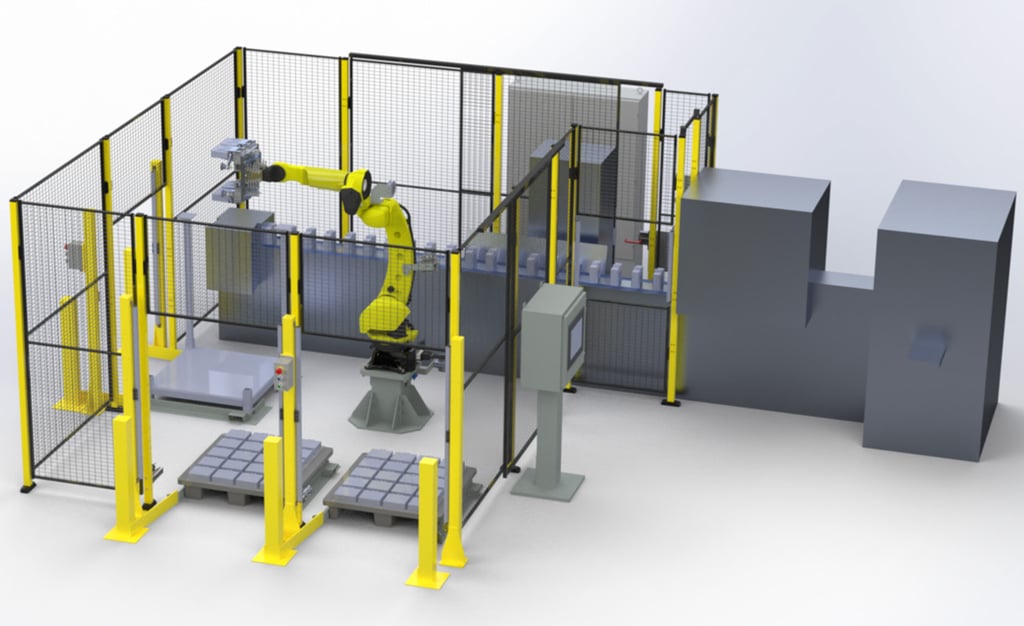
A robot by itself is just a very expensive sculpture. It can pose, it can move, but it cannot produce a single finished part until someone builds a world around it. That world is called a workcell. It is the robot, the controller, the end-of-arm tooling, the safety fencing, the part feeders, the fixture table, and sometimes a vision system, all bolted down and wired together so that when someone hits the green button, the same thing happens every cycle. A lot of first-time automation buyers focus entirely on the robot and treat the rest of the cell as an afterthought. That is how projects go over budget and past deadline. Understanding what goes into a workcell, what the different types are, and what it takes to lay one out properly is what separates a cell that starts producing on schedule from one that sits half-built while the integrator figures out why the safety circuit will not clear.
What a Robotic Workcell Actually Includes
A workcell is not a collection of accessories. Every component is mandatory, and if one is missing, the cell does not run. The robot arm is the motion platform. The controller is the brain. The end-of-arm tooling, whether it is a gripper, a weld torch, or a deburring spindle, is the hand that does the work. The safety fencing, light curtains, and interlocks are not optional extras. They are what makes the cell legal to operate and safe for the people working near it. The part feeding system, whether it is a conveyor, a bowl feeder, or a simple presentation tray, is how the robot gets its hands on the next part without a human being standing there handing it over. The fixture holds the part in a known position so the robot can find it every time. A vision system can replace some fixturing by letting the robot find the part on its own, but vision adds its own integration and calibration work. All of these pieces have to be designed, sourced, installed, and tested together. Buying a robot without planning the rest of the cell is like buying an engine and then realizing you still need a chassis, wheels, and a steering wheel to go anywhere.
Types of Workcells by Integration Depth
Not every workcell is the same size of project, and the difference between them is not just cost. It is time, risk, and how much engineering the buyer has to do themselves. The simplest type is a drop-in replacement. A robot dies on an existing line. The buyer sources an identical used unit of the same model and controller generation, bolts it into the same mounting holes, reloads the program, and the cell is back up in days. This is the lowest-cost, lowest-risk path, and it only works when the original cell was well-documented and the replacement robot is a true match.
One step up is a standard pre-configured cell. The robot comes with the end-of-arm tooling, the welding package or palletizing software, and the recommended safety layout already specified. The buyer provides the floor space, the utilities, and the parts. The integration work focuses on fixturing, programming, and fine-tuning. These cells go from delivery to production in weeks, not months. The growth in demand for pre-configured workcells is real. Industries like chemical manufacturing and warehouse logistics are using them to meet rising production needs without the long lead times of a fully custom build.
At the far end is a turnkey custom cell. The integrator designs everything from scratch. Custom tooling, custom safety layout, custom part feeding, full PLC integration. This is a multi-month project, and the cost reflects the engineering hours. It makes sense when the application is unusual, the part is complex, or the production volume justifies the investment.
Workcell Applications: Welding, Palletizing, and More
Most workcells fall into a handful of well-understood application types. Welding cells are the most common. A FANUC Arc Mate paired with an ArcTool software package, or an ABB robot running a SpotPack configuration, or a KUKA with ArcTech, or a Motoman running MotoWeld, all represent pre-integrated welding workcells where the robot, power source, torch, and wire feeder were designed to work together. Palletizing cells are the second big category. A FANUC M-410iC or an ABB IRB 460 running a palletizing workcell stacks bags, cases, or boxes at the end of a production line. Machine tending cells use a robot to load and unload CNC machines, injection molders, or stamping presses. A FANUC M-710iC, an ABB IRB 2600, or a KUKA KR 16 can tend multiple machines if they are laid out within reach. Pick-and-place and assembly cells handle small parts at high speed. The FANUC LR Mate 200iD is a common choice here. Inspection cells use vision-equipped robots to check dimensions and surface quality faster than manual inspectors.
Layout and Space: The Stuff That Gets Overlooked
The layout of a workcell determines whether it runs smoothly or fights itself every cycle. The first constraint is safety clearance. The distance between the robot's maximum reach and the safety fencing is not a suggestion. It is a calculated number based on the robot's stopping distance at full speed and full payload. Get it wrong and the cell will not pass a safety audit. The second is the position of the fixtures, conveyors, and part feeders. The robot has to reach every station without colliding with anything. A fixture that looked fine in CAD can block the robot's path in the real world if the arm has to snake around it at an awkward angle. The third is maintenance access. The controller cabinet needs space behind it for airflow and cable access. The robot base needs enough clearance for a technician to reach the mounting bolts. These things sound trivial until you are the one trying to troubleshoot a fault with your back pressed against a wall. The fourth is utilities. Power, compressed air, network drops, and sometimes cooling water all have to reach the cell. If the floor is not ready for them, the robot sits in its crate while the electrician runs conduit.
What to Know When Buying a Used Workcell
A used workcell is more than a used robot with some extra parts. The inspection has three layers. The robot itself is the first layer, and the checklist is the same as any other used machine. Wrist backlash, controller battery, software licenses, loaded test report. The second layer is the safety system. Fencing, light curtains, and safety interlocks are not cosmetic. They are what keeps people safe, and they have to work. Check for bent or damaged fence panels, verify that the light curtains trip and reset correctly, and confirm that the safety relay or safety PLC clears without bypassed channels. A workcell with a compromised safety system is not a bargain. It is a liability. The third layer is the end-of-arm tooling and the part handling equipment. Grippers wear at the finger joints. Weld torches have spatter damage on the nozzle and cable jacket. Wire feeders have worn drive rollers. Conveyor belts stretch and fray. These are wear items, and their condition determines whether the cell starts producing on day one or spends the first month chasing intermittent faults. If the cell is being sold as a complete working system, ask for a video of it running production before it was decommissioned. A loaded test report for the robot alone is not enough when the cell includes a dozen other components that can fail.
This article was prepared by Tyche Robotic, a supplier of refurbished six-axis industrial robots serving integrators and resellers in Latin America, Southeast Asia, and Europe.

Contact Us
As a professional supplier of used industrial robots, Jiangmen Tyche Robotic Co., Ltd. is committed to providing customers with integrated solutions—from hardware selection and configuration to software programming, debugging, and after‑sales maintenance.
© 2025. All rights reserved.

Mr. Victor Ismael