Robotic Grippers Explained: How to Match the Right End-of-Arm Tool to Your Job
A practical guide to robotic grippers covering mechanical, vacuum, and magnetic types, plus pneumatic, electric, and hydraulic drives. Includes selection tips, Big Four integration, and used gripper inspection.
Tyche Robotic
5/21/20266 min read
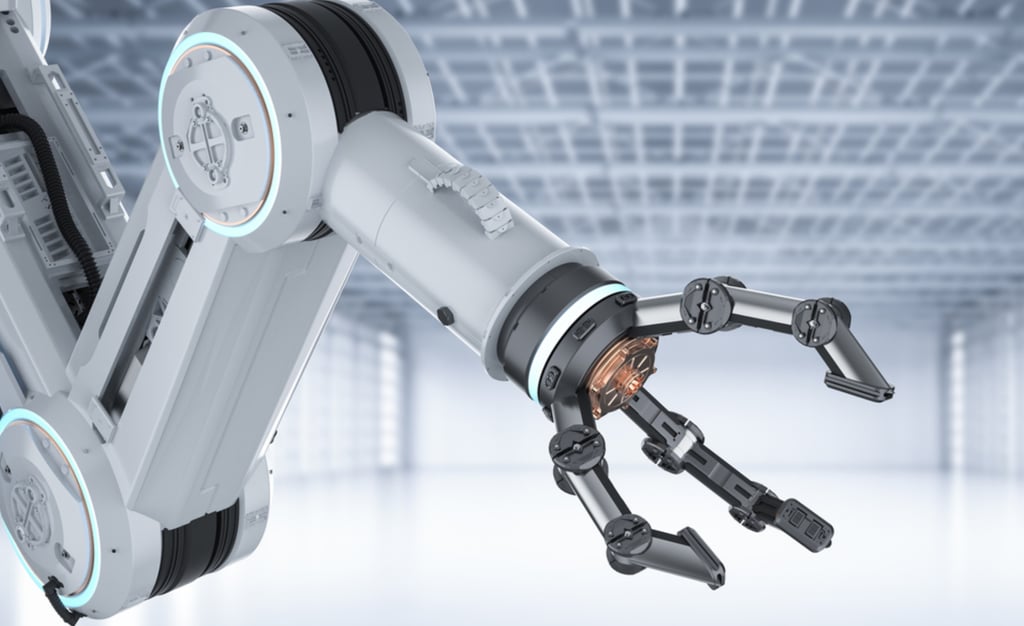
A robot without a gripper is like a arm without a hand. It can move, position itself beautifully, and then sit there with nothing to grab. The global market for robotic grippers sat at around one point four billion dollars in 2024 and is projected to reach about one point eight billion by 2030. That is steady growth, and it reflects a simple truth: the end-of-arm tooling is where a lot of automation projects either pay off or fall apart. Pick the right gripper for the job, and a single robot can handle multiple parts, multiple shifts, and multiple product changes without anyone touching a wrench. Pick the wrong one, and the robot spends more time dropping parts than moving them. Understanding what types of grippers exist, how they are powered, and what to look for when buying a used robot that already has a gripper mounted is not a side topic. It is central to making automation work.
What Robotic Grippers Are and How They Work
A robotic gripper is the mechanical hand at the end of the robot arm. It grabs, holds, and releases the part. In most applications, the gripper is the only part of the robot that actually touches the product, which means its design directly determines whether the part arrives at the next station undamaged, oriented correctly, and on time. Compared to custom-built end-of-arm tooling for a single part number, a well-chosen gripper can often handle a family of parts without changeover. That flexibility is worth real money on a production line where batch sizes are shrinking and part variety is growing.
The Main Gripper Types: Mechanical, Vacuum, and Magnetic
Mechanical grippers use two or three fingers to clamp onto the part. A two-finger gripper with parallel motion is the most common configuration in factories, and it works for most parts with parallel gripping surfaces. Three-finger grippers self-center round parts. If the part has irregular geometry or needs to be gripped from the inside or the outside depending on the variant, an angular gripper that pivots the fingers can handle both. Heavy-duty mechanical grippers running on hydraulic or high-pressure pneumatic systems handle the kind of loads you see in foundries and palletizing cells, where a FANUC M-900iA/350 or a KUKA KR QUANTEC might swing a raw casting or a full pallet of bagged product.
Vacuum grippers use suction cups and a regulated air supply to pick up parts. They are the default choice for flat, smooth surfaces like sheet metal, glass, and plastic panels. In the food industry, vacuum grippers handle bags, pouches, and trays without damaging the product. The grip force is controlled by adjusting the vacuum level, which means the same gripper can handle delicate pastries and heavy boxes by changing a setting rather than the hardware. An ABB IRB 6640 running a vacuum head can switch from case packing to palletizing without a tool change.
Magnetic grippers use electromagnetic or permanent magnets to grab ferrous parts. They are fast and simple, with no moving fingers to wear out and no vacuum cups to replace. The limitation is obvious: the part has to be magnetic. But in automotive stamping and structural steel handling, that covers a lot of ground. A magnetic gripper on a FANUC R-2000iB or an ABB IRB 6700 can pick up a stamped body panel or a steel beam in a fraction of a second and release it just as fast when the magnet is switched off.
Pneumatic, Electric, or Hydraulic: How the Gripper Gets Its Power
The gripper type determines how it contacts the part. The drive type determines how it opens, closes, and controls that contact. Pneumatic grippers run on compressed air. They are fast, simple, and the most common drive type on factory floors. The downside is that the grip force depends on the air pressure available, and the positioning is usually open or closed rather than infinitely adjustable. Electric grippers use a motor and a controller to move the fingers. They offer programmable grip force, precise finger positioning, and the ability to report status back to the robot controller. This level of control makes them the go-to for precision assembly, cleanrooms, and applications where the robot needs to handle multiple part sizes without changing tooling. The cost is higher than pneumatic, and the speed can be slightly slower, but for applications that demand data and flexibility, the trade-off makes sense. Hydraulic grippers use pressurized fluid to generate force. They handle the heaviest loads, the kind of parts that would stall a pneumatic gripper mid-cycle. Foundries and forge shops use hydraulic grippers to handle castings and forgings that weigh hundreds of kilograms. The trade-off is maintenance. Hydraulic systems can leak, and a hydraulic leak near a hot part or a machining center is a problem that needs immediate attention.
What to Consider When Choosing a Gripper
Five factors drive the gripper decision, and none of them are about the robot brand. The part comes first. Weight, material, surface finish, and geometry determine whether the gripper needs to be mechanical, vacuum, or magnetic. A porous or textured surface rules out vacuum. A non-ferrous part rules out magnetics. The environment comes second. Food-grade applications need grippers with smooth, crevice-free surfaces and food-grade lubricants. Cleanrooms need grippers that do not generate particles. Explosive environments need certifications. Safety is third. A gripper that loses power or air pressure has to fail safe, meaning it stays locked on the part rather than dropping it. This is non-negotiable for overhead handling and heavy payloads. The interface is fourth. Mechanical mounting is standardized across most robot brands, and the I/O integration usually runs through standard digital or analog signals. A gripper is rarely brand-specific. Maintenance is fifth. Pneumatic grippers need periodic seal replacement. Electric grippers are largely sealed and require less routine attention. Hydraulic grippers need fluid checks and hose inspections. The right choice balances all five factors against the budget and the production schedule.
How the Big Four Work with Grippers
The gripper market is one of the most open ecosystems in industrial automation. A FANUC robot can run a Schunk, a Zimmer, or an ATI gripper just as easily as an ABB or a KUKA can. The mechanical mounting pattern is standardized, and the controller I/O handles the open and close signals with nothing more than a few digital outputs. FANUC robots in food and palletizing applications frequently pair with vacuum and mechanical grippers from third-party suppliers. ABB integrates magnetic grippers into automotive stamping lines where speed and simplicity matter. KUKA's heavy payload robots work with hydraulic and large pneumatic grippers for foundry and structural steel handling. Yaskawa Motoman robots are often found with electric grippers in precision assembly and with mechanical grippers in welding cells where the tool has to stay locked through high-speed repositioning. The point for a buyer is that the gripper is a separate decision from the robot. It is chosen for the part and the process, not for the color of the arm.
What to Know When Buying a Used Robot with a Gripper
A used robot that already has a gripper mounted saves setup time, but only if the gripper is in good condition. Mechanical grippers wear at the finger joints. Open and close the gripper a few times. Listen for grinding or hesitation. If the motion is not smooth, the bushings or the guide rails are worn. Ask for grip force test data to confirm the clamping force still meets the original specification. Vacuum grippers degrade through the cups. Rubber and silicone cups harden, crack, or lose their shape over time, especially in hot or chemical environments. A vacuum cup that looks fine on casual inspection may leak under load. Replacements are cheap, but if the previous owner ran the cups past their service life, check the vacuum generator and the seals in the air circuit for damage from overwork. Pneumatic grippers need seal inspection. The O-rings and gaskets inside the cylinder wear with every cycle, and in a wet or corrosive environment they degrade faster. Look for oil or moisture around the cylinder body and the fittings. Electric grippers need a functional test. Run the gripper through its full range of motion and verify that the position feedback matches the actual finger position. A gripper that reports it is open when it is partially closed will cause a crash on the first cycle. Magnetic grippers need a simple check: engage the magnet, verify it holds rated weight, disengage, and verify it releases cleanly. Check the electrical connections for corrosion, especially if the gripper worked in a humid or outdoor environment. The gripper is not an afterthought. It is the business end of the robot, and its condition determines whether the cell runs or stalls.
This article was prepared by Tyche Robotic, a supplier of refurbished six-axis industrial robots serving integrators and resellers in Latin America, Southeast Asia, and Europe.

Contact Us
As a professional supplier of used industrial robots, Jiangmen Tyche Robotic Co., Ltd. is committed to providing customers with integrated solutions—from hardware selection and configuration to software programming, debugging, and after‑sales maintenance.
© 2025. All rights reserved.

Mr. Victor Ismael