Why Manufacturers Are Switching to Arc Welding Robots
A data-backed look at the benefits of arc welding robots, including cost savings, weld quality, throughput gains, and energy efficiency. Covers the Big Four's arc welding solutions and the used arc welding robot advantage.
Tyche Robotic
6/3/20265 min read
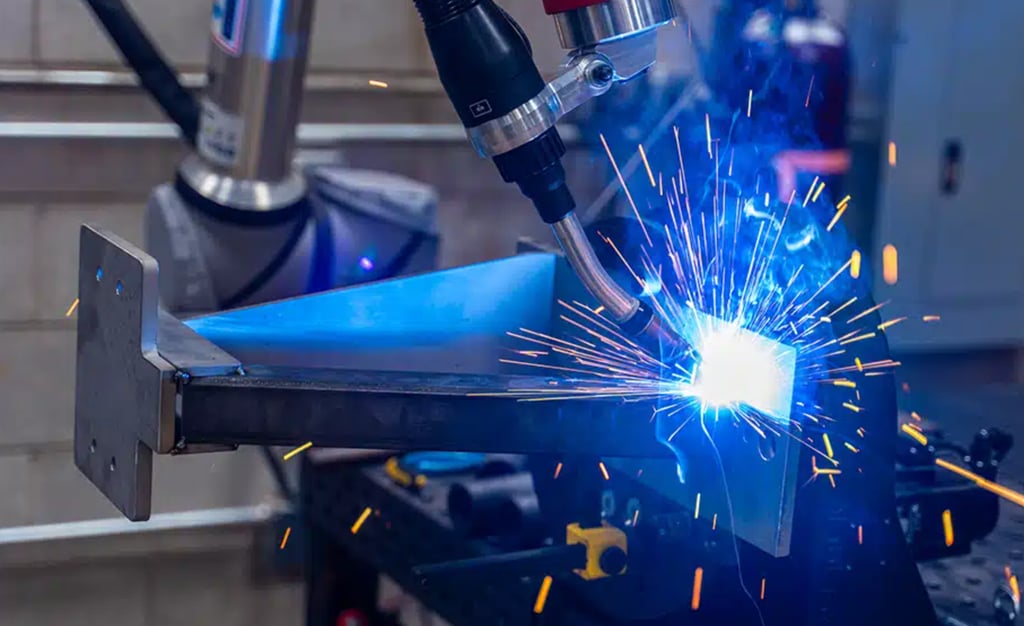
The global market for arc welding robots sat at just over four billion dollars in 2024 and is projected to reach nearly five point seven billion by 2028. That is not a slow, steady climb. That is an industry voting with its wallet. The reason is simple: the math on robotic arc welding has become too clear to ignore. A robot lays down welds that are consistent from the first part to the thousandth, runs longer hours than any human can sustain, and turns welding from a variable cost into a predictable one. For manufacturers trying to control costs, hit delivery dates, and fill welding positions that have been open for months, the question is no longer "should we automate?" It is "which robot and when?"
Lower Welding Costs, Faster Payback
The cost difference between manual and robotic arc welding is not a rounding error. A robotic cell can put down a weld for roughly seventy-five cents per part. The same weld done manually costs between a dollar eighty and two fifty. The gap comes from speed, arc-on time, and the elimination of rework. A manual welder spends roughly thirty percent of the shift actually welding. The rest goes to setup, part handling, and repositioning. A robot flips that ratio. Arc-on time runs above ninety percent. Fewer hours per part, fewer rejects, less grinding and cleanup. The payback period on a new robotic welding cell can run eighteen to twenty-four months. On a used robot, the payback shrinks further because the equipment cost is forty to sixty percent lower. Some shops see their money back in under a year.
Less Consumable Waste, More Predictable Costs
Manual welding wastes filler metal. The spatter on the floor, the stub ends of wire, the over-welding that happens when a welder adds a little extra just to be safe. Those losses add up to roughly sixty to seventy percent of the consumable material in a manual cell. A robot does not add a little extra. It puts down exactly the bead the program calls for, at exactly the travel speed, with exactly the wire feed rate. The filler metal utilization jumps past ninety percent. Less metal on the floor means less metal to buy. It also means less grinding and cleanup time, which is a labor cost that rarely shows up in the welding budget but shows up every day on the shop floor. When consumable costs become predictable instead of variable, the accounting department stops guessing and starts planning.
Consistent Weld Quality, Every Shift
A robot does not get tired at the end of a ten-hour shift. It does not rush through the last few parts to make it to break. The weld bead width, penetration, and appearance are the same on the last part of the night as they were on the first part of the morning. That consistency removes variables from downstream processes. When a weld joint is exactly where the robot put it and exactly the size the program called for, the assembly team is not fighting misalignment, and the inspection team is not chasing random defects. Quality stops being something you inspect for and starts being something you can count on.
Higher Throughput Without Adding Labor
Manufacturers have been trying to hire skilled welders for years, and the shortage is not getting better. The welders who are available are expensive, and they are being asked to do more with less. A robot changes the throughput equation without adding to the payroll. It runs through breaks, between shifts, and in lights-out operation. A single robot cell can outproduce multiple manual welders on the same part, not because the robot moves faster, but because it moves continuously. The bottleneck stops being the welder and starts being how fast parts can be fed into the cell.
Energy Savings and a Lighter Utility Bill
Robotic welding is more energy-efficient than manual welding because the process is more precise and the duty cycle is compressed. The robot puts down the weld with less heat input, which means less energy per part. And because a robotic cell can run with reduced lighting and climate control compared to a manual station spread across more floor space, the utility savings stack up. Compressed air, ventilation, and HVAC are all smaller line items in an automated cell. None of these savings are dramatic on their own, but across three shifts and multiple cells, they show up in the plant's operating budget.
How the Big Four Handle Arc Welding
Each of the major robot brands has its own approach to arc welding, and the differences matter when you are choosing a robot and a welding ecosystem. FANUC's Arc Mate series is the volume leader. The Arc Mate 120iC and 120iD pair with the R-30iB controller and integrate iRVision for seam tracking and part location without a separate PC. ABB's IRB 1520ID is built around a hollow wrist that routes the torch cable internally, which protects the leads and gives the robot access to tight joints. It runs on the IRC5 or OmniCore controller with TrueMove and QuickMove for path accuracy and cycle time. KUKA's ArcTech software runs on the KRC4 and KRC5, and its open architecture works with power supplies from multiple manufacturers, which gives integrators more freedom to choose welding equipment. Yaskawa's Motoman AR and MH series ship more arc welding robots than any other brand. The MotoWeld software package handles multipass scheduling and adaptive fill, and the YRC1000 controller manages multi-robot coordination natively. The best arc welding robot is not a universal answer. It is the one that matches the power supply you already use, the controller your integrator already knows, and the parts you actually weld.
The Used Arc Welding Robot Advantage
Arc welding is one of the best applications for buying a used robot. The precision requirement for arc welding is typically around six hundredths of a millimeter, which a well-maintained used robot can hold without trouble. The supply of used arc welding robots is steady because automotive component lines and fab shops retire them on predictable cycles when they upgrade to newer models. The FANUC Arc Mate 120iC and the Motoman MA1400 are two of the most common used arc welding robots on the market, and parts, service, and integrator knowledge are widely available for both. A used arc welding robot with the welding software already installed and licensed can be integrated into a cell in a fraction of the time and cost of starting from scratch. Before buying, there are three things specific to a used arc welding robot that need inspection: the torch cable for spatter burns and flex damage near the wrist, the wire feeder drive rollers for wear, and the welding software license to confirm it is installed, active, and transferable. A robot without its welding software is just a handling robot with a torch bolted to it.
This article was prepared by Tyche Robotic, a supplier of refurbished six-axis industrial robots serving integrators and resellers in Latin America, Southeast Asia, and Europe.

Contact Us
As a professional supplier of used industrial robots, Jiangmen Tyche Robotic Co., Ltd. is committed to providing customers with integrated solutions—from hardware selection and configuration to software programming, debugging, and after‑sales maintenance.
© 2025. All rights reserved.

Mr. Victor Ismael