What Is an Articulated Robot? How They Work and What to Check When Buying Used
A clear explanation of articulated industrial robots covering how they work, axes and degrees of freedom, common applications, how FANUC, ABB, KUKA, and Yaskawa build them, and what to inspect when buying a used articulated robot.
Tyche Robotic
6/16/20265 min read
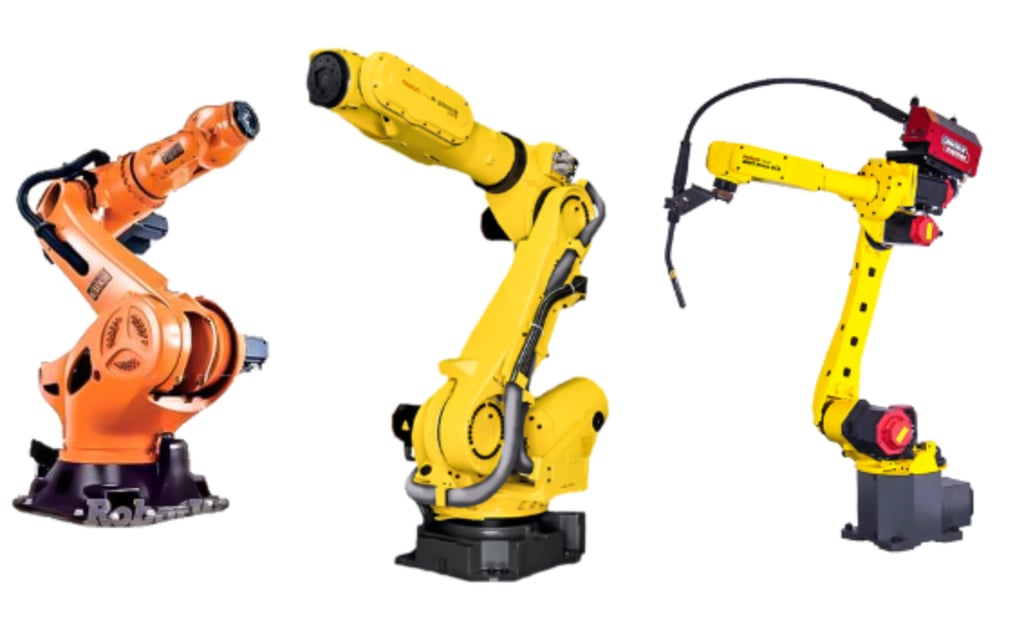
An articulated robot is the machine most people picture when they hear the words "industrial robot." It is an arm made of linked segments, connected by rotating joints, usually sitting on a base and ending in a wrist. The arm bends at the shoulder, swivels at the waist, and twists at the wrist, moving a lot like a human arm but without the limitations of flesh and bone. Articulated robots are by far the most common type of industrial robot in the world. If you see a robot welding a car frame, stacking boxes on a pallet, or loading a CNC machine, it is almost certainly an articulated robot. Understanding what makes this type of robot different from the others, how many axes it needs, and what to look for when buying one used is the starting point for almost any automation purchase.
What Is an Articulated Robot?
An articulated robot is a robot whose arm is built from rigid segments connected by rotating joints. Each joint provides one degree of freedom, which is a fancy way of saying it can rotate around one axis. Stack enough of these rotating joints together, and the robot can reach almost any point within its work envelope and orient its wrist at almost any angle. This is fundamentally different from a Cartesian robot, which moves in straight lines along X, Y, and Z axes like a gantry crane. A Cartesian robot is easier to program because the motion is linear, but it takes up far more space than it can reach. An articulated robot folds into itself when it is not extended, which means it can cover a much larger work volume relative to its footprint. The ability to snake into tight spots, reach around obstacles, and change orientation without moving the base is what makes articulated robots the default choice for most industrial applications.
How Many Axes and Why It Matters
The number of axes on an articulated robot is not just a spec on a sheet. It determines what the robot can physically do. A four-axis robot, like a SCARA, moves in a horizontal plane with a vertical wrist. It is fast and precise for pick-and-place and light assembly on flat surfaces. A five-axis robot adds a second tilt axis and is sometimes used for specific processes like certain types of welding or dispensing. A six-axis robot is the universal standard. It can reach any point in its work envelope from any approach angle, which means it can weld, palletize, machine-tend, assemble, paint, and handle material without being reconfigured. A seven-axis robot adds a redundant joint, usually in the middle of the arm, which gives it extra flexibility for working in confined spaces or avoiding obstacles. Six axes became the standard because that is the minimum number needed to achieve full orientation in three-dimensional space. More axes add cost and complexity, and for most applications, six is exactly right.
Where Articulated Robots Are Used
Articulated robots run the heavy, hot, repetitive, and precise work across almost every manufacturing sector. Spot welding in automotive body shops is the largest single application. A six-axis articulated robot like the FANUC R-2000iB carries a weld gun weighing over a hundred kilograms and hits the same points millions of times. Arc welding is a close second, with articulated robots running the seams on everything from bicycle frames to structural steel. Material handling and palletizing put articulated robots at the end of production lines stacking bags, cases, and building materials. Assembly cells use smaller articulated robots to put together electronics, medical devices, and automotive components. Paint shops run long-reach articulated robots that are explosion-proof and tuned for smooth continuous motion. Machine tending is another common application, where a compact articulated robot loads and unloads CNC machines, injection molders, and stamping presses. The reason articulated robots dominate these applications is the wrist. The ability to tilt, rotate, and angle the tool without moving the entire arm is what makes the difference between a robot that can weld a curved seam and one that cannot.
How the Big Four Build Articulated Robots
Every major robot brand builds articulated robots across the full payload spectrum, but the product lines have different strengths. FANUC offers more than a hundred articulated models, from the desktop LR Mate series with seven kilograms of payload and repeatability at one hundredth of a millimeter, to the M-900iA heavy-payload series lifting over seven hundred kilograms. ABB's articulated line runs from the compact IRB 1200, which handles seven kilograms over nine hundred millimeters, to the IRB 8700 with eight hundred kilograms of payload for foundry and heavy handling. ABB's motion control software, TrueMove and QuickMove, gives the articulated arms their characteristic smoothness and path accuracy. KUKA builds articulated robots from the KR AGILUS for high-speed small-part handling to the KR 1000 titan with thirteen hundred kilograms of payload, the upper limit of what a six-axis articulated robot can lift. KUKA's controllers run on a Windows-based open architecture that appeals to integrators who want flexibility. Yaskawa Motoman covers the range with the GP and MH series articulated arms, with the AR and MA series dominating arc welding. The Motoman lineup ships more arc welding robots than any other brand.
What to Know When Buying a Used Articulated Robot
Articulated robots dominate the used market for the same reasons they dominate the new market. They are the most common type, so supply is deep. They can be redeployed across different applications, so demand is broad. And they are built to last for decades, so a well-maintained used articulated robot still has years of productive life ahead of it. The inspection starts with the joints. Backlash in the wrist axes, A4, A5, and A6, is the first measurement to ask for. The wrist takes the most abuse, especially on robots retired from spot welding or heavy material handling. The controller battery is next. A dead battery wipes the mastering data, and re-mastering a six-axis articulated arm adds commissioning time. The software licenses need to be verified. Welding software, handling software, and vision packages are all licensed features, not standard inclusions. A robot without its software is just an arm that moves. The dress pack, the bundle of cables and hoses running from the base to the wrist, wears where it flexes. The wrist area is the first place to look for cracks, pinholes, and stiffness. On heavy-payload articulated robots, check the base mounting points for fatigue cracks. A robot that has spent years carrying hundreds of kilograms transmits significant forces into its base. The used articulated robot market is the largest segment of used industrial automation for a reason. The machines are out there, the supply is steady, and a buyer who knows what to check can get a robot that runs for another decade at a fraction of what it cost new.
This article was prepared by Tyche Robotic, a supplier of refurbished six-axis industrial robots serving integrators and resellers in Latin America, Southeast Asia, and Europe.
Contact Us
As a professional supplier of used industrial robots, Jiangmen Tyche Robotic Co., Ltd. is committed to providing customers with integrated solutions—from hardware selection and configuration to software programming, debugging, and after‑sales maintenance.
© 2025. All rights reserved.

Mr. Victor Ismael