What Can a FANUC M-900iA Handle? A Look at the Models, Applications, and What to Check When Buying One
A detailed look at the FANUC M-900iA heavy payload robot series. Covers seven models from 150P to 600, automotive and foundry applications, M-900iA vs M-900iB comparison, and what to check when buying used.
Tyche Robotic
5/18/20265 min read
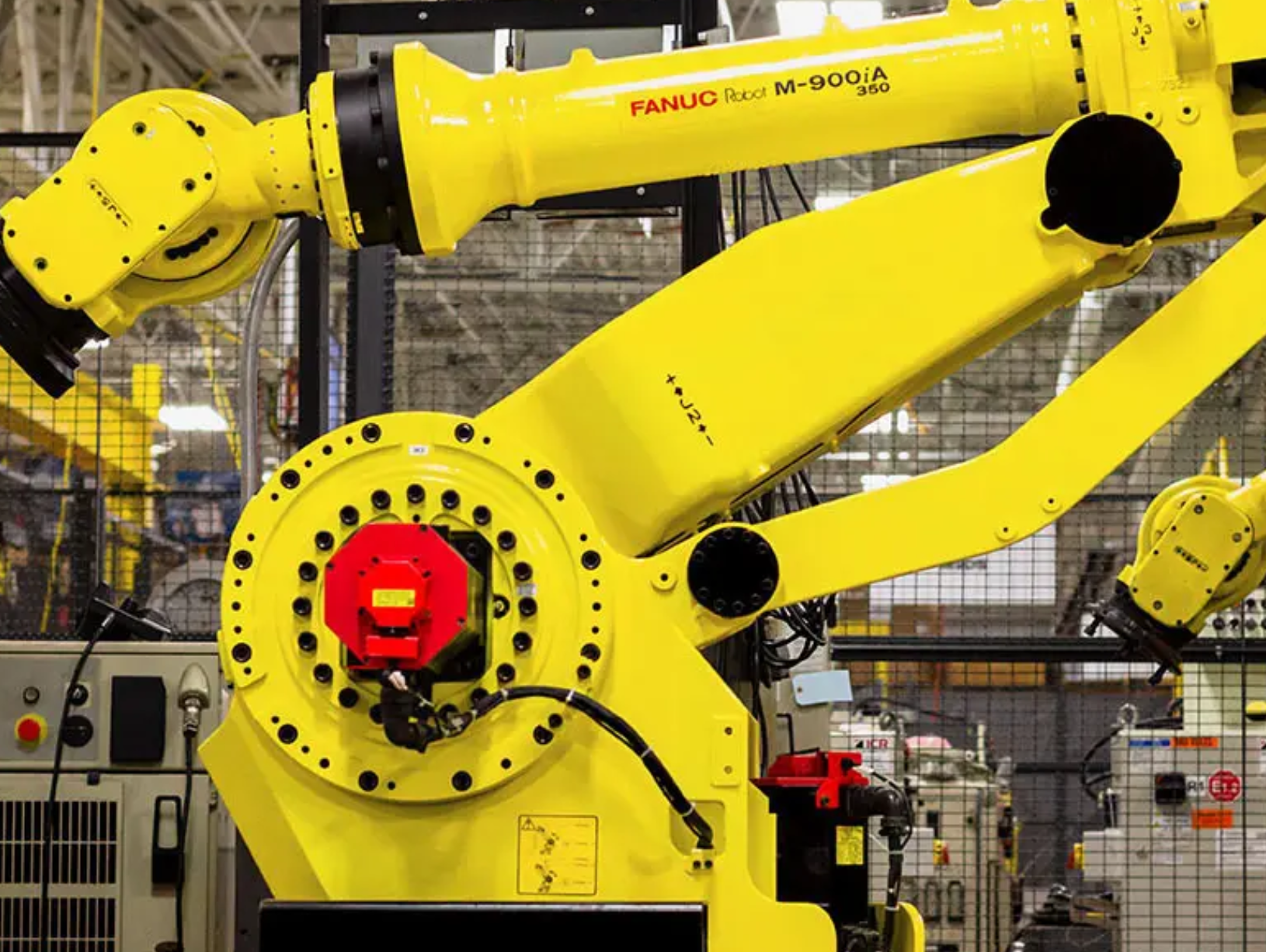
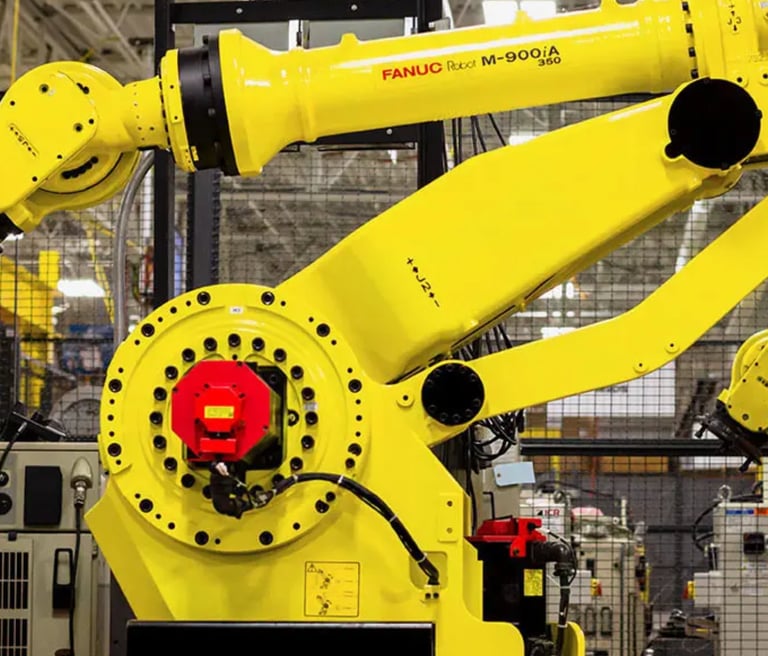
When a robot needs to lift something that weighs as much as a small car, the list of machines built for the job gets short. The FANUC M-900iA is on that list. With payloads from 150 to 700 kilograms, this series handles the kind of lifts that would fold a standard industrial robot in half. It competes in the same weight class as the ABB IRB 8700 and the KUKA KR 1000 titan, which is to say it sits near the top of what a six-axis robot can physically manage. Seven main models span the range from ultra-long reach to ultra-heavy payload, and each one was built for a different corner of the heavy manufacturing world. For a used buyer, knowing which model does what and where the wear accumulates after years of heavy lifting is the difference between a machine that keeps paying for itself and one that arrives with hidden problems.
The M-900iA Family: Seven Models for Different Heavy Lifting Jobs
The M-900iA lineup splits into two groups: long-reach machines that prioritize horizontal reach over maximum payload, and heavy-lift machines that do the opposite. The M-900iA/150P sits at one end of the spectrum. It carries 150 kilograms but reaches over three and a half meters, which makes it the press shop specialist. The M-900iA/200P raises payload to 200 kilograms at the same extended reach, covering heavier stampings and larger panels. The M-900iA/260L pushes payload to 260 kilograms with just over three point one meters of reach, a balance point for general heavy handling. The M-900iA/350 is the workhorse of the family. It carries 350 kilograms over just under two point seven meters with repeatability of plus or minus three tenths of a millimeter, and the robot itself weighs about 1,540 kilograms. This is the most common M-900iA variant on the used market. The M-900iA/400L takes payload to 400 kilograms at over three point seven meters, the longest reach in the series at the highest payload. The M-900iA/600 pushes payload to 600 kilograms at the same reach as the 350. Think of the 150P as the one that reaches farthest but lifts the least, the 600 as the one that lifts the most, the 350 as the balanced workhorse, and the 400L as the one that tries to do both.
What Makes the M-900iA Built for Heavy Work
Four design choices separate the M-900iA from lighter industrial robots. The first is where the wrist motors live. Instead of mounting the J4, J5, and J6 motors in the wrist itself, FANUC put them in the shoulder housing and transmits power through the arm. That keeps the motors away from the heat, dust, and impact at the tool end. It also makes the wrist lighter, which means less inertia when the robot reorients a heavy part. The second is IP67 protection on the wrist and the J3 arm. This is not a cosmetic rating. It means the joints that sit closest to the work can handle dust, moisture, and the kind of grime that builds up in foundries and stamping plants. The third is the parallel-link arm structure. Two solid links connect the shoulder to the elbow instead of a single arm casting. That gives the robot the rigidity to hold a heavy part steady while the wrist moves it through position changes. It also eliminates the spring counterbalance found on many lighter robots, which removes a wear item from the maintenance schedule. The fourth is the software. The R-30iB controller runs high-inertia algorithms that let the robot accelerate and decelerate smoothly even when the payload is close to the maximum rating.
Where You Will See M-900iA Robots at Work
In automotive body shops, the M-900iA/350 and /600 move body sides and chassis assemblies between framing stations. These are not quick, delicate moves. They are heavy transfers that happen hundreds of times per shift. In press shops, the /150P and /260L load raw blanks and extract stamped panels from large tandem press lines. The reach matters more than the payload here, because the robot has to reach deep into the press and pull the panel clear before the next stroke. In foundries and forge shops, the /260L and /350 handle hot castings and forgings at temperatures that would degrade standard seals in weeks. The IP67 wrist and the FoundryPro option exist specifically for this environment. In building materials and structural steel, the /600 moves long beams, large concrete forms, and heavy bagged product where the combination of weight and awkward geometry demands both payload and rigidity. The /400L handles large-scale cutting, polishing, and deburring on heavy workpieces that smaller robots simply cannot hold steady enough to finish.
M-900iA vs. M-900iB: What Changed
The M-900iB is the successor series, and it pushes the numbers a little further. Payload tops out at 700 kilograms on the iB/700, up from 600 on the iA. The iB/400L reaches 3,704 millimeters at 400 kilograms, a slight stretch beyond the iA/400L. The iB series also runs exclusively on the R-30iB controller, with updated servo tuning and slightly faster cycle times. But none of that makes the M-900iA obsolete. The iA is more common on the used market and prices lower. For a manufacturer that does not need the last few percentage points of speed or the absolute maximum payload, an iA is often the better value. The mechanical platform is nearly identical. The same parallel-link arm design, the same shoulder-mounted wrist motors, the same IP67 protection. The difference is more about availability and price than capability.
What to Know When Buying a Used M-900iA
A used M-900iA has spent years carrying loads that would destroy a lighter robot, and that history is written in its joints. The first thing to check is wrist backlash. Every kilogram the robot lifts multiplies the force through the reducers, and the wrist axes absorb the most punishment. Backlash measurements on A4, A5, and A6 are essential. A machine that spent its life in a foundry or stamping plant may have reducers that are still within spec but closer to their service limit than the hour meter alone would suggest. The second thing is seals. IP67 protection works, but it degrades with time, heat, and chemical exposure. Inspect the seals at each axis and around the connector glands for hardening, cracking, or swelling. A robot with compromised seals may have moisture or conductive dust inside the reducers, and that damage is not visible from the outside. The third thing is the shoulder motors. The design keeps them away from the worst of the environment, which helps, but the motors themselves have been driving heavy loads for years. Ask for a loaded test report that shows motor current draw and temperature under load. Unusual current spikes or high running temperatures suggest a motor that is working harder than it should. The fourth thing is the controller. M-900iA units shipped with RJ3iB, R-30iA, or R-30iB controllers depending on the year. Confirm the battery condition. A dead battery means lost mastering, and re-mastering a robot this large is not a quick job. The fifth thing is software. Verify that any application software is installed, licensed, and transferable. A foundry robot missing its HandlingTool or PressTool license is not ready to run. Used M-900iA pricing varies widely by model and condition. A clean /350 with an R-30iB controller might price around the mid-teens in thousands of dollars, while a /600 or a long-reach /400L commands a premium. The /150P and /260L are more common because press shops retire them on predictable cycles, so supply is steadier and pricing is more transparent. If the robot spent time in a foundry, ask for maintenance records. Foundries that run three shifts tend to be disciplined about preventive maintenance, but the environment is unforgiving. Records showing regular seal inspection and lubrication are worth more than a seller's verbal assurance that the machine was well maintained.
This article was prepared by Tyche Robotic, a supplier of refurbished six-axis industrial robots serving integrators and resellers in Latin America, Southeast Asia, and Europe.

Contact Us
As a professional supplier of used industrial robots, Jiangmen Tyche Robotic Co., Ltd. is committed to providing customers with integrated solutions—from hardware selection and configuration to software programming, debugging, and after‑sales maintenance.
© 2025. All rights reserved.

Mr. Victor Ismael