What Are Industrial Robots and How Do They Improve Plant Efficiency?
A beginner's guide to industrial robots. Learn what they are, how they boost factory productivity, common applications like welding and palletizing, and how to get started.
Tyche Robotic
4/22/20265 min read
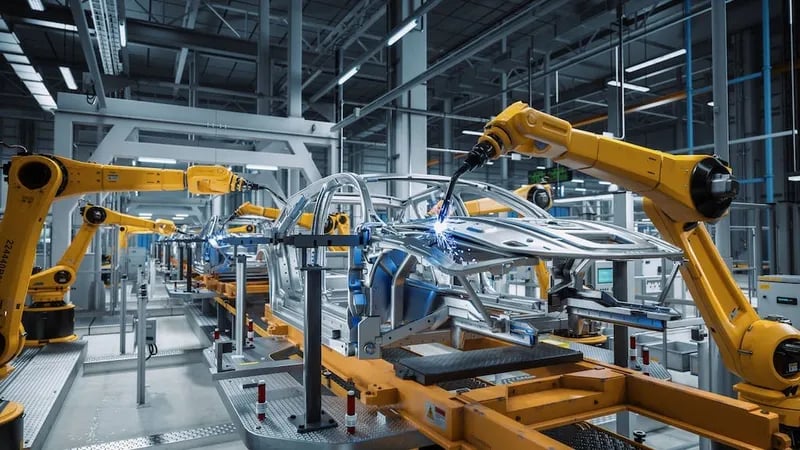
Walk into almost any modern factory and you'll see them. Orange arms swinging through welding cells, yellow robots stacking pallets, white machines gliding through paint booths. Industrial robots have gone from exotic technology to factory floor staple in a couple of decades. But for a lot of manufacturers who haven't taken the plunge yet, the questions are still pretty basic. What exactly is an industrial robot? What makes it different from any other machine? And the real question: does adding one actually make the plant run better, or is it just an expensive way to do what people already do? The answers are more straightforward than you might think.
So What Exactly Is an Industrial Robot?
At its core, an industrial robot is a programmable machine designed to move things, weld things, assemble things, or inspect things without a human holding its hand. The most common type you'll see is the six-axis articulated arm. Six axes means it can move in six different ways, basically mimicking the range of motion of a human arm from shoulder to wrist. That flexibility is what makes these machines so useful. They can reach into tight spots, orient a tool at weird angles, and follow complex paths over and over. Different types exist for different jobs. SCARA robots are faster for simple pick-and-place. Delta robots zip around for high-speed sorting. But the six-axis arm is the workhorse. It's what you'll find welding car frames, stacking bags of cement, and loading CNC machines. The key thing to understand is that an industrial robot isn't a standalone appliance like a toaster. It's a component in a larger system. You need tooling, programming, and often some safety guarding to make it productive. But once it's set up, it does the job the same way every single time.
Why Factories Keep Adding Robots?
The reasons factories invest in robots are pretty consistent across industries. Speed is an obvious one. A robot doesn't slow down after lunch or start making mistakes at the end of a ten-hour shift. It runs at the same pace from the first cycle to the last. Precision is another. For applications like dispensing adhesive or welding a seam, holding position within a fraction of a millimeter matters. People are good at a lot of things, but doing the exact same motion with sub-millimeter accuracy for eight hours straight is not one of them. Then there's the dull and dangerous stuff. Robots take over jobs that are repetitive, heavy, or expose workers to fumes, dust, and heat. That frees up people to handle tasks that actually require judgment and adaptability. And yes, cost matters too. A robot isn't cheap, but neither is downtime, scrap, or constant hiring and training. For manufacturers watching their margins, the math often works out. One thing worth knowing: you don't have to buy new. Quality used industrial robots are widely available at forty to sixty percent off new pricing, and for a lot of applications, they deliver the same mechanical performance. That lower entry point is why many shops take their first step into automation with refurbished equipment.
How Robots Actually Make a Plant More Efficient
Efficiency isn't just about working faster. It's about consistency, uptime, and using resources wisely. Robots help on all three fronts. Consistency means fewer defects and less rework. When a robot welds the same joint or places the same part a thousand times, the result barely varies. That predictability reduces scrap and keeps downstream processes running smoothly. Uptime improves because robots don't call in sick or take vacation. A well-maintained robot can run twenty-four hours a day, stopping only for scheduled maintenance. That's a lot of productive hours that a manual station simply can't match. And resource use gets smarter. Robots apply paint and sealant exactly where needed, cutting material waste. They work with lights-out capability, reducing energy spent on heating and cooling for human comfort. Industry reports suggest that adding robots can boost productivity anywhere from ten to twenty-five percent depending on the application and how well the integration is done. That's not magic. It's just taking the variability out of the process.
Where You'll Actually See These Machines at Work
Industrial robots show up in more places than most people realize. Welding is the biggest single application. Automotive plants are full of them, but plenty of smaller fabrication shops run robotic welding cells too. The robot handles the torch or the welding gun, laying down consistent beads hour after hour. Palletizing is another major category. Any facility shipping bags, boxes, or cases by the pallet load can benefit from a robot that never gets tired of stacking. Food and beverage, chemicals, building materials, all use palletizing robots heavily. Assembly robots put together everything from electronics to automotive components to medical devices. They're precise, they don't lose focus, and they apply consistent force. Material handling covers machine tending, part transfer, and moving heavy castings or molds. It's not glamorous, but it's often the easiest first automation project. Then there's painting and dispensing, where robots deliver even coverage and keep operators away from chemicals. Inspection robots equipped with cameras catch defects faster than human eyes. Each application has its own requirements for payload, reach, and precision, but the underlying theme is the same: take a repetitive, demanding task and let a machine own it.
What About the People?
There's a persistent worry that robots take jobs. The reality on the ground is usually more complicated and less scary. What robots mostly take are tasks that factories already struggle to staff. Welding positions go unfilled for months. Palletizing jobs have high turnover because they're physically brutal. Machine tending is mind-numbing. Robots fill those gaps. Meanwhile, the plant still needs people who can program the robots, maintain them, set up tooling, and handle the exceptions that automation doesn't cover. The skill set shifts, but the work doesn't disappear. A lot of manufacturers find that once they automate the repetitive bottlenecks, their existing workforce becomes more productive. Instead of a skilled welder spending half the day on simple tack welds, they're doing complex fit-ups and quality checks. That's a better use of their time and frankly more satisfying work.
Taking the First Step
Getting started with automation doesn't mean buying ten robots and reworking the entire floor. Most successful projects begin with one cell. A single welding station. One palletizing line. A robot loading a machine that spends too much time waiting for an operator. The key is to pick a spot where the problem is obvious and the payoff is measurable. From there, you learn what works and what doesn't, and the next project gets easier. Finding a supplier who understands your application and can guide you through the process makes a real difference. Tyche Robotic and other established names in the industry focus on matching the right equipment to the job, whether it's a new installation or a quality refurbished unit. The equipment is out there, the applications are well understood, and the path to getting started is shorter than it used to be.
This guide was prepared by Tyche Robotic, a supplier of refurbished six-axis industrial robots serving integrators and resellers in Latin America, Southeast Asia, and Europe.
Contact Us
As a professional supplier of used industrial robots, Jiangmen Tyche Robotic Co., Ltd. is committed to providing customers with integrated solutions—from hardware selection and configuration to software programming, debugging, and after‑sales maintenance.
© 2025. All rights reserved.

Mr. Victor Ismael