Safety Equipment for Robotic Workcells: A Guide to Protecting People and Staying Compliant
A practical guide to robotic workcell safety covering layered protection, ISO 10218 safety standards, fencing, light curtains, area scanners, Big Four controller-based safety functions, and what to check when buying a used robot with safety equipment.
Tyche Robotic
6/15/20266 min read
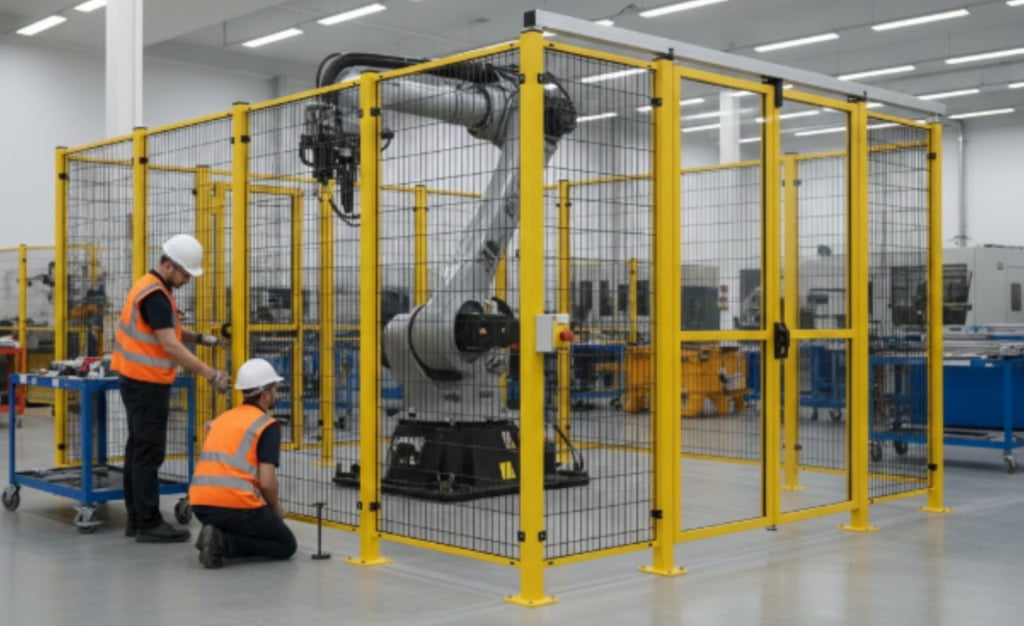
A robotic workcell without proper safety equipment is not a workcell. It is a hazard with a power switch. The robots themselves are powerful machines that move fast and do not stop unless something tells them to. The safety equipment is what tells them to stop, and it is what keeps the people working near them from becoming part of the automation. Safety in a robotic cell is not a single device or a checklist item that gets signed off once and forgotten. It is a layered system where each piece backs up the others, and if one layer fails, the next one catches the gap.
The Layered Approach to Robot Safety
Industrial robot safety is built in layers because no single device is enough. The first layer is physical isolation. Fencing, guarding, and barriers keep people out of the robot's work envelope while it is running at full speed. This is the oldest and most reliable form of safety. If a person cannot physically reach the robot, the robot cannot hurt them. The second layer is electronic detection. Light curtains, area scanners, and safety mats create zones that the robot controller monitors in real time. When someone steps into a monitored zone, the robot slows down or stops before the person gets close enough to be in danger. These devices allow more flexibility than fixed fencing because they create invisible barriers that do not require a physical door. The third layer is controller-based safety. The robot's own controller runs safety-rated software that monitors speed, position, and torque on every axis. If any axis exceeds its safety limits, the robot stops within milliseconds. This is the layer that catches failures in the other two.
These three layers are not alternatives. They are complements. A cell with only fencing is safe as long as the door stays closed, but the moment someone opens it, all protection is gone. A cell with only light curtains is safe until the curtains are misaligned or blocked. A cell with all three layers has multiple independent systems watching over it, and that is the standard that modern safety regulations require.
The Standards That Govern Robot Safety
The safety equipment on a robotic cell is not installed based on someone's opinion of what looks safe enough. It is installed to meet specific standards that have the force of law in most jurisdictions. ISO 10218-1 and ISO 10218-2 cover the safety requirements for industrial robots and robotic workcells. The 2025 revision of ISO 10218 makes something clear that the industry had been debating for years: there is no such thing as an inherently collaborative robot. A robot is only collaborative in the context of a specific application that has been risk-assessed and found to meet the requirements for collaborative operation. ISO/TS 15066 provides the technical specification for collaborative robot safety, including the force and pressure limits that a robot must not exceed when contacting a human body. ANSI/RIA R15.06 is the American national standard that aligns with the ISO standards and governs robot safety in the United States. These standards are not optional guidelines. They are the requirements that a cell must meet before it can be put into production, and a cell that does not meet them is a legal and financial liability for its owner.
Physical Barriers: Fencing, Guarding, and Interlocks
The first and most visible layer of robot safety is the fence around the cell. Aluminum extrusion framing with transparent polycarbonate panels is the most common configuration. It is modular, so the cell can be reconfigured later, and the transparent panels let operators and supervisors see what is happening inside without opening a door. The fencing is not just a barrier. It is part of a system that includes the safety interlock switches on every access gate. When a gate opens, the interlock signals the safety PLC, and the robot either stops or drops to a reduced speed that is safe for a person to approach. The interlock is not a convenience feature. It is the mechanism that enforces the boundary between the robot's workspace and the human workspace. A cell that runs with an interlock bypassed is a cell that has defeated its own primary safety layer, and bypassed interlocks are one of the most common safety violations found during audits.
Electronic Detection: Light Curtains, Area Scanners, and Safety Mats
Electronic detection devices create safety zones that the robot controller can monitor without the physical obstruction of a fence. Light curtains project an array of infrared beams between a transmitter and a receiver. When a hand, arm, or body breaks the beams, the robot responds. Light curtains come in different resolutions depending on what they are protecting against. Finger detection requires tighter beam spacing than body detection. The advantage over a physical gate is speed. A light curtain does not need to be opened and closed. The operator reaches through, the robot stops, and when the beams are clear again, the robot resumes. There is no door to wear out and no interlock to bypass.
Area scanners use laser-based ranging to create a two-dimensional safety zone that can be any shape. The zone can be programmed to change when the robot is in different parts of its cycle. A scanner can create a larger warning zone that slows the robot down and a smaller stop zone that brings it to a complete halt. This flexibility makes scanners the right choice for cells where people and robots share space frequently and the interaction patterns are predictable.
Safety mats are pressure-sensitive floor coverings. When someone steps on the mat, the pressure triggers a stop signal. The reset is manual, which means someone has to go to a reset button and intentionally restart the cell. Safety mats are simple, reliable, and best suited to areas where entry is infrequent but the risk is high.
Controller-Based Safety: How the Big Four Handle It
The robot controller itself is a safety device. Every major robot brand builds safety-rated motion monitoring into its controllers, and these functions are the last line of defense if the physical and electronic layers fail. FANUC's DCS, Dual Check Safety, runs a redundant safety check on every axis. It monitors position, speed, and torque, and if any value exceeds its safe limit, the robot stops. FANUC also offers a Safe I/O module that connects the controller directly to external safety devices like light curtains and interlocks. ABB's SafeMove2 is a safety-rated motion control software that runs on the IRC5 and OmniCore controllers. It provides safe speed limit, safe standstill monitoring, safe axis range, and safe position and orientation monitoring. The robot can run at a reduced speed when a person is nearby and stop instantly if someone steps into a monitored zone, without a full emergency stop that requires a manual restart. KUKA's SafeOperation is the safety function package for the KRC4 and KRC5 controllers, handling safe speed monitoring, safe position monitoring, and safe torque monitoring. Yaskawa's functional safety package on the YRC1000 controller provides safe torque detection, safe speed limiting, and safe position monitoring, with the multi-axis coordination capability that is the brand's hallmark. These controller-based safety functions are not optional extras on modern robots. They are built in and must be properly configured before the cell can operate safely.
What to Know When Buying a Used Robot with Safety Equipment
Safety equipment wears, and on a used robot, the safety system needs its own inspection before the cell can be trusted. The fencing and guarding are the easiest to check and the most likely to have damage. Look for bent or missing panels, loose mounting brackets, and any gaps that a person could reach through. A fence with a hole is not a fence. The safety interlocks on every gate need to be tested. Open each gate and confirm the robot stops or slows. Check for signs that an interlock has been bypassed, tape over the sensor, a jumper wire in the connector, a key left permanently in the switch. A bypassed interlock means the cell has been running without its primary safety layer, and it needs to be restored to compliant operation before the cell goes back into production. Light curtains and area scanners need a functional test. Block the beams by hand and confirm the robot responds within the expected time. Check that the transmitter and receiver are aligned and that the mounting brackets have not shifted. A light curtain that is slightly out of alignment may still work but create blind spots. Clean the scanner lens. Dust and residue reduce detection range and can create zones where the scanner does not see what it should. Safety mats need a visual and physical check. Look for cracks, wear-through spots, and hardened areas that might not compress underfoot. Step on every section of the mat and confirm the stop signal triggers and that the reset function works. A safety mat that does not trigger reliably is worse than no mat because it creates a false sense of security. The controller-based safety configuration is the last and most critical check. DCS, SafeMove2, SafeOperation, or the Yaskawa safety parameters need to be intact and accessible. Confirm the safety PLC configuration has not been wiped or locked with a password that is no longer available. If the safety software parameters were reset during decommissioning, they will need to be reconfigured from scratch, and that is a significant engineering effort. The safety system on a used robot is not a place to save money. The robot itself can be refurbished and tested. The safety equipment needs to be verified and, if necessary, replaced with new components. The cost of a light curtain or an interlock switch is trivial compared to the cost of an injury.
This article was prepared by Tyche Robotic, a supplier of refurbished six-axis industrial robots serving integrators and resellers in Latin America, Southeast Asia, and Europe.

Contact Us
As a professional supplier of used industrial robots, Jiangmen Tyche Robotic Co., Ltd. is committed to providing customers with integrated solutions—from hardware selection and configuration to software programming, debugging, and after‑sales maintenance.
© 2025. All rights reserved.

Mr. Victor Ismael