Robotic Welding Packages: What They Include and What to Check When Buying Used
A practical guide to robotic welding packages covering power sources, weld torches, wire feeders, pre-integrated solutions from FANUC, ABB, KUKA and Yaskawa, and what to inspect when buying a used welding package.
Tyche Robotic
5/28/20265 min read
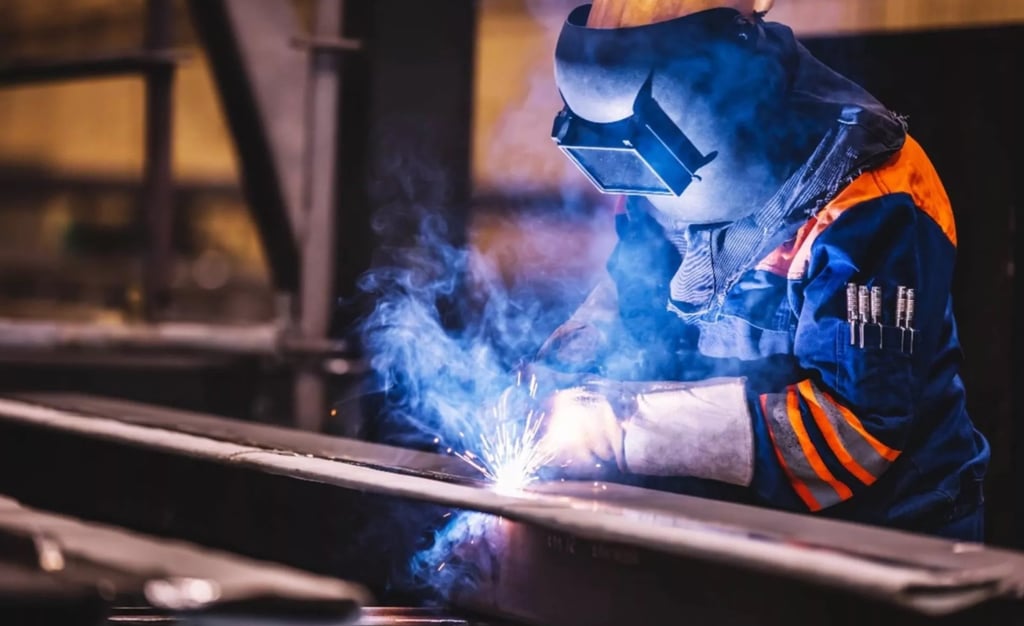
A robot that welds is never just a robot. The arm positions the torch and moves it along the seam, but the actual welding happens somewhere else. The arc comes from a power source. The filler metal comes from a wire feeder. The shielding gas comes from a tank. All of it flows through a torch that has to survive spatter, heat, and millions of cycles of flexing. If any one of those pieces is wrong, the weld quality suffers. If the pieces do not talk to each other correctly, the cell never leaves the integration phase. A robotic welding package bundles the robot, the power source, the torch, the wire feeder, and the welding software into a system that was designed to work together. On the used market, these packages show up regularly, sold as complete cells or as components that the buyer has to reassemble. Understanding what goes into a welding package, how the major robot brands handle their pre-integrated offerings, and what to inspect before buying a used one is the difference between a cell that strikes an arc on day one and one that sits idle while the integrator figures out why the power source will not talk to the controller.
What a Robotic Welding Package Includes
A robotic welding package has three core components beyond the robot arm itself, and all three have to be matched to the application and to each other. The power source generates the arc. It converts input power into a controlled welding current. Lincoln Electric and Miller Electric are the two names that show up most often in robotic welding cells. A Lincoln Powerwave or a Miller Auto Axcess can pair with FANUC and Motoman robots through standard communication protocols. The power source determines what welding processes the cell can run, MIG, pulse MIG, TIG, and the quality of the arc control directly affects bead appearance and spatter levels. The weld torch carries the arc, the shielding gas, and the filler wire to the weld joint. Through-arm torches route the cable inside the robot arm, which protects it from spatter, snagging, and the constant flexing that happens when the robot repositions between welds. Over-arm torches mount the cable externally, which makes maintenance easier but leaves the cable exposed to damage. For a high-cycle cell, through-arm routing usually wins. The wire feeder pushes filler metal into the weld pool at a consistent rate. It can run on constant voltage, constant current, or a combination. A worn drive roller or a misaligned guide tube will cause erratic wire feed, and erratic wire feed shows up in the weld as porosity, inconsistent bead width, or arc instability. The feeder has to be matched to the power source and the wire type. A feeder set up for aluminum does not run steel well, and vice versa. These three components are not optional. They are not accessories. They are the welding system, and the robot is the motion platform that carries them.
Pre-Integrated Welding Packages from the Big Four
Each of the major robot brands offers its own pre-integrated welding package, and the differences matter when you are looking at a used system that was built around one of them. FANUC's ArcTool is a software suite that runs on the R-30iB controller and bundles Torch Guard for collision protection, Torch Mate for torch calibration, Collision Guard for detecting crashes, 4D Graphics for visualizing the weld path, and TAST for seam tracking. It integrates directly with Lincoln and Miller power sources through standard interfaces. A used FANUC welding robot with ArcTool already installed and licensed is ready to weld. Without the license, it is just an arm that moves. ABB's SpotPack is a hardware and software bundle built around the IRC5 controller. It includes a DressPack Lean ID for internal cable routing, a servo weld gun, a water and air unit, and a tip dresser. The whole package is tested and tuned before it leaves ABB, which means the integration work is largely done. KUKA's ArcTech welding software runs on the KRC4 and KRC5 controllers in two tiers. ArcTech Basic handles standard welding tasks. ArcTech Advanced adds complex weave patterns and multipass scheduling. KUKA's open controller architecture means ArcTech can work with power supplies from multiple manufacturers, though the integration effort falls on the integrator rather than coming pre-configured from KUKA. Yaskawa's MotoWeld is a GMAW package that includes a Motoman torch, wire feeder, and side-mounted GMAW process kit. It runs on the YRC1000 controller and handles multipass scheduling and adaptive fill. MotoWeld is tied directly to Motoman's own welding ecosystem, which means the components are designed to work together with minimal tuning.
What to Know When Buying a Used Welding Package
A used welding package has five things that need inspection, and none of them are the robot arm itself. The power source is the first stop. A welding power source that has run thousands of hours at high current may still work, but its output can drift. Ask for a recent calibration report or run a test bead to confirm the arc is stable and the settings match the actual output. Listen to the inverter. A high-pitched whine or an intermittent hum can mean components are near the end of their life. Check that the cooling fans spin freely and the heat sinks are not packed with grinding dust. The weld torch is the second stop. Through-arm torches wear where the cable flexes near the wrist. Look for burn marks from spatter, cracks in the outer jacket, and any stiffness in the cable that suggests the copper conductors inside have work-hardened. An over-arm torch needs the external cable inspected along its entire length for cuts and heat damage. The wire feeder is the third stop. Open it up. Check the drive rollers for wear. A grooved or polished roller will slip and cause erratic wire feed. Check that the guide tubes are aligned and not clogged with wire shavings. A feeder that has run aluminum for years will have fine aluminum dust packed into every crevice, and that dust is conductive. The welding software license is the fourth stop. ArcTool, ArcTech, MotoWeld, and SpotPack are all licensed features. Verify the software is installed, active, and transferable. A welding robot without its welding software is just a handling robot with a torch bolted to it. The dress pack is the fifth stop. The protective tubing around the torch cable and air lines takes the brunt of spatter and heat exposure. Look for pinholes, cracks, and hardened sections, especially near the wrist where the flexing is most aggressive. A damaged dress pack can cause intermittent arc starts that take hours to diagnose.
This article was prepared by Tyche Robotic, a supplier of refurbished six-axis industrial robots serving integrators and resellers in Latin America, Southeast Asia, and Europe.

Contact Us
As a professional supplier of used industrial robots, Jiangmen Tyche Robotic Co., Ltd. is committed to providing customers with integrated solutions—from hardware selection and configuration to software programming, debugging, and after‑sales maintenance.
© 2025. All rights reserved.

Mr. Victor Ismael