Robotic Preventive Maintenance: Key Checks, Brand Differences, and Used Robot Considerations
A practical guide to industrial robot preventive maintenance covering daily to annual inspection schedules, how FANUC, ABB, KUKA, and Yaskawa differ in maintenance needs, and what used robot buyers should check before and after purchase.
Tyche Robotic
6/18/20264 min read
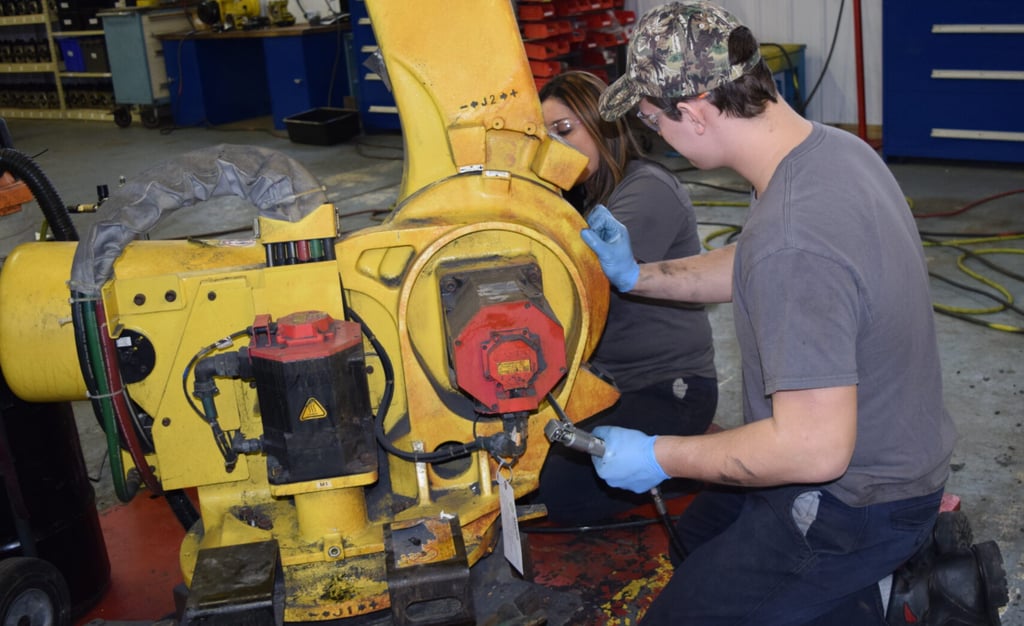
Preventive maintenance is the difference between a robot that runs for twenty years and one that fails at ten. The industrial robots from the major brands are built to last. The RV reducers in the joints, the servo motors, the castings, all of it is engineered for decades of continuous duty. But that engineering assumes the machine gets the care it was designed to receive. Grease breaks down. Batteries drain. Seals harden. Dust accumulates on circuit boards. These things happen slowly, and a robot that is not maintained will keep running right up until the moment it does not. For a used robot buyer, understanding preventive maintenance is not just about knowing what to do after the machine arrives. It is about knowing what to look for during the inspection, before writing the check.
Why Preventive Maintenance Pays for Itself
The math on preventive maintenance is straightforward because the cost of failure is so much higher than the cost of prevention. An unexpected robot failure stops the entire cell. The cost of a major breakdown runs from several thousand dollars for a reducer replacement to tens of thousands in lost production. Preventive maintenance reduces the risk of unplanned downtime by an estimated thirty to fifty percent compared to reactive repair-only approaches. A controller battery costs a few hundred dollars and takes minutes to replace. The mastering data that battery protects takes hours to restore if it is lost. A gearbox lubrication service costs a few hundred dollars in grease and labor. A failed reducer costs several thousand dollars in parts and several days of downtime. The pattern is the same across every maintenance item. The preventive action is cheap and scheduled. The failure is expensive and unplanned.
Maintenance Checks by Frequency: Daily, Weekly, Monthly, and Beyond
A maintenance schedule breaks into tiers. The daily and weekly checks are quick and visual, and they catch the problems that develop fast. Walk around the robot. Look for oil or grease seepage around the joints. A seal that leaks lubricant outward is also letting dust and moisture inward. Listen for unusual noise during operation. Grinding, clicking, or a change in pitch can mean a bearing or a reducer is wearing faster than it should. Check the cables and the dress pack where they flex near the wrist. Cracks, pinholes, and stiffness in the protective tubing are the early signs of a failure that will cause intermittent electrical faults. Run a quick test of the emergency stop and the enabling switch on the teach pendant. These are safety devices, and they need to work every time.
The monthly and quarterly checks go deeper. Backlash measurement on the wrist axes is the most valuable single data point for tracking long-term mechanical wear. The absolute number matters, but the trend matters more. A robot whose backlash is stable over multiple checks is a robot whose reducers are wearing normally. A robot whose backlash increases between every check needs investigation. The controller battery voltage should be measured before it drops below the warning threshold. A proactive battery replacement costs less than an emergency mastering recovery.
The annual and biannual checks are the major service items. Gearbox lubrication is the big one. RV reducers need fresh grease roughly every twelve thousand to twenty thousand hours of operation or annually, whichever comes first. The controller cabinet should be opened, inspected for dust accumulation, and cleaned. Fine metallic dust from grinding or casting environments is conductive and causes intermittent faults. A full accuracy test verifies that the robot still holds its programmed path within specification. The safety system, fencing interlocks, light curtains, e-stops, and controller-based safety functions, should be tested end to end.
How the Big Four Handle Maintenance Differently
The four major robot brands all require the same basic maintenance, but the way they deliver it differs enough to matter. FANUC's R-30iB controller is a closed system that runs the same way for years. The maintenance burden is low, but when something does go wrong, the diagnostic process follows FANUC's prescribed path. The controller battery is the most common service item, and it is easy to replace. ABB's IRC5 and OmniCore controllers run self-diagnostics that flag issues before they cause a fault. The TrueMove and QuickMove motion control depends on proper servo tuning, so regular path accuracy tests are more valuable on an ABB than a simple repeatability check. The FlexPendant cable and the connectors where it plugs into the controller are common wear points. KUKA's KRC4 and KRC5 run on a Windows-based PC architecture, which adds an IT maintenance layer that the other brands do not have. Software updates, security patches, and the occasional hard drive check are part of owning a KUKA. The open architecture makes it easier to integrate third-party diagnostic tools. Yaskawa's YRC1000 is a compact, low-maintenance controller. The maintenance focus on Motoman robots in arc welding cells shifts toward the welding equipment. The wire feeder, the torch cable, and the weld power connections need more attention than the robot itself.
What Used Robot Buyers Should Know About Maintenance
A used robot arrives without a known maintenance history in most cases, and that changes the maintenance equation. The first service after purchase should be a full annual-level maintenance, regardless of what the seller says was done. Replace the controller battery, even if the old one still has charge. The cost is small, and the risk of losing mastering data is large. Measure backlash on all six axes and record the values. These are the baseline numbers that all future measurements will compare against. Pay attention to the environment the robot came from. A robot retired from a foundry needs every seal inspected, even if the backlash numbers look fine. Heat and chemical exposure degrade rubber and silicone in ways that a backlash measurement will not catch. A robot from a cleanroom may have perfect mechanicals but aged seals that have simply dried out over time. Maintenance costs also vary by brand and region. FANUC and Yaskawa Motoman have the largest independent service networks and the widest spare parts availability in most markets. ABB and KUKA are well supported, but in some regions, maintenance may need to go through authorized service providers, which can cost more. A buyer who factors maintenance access into the brand decision is thinking further ahead than one who only looks at the purchase price.
This article was prepared by Tyche Robotic, a supplier of refurbished six-axis industrial robots serving integrators and resellers in Latin America, Southeast Asia, and Europe.

Contact Us
As a professional supplier of used industrial robots, Jiangmen Tyche Robotic Co., Ltd. is committed to providing customers with integrated solutions—from hardware selection and configuration to software programming, debugging, and after‑sales maintenance.
© 2025. All rights reserved.

Mr. Victor Ismael