Robotic EOAT: How the Right End-of-Arm Tooling Makes a Robot Productive
A practical guide to robotic end-of-arm tooling covering grippers, process tools, sensors and tool changers. Includes selection framework, Big Four integration, cost breakdown, collision protection, and used EOAT inspection.
Tyche Robotic
5/21/20266 min read
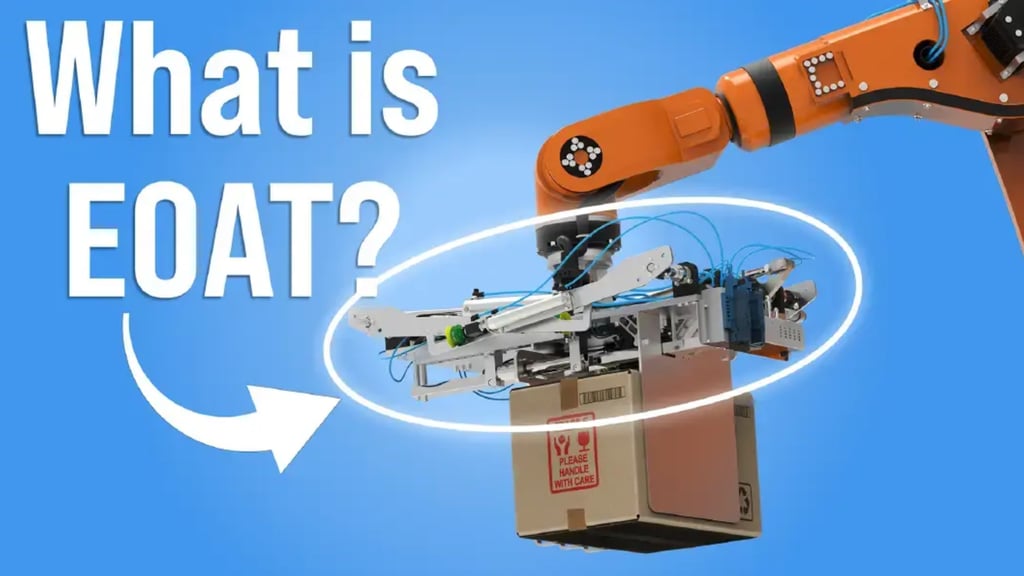
A robot arm by itself produces nothing. It can move to a programmed position, orient itself in space, and wait. What turns that motion into a finished weld, a stacked pallet, or an inspected part is the hardware bolted to the wrist. That hardware is called end-of-arm tooling, or EOAT. The global market for robotic EOAT sat at roughly four point three billion dollars in 2024 and is projected to reach around five point five billion by 2030. Material handling is the largest application area, and automotive is the biggest end user. These numbers reflect a simple fact: the robot is a platform, and the EOAT is what gives it a job. Understanding the different types of EOAT, how to choose the right one, and what to inspect on a used robot that already has EOAT mounted is as important as picking the robot itself.
What Is EOAT and Why It Matters
EOAT, sometimes called an end-effector, is everything mounted to the robot wrist that interacts with the product or the process. It is the hand that grips a casting, the weld gun that joins two panels, the vision sensor that checks a dimension, or the tool changer that lets the robot switch between all three. EOAT serves four main functions in a production environment. Gripping tools hold and move parts. Process tools apply something to the part, like a weld bead, a bead of adhesive, or a spray of paint. Sensing tools measure, inspect, and verify. Quick-change systems let the robot swap between different EOAT automatically without manual intervention. Among these, gripping tools are the most common by volume, simply because every automated line has to move parts from one place to another.
Types of EOAT: Grippers, Process Tools, Sensors, and Tool Changers
Grippers are the workhorses. They handle parts during pick-and-place, machine tending, palletizing, and packaging. A mechanical gripper uses two or three fingers to clamp onto the part. A vacuum gripper uses suction cups for flat, smooth surfaces. A magnetic gripper grabs ferrous parts without moving fingers. Most general manufacturing applications run some kind of gripper because most automation starts with moving something.
Process tools perform a specific manufacturing operation. A weld gun makes a spot weld. An arc welding torch lays a bead. A spray gun applies paint or coating. A router or deburring tool removes material. Unlike grippers, which can often handle a family of parts, process tools tend to be application-specific. A MIG welding torch cannot palletize. A paint gun cannot deburr. The robot stays the same; the tool defines the task.
Sensing and inspection tools are a growing category. Cameras, laser profilers, and force-torque sensors let the robot check its own work. A vision sensor mounted as EOAT can verify a weld bead, measure a gap, or confirm that a part is seated correctly before the next operation begins. These tools are increasingly common as manufacturers push for real-time quality data rather than downstream inspection.
Tool changers are not tools themselves but the devices that let a robot switch between the other three types automatically. A robot in a body shop might run a spot weld gun, then switch to a gripper to move the panel, then switch back to a weld gun. The tool changer makes that possible in seconds.
How to Choose the Right EOAT
Five factors drive the EOAT decision, and none of them start with the robot brand. The part comes first. Weight, material, surface finish, and geometry determine whether the tool needs to grip, vacuum, or magnetically attach, and what size it needs to be. The robot constraint comes second. EOAT weight counts against the robot's payload. A heavy gripper on a low-payload robot leaves no room for the part. The process requirement is third. Welding, painting, cutting, and inspection each demand completely different EOAT categories. Flexibility versus volume is fourth. A high-mix, low-volume cell needs quick-change systems and adjustable grippers. A dedicated high-volume line can justify custom-optimized EOAT that runs faster and costs less per unit. The environment is fifth. Food-grade, cleanroom, explosive, and washdown environments impose material and certification requirements on everything that touches the product.
Safety and Collision Protection
EOAT is the part of the robot most likely to hit something. A misaligned part, a misplaced fixture, or a programming error sends the tool into a collision. Collision detection sensors mounted on the EOAT or between the EOAT and the wrist detect the impact and signal the robot to stop immediately. This protects the tool, the robot wrist, and the part. In high-value tooling like laser cutting heads or multi-axis weld guns, a collision sensor can pay for itself the first time it triggers. Modern systems measure abnormal force and torque changes at the point of contact, providing both equipment and personnel protection. When evaluating a used robot with EOAT, confirming that the collision sensor is present and functional is as important as checking the tool itself.
The Cost Side of EOAT: What to Expect
EOAT cost is not a single number. It is the sum of four choices. The type drives the baseline. A simple pneumatic gripper costs a few hundred dollars. A multi-axis servo weld gun can run well into six figures. The payload class matters next. Heavy-duty grippers and process tools cost more because the castings, actuators, and seals are larger and stronger. Sensing and intelligence add another layer. A basic mechanical gripper with no feedback is cheaper than an electric gripper with programmable force and position reporting. Quick-change capability adds the tool changer hardware plus the cost of multiple tool plates, but it eliminates the labor cost of manual changeovers. Standardized EOAT designs reduce total cost of ownership by compressing deployment time. A pre-engineered gripper with a standard mounting interface can go from crate to production in hours. A custom-designed and machined tool can take weeks. The ROI calculation is straightforward in high-cycle applications. If a quick-change system saves ten minutes of manual changeover time per shift and the line runs three shifts, the system pays for itself in months.
How the Big Four Integrate with EOAT
The EOAT market is one of the most open ecosystems in industrial automation. A Schunk gripper, an ATI tool changer, or an OnRobot vacuum head mounts to any major robot brand without modification. The mechanical interface at the wrist is standardized across FANUC, KUKA, ABB, and Yaskawa, and the I/O integration runs through standard digital, analog, or Ethernet-based protocols. FANUC robots in welding cells often pair with dedicated servo weld guns and in palletizing with heavy-duty mechanical or vacuum grippers. ABB integrates magnetic grippers into high-speed automotive stamping lines. KUKA's heavy-payload robots work with large hydraulic and pneumatic grippers for foundry and structural steel handling. Yaskawa Motoman robots are a common sight with arc welding torches and electric grippers in precision assembly. The practical takeaway is that EOAT is a separate decision from the robot brand. It is chosen for the part and the process, not for the color of the arm.
What to Know When Buying a Used Robot with EOAT
A used robot that comes with EOAT already mounted can save weeks of integration time, but only if the EOAT is in serviceable condition. The inspection has three levels. The mechanical level looks at the tool body, the moving parts, and the wear surfaces. On a gripper, cycle the fingers and listen for grinding or hesitation. Check the guide rails and bushings for play. On a weld gun, inspect the electrode tips and the insulation on the power cables. On a vacuum gripper, check the cups for hardening, cracking, or deformation. The electrical and sensing level checks the feedback and the wiring. An electric gripper should report its actual position and match it to the commanded position. A collision sensor should trip at its set threshold, not at some unknown point after years of drift. Connectors and cables should be free of corrosion and fatigue cracks. The integration level asks whether the EOAT was originally engineered with the robot or added later. Factory-integrated EOAT usually comes with documentation, calibration records, and known performance data. Third-party add-ons can work just as well, but the buyer needs to verify that the mounting, wiring, and control setup were done correctly. The EOAT is the business end of the robot. Its condition determines whether the cell starts producing or starts debugging.
This article was prepared by Tyche Robotic, a supplier of refurbished six-axis industrial robots serving integrators and resellers in Latin America, Southeast Asia, and Europe.
Contact Us
As a professional supplier of used industrial robots, Jiangmen Tyche Robotic Co., Ltd. is committed to providing customers with integrated solutions—from hardware selection and configuration to software programming, debugging, and after‑sales maintenance.
© 2025. All rights reserved.

Mr. Victor Ismael