Robot IP Ratings Explained: What Those Two Numbers Mean for Your Application
A practical guide to industrial robot IP ratings. Covers IP65, IP67, and IP69K differences, how to match ratings to real-world applications, Big Four protection approaches, and what to check when buying a used robot with an IP rating.
Tyche Robotic
5/22/20265 min read
A robot that welds car frames lives in a different world from one that stacks boxes in a dry warehouse. One gets hit with weld spatter, grinding dust, and maybe a splash of coolant every few minutes. The other sits in a climate-controlled room where the biggest threat is a forklift bumping into its base. The IP rating stamped on a robot's spec sheet is the simplest way to know whether the machine is built for the environment you are about to put it in. Two digits tell you whether it will shrug off a washdown hose or short out the first time a casting quench tank splashes nearby. Understanding what those numbers actually mean, which ones matter for your application, and how to check whether a used robot still earns its rating is not a technical footnote. It is the difference between a machine that keeps running and one that dies young.
What IP Ratings Mean and How to Read Them
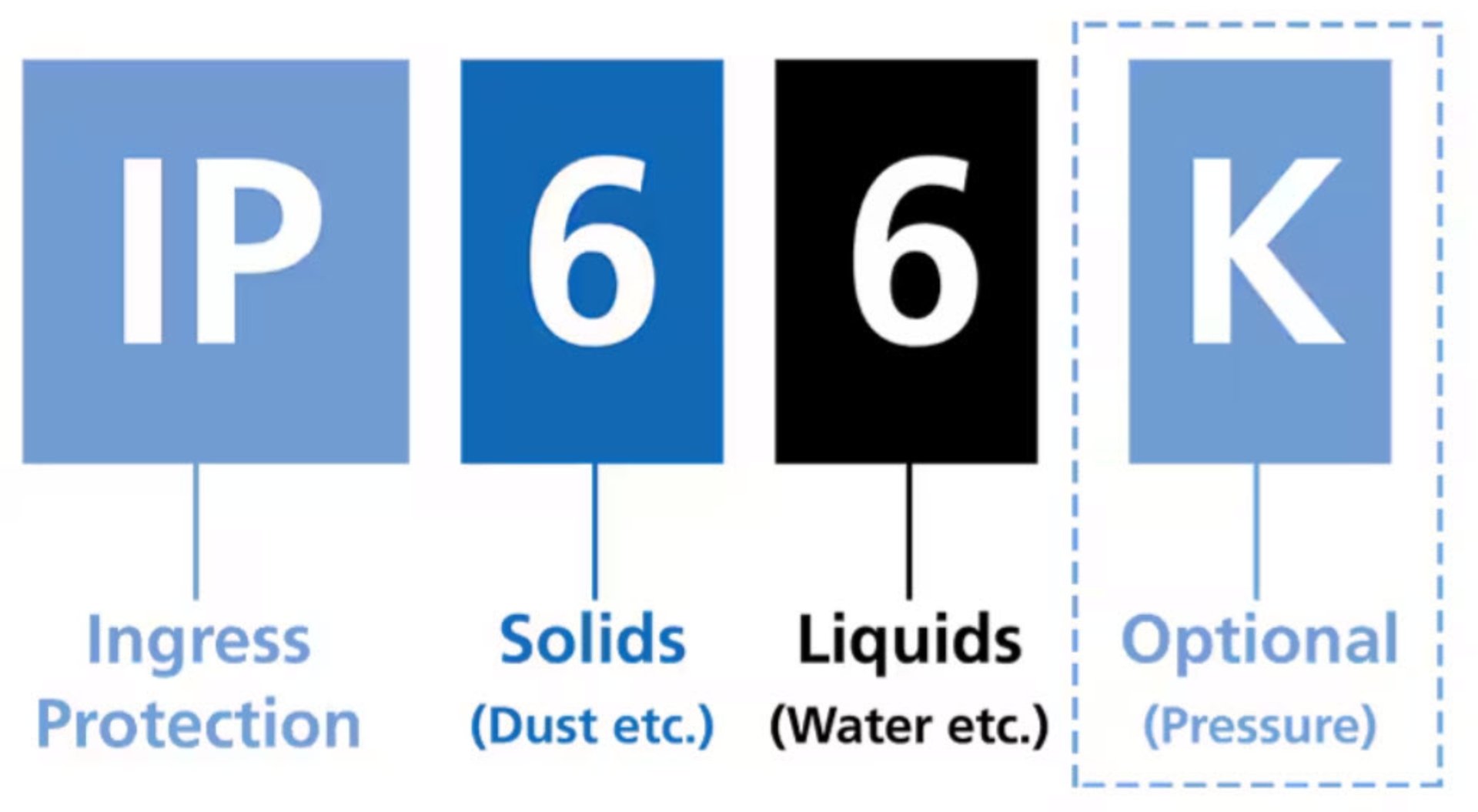
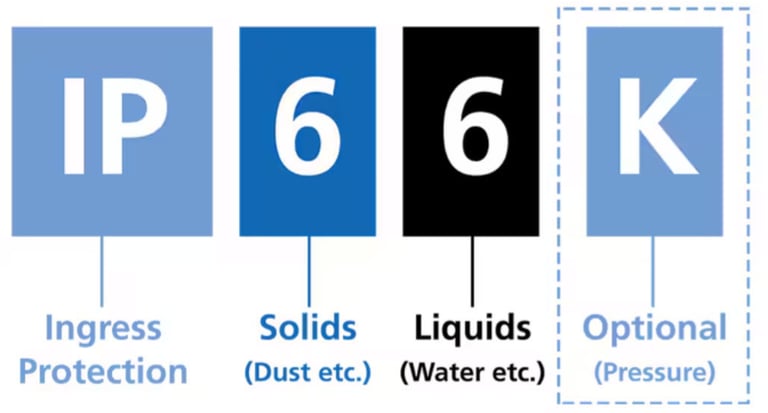
IP stands for Ingress Protection. The first digit after the letters tells you how well the robot keeps solid stuff out. A 0 means no protection at all. A 6 means the enclosure is completely dust-tight, with no ingress of even the finest particles after hours of exposure in a dust chamber. The second digit tells you about water. A 0 means no water protection. A 7 means the robot can sit in one meter of water for thirty minutes and come out dry inside. When you see a rating like IP65, the robot is fully dust-tight and can handle water jets from any direction. When you see IP67, it adds temporary immersion to that list. An X in either position means that digit was not tested, not that protection is absent. The rating is a physical test result, not a design promise. A robot that left the factory at IP67 ten years ago may or may not still hold that rating today depending on how its seals have aged.
IP65, IP67, and IP69K: The Three Ratings That Matter Most
Three ratings show up more than any others on industrial robot spec sheets, and they are not interchangeable. IP65 is the industrial standard. The robot is dust-tight and can handle low-pressure water jets from any direction. This is enough for most general manufacturing, machine tending, and palletizing where the environment is controlled and the biggest liquid threat is an occasional splash from a coolant line. IP67 is the foundry and wet-environment upgrade. Same complete dust protection, but the robot can survive temporary immersion in up to a meter of water. This is the baseline for die-casting cells, grinding stations, and anywhere else where conductive dust and liquid pooling are daily realities. A robot with IP67 can handle being hosed down at the end of a shift, as long as the pressure is not excessive.
IP69K is a different category entirely. It is not simply a higher number on the same scale. The test involves a high-pressure, high-temperature water jet at one hundred bar of pressure and eighty degrees Celsius, blasted at the robot from multiple angles at close range. This is the rating for food processing, pharmaceutical manufacturing, and any facility where aggressive chemical washdown happens every day. A robot that passes IP69K is built to survive cleaning protocols that would destroy a standard industrial machine in weeks. One thing worth knowing: IP69K is tested differently from IP67. Passing IP69K does not automatically mean the robot meets IP67 or IP68. The tests are separate, and the ratings are independent. A robot can carry IP69K without being rated for immersion, and the spec sheet should list the individual ratings the robot actually holds.
Matching IP Ratings to Real-World Applications
The application should drive the IP rating, not the other way around. In general manufacturing environments like dry palletizing, assembly, and packaging, IP40 to IP54 is usually enough. The dust is minimal and the liquids are mostly accidental. In machining, welding, and cutting cells, IP65 becomes the starting point. Coolant spray, metal chips, and grinding dust are part of the daily routine, and a robot that cannot handle them will accumulate conductive debris inside its joints. Foundries, forge shops, and stamping plants push the requirement to IP67, often with additional protection layers like FANUC's FoundryPro or ABB's Foundry Plus. The heat, the scale, and the die lubricant spray create an environment where standard seals harden and fail within months. In food, beverage, and pharmaceutical production, IP69K is the hard requirement. The robot has to handle high-pressure, high-temperature washdown with aggressive cleaning chemicals, and it has to do it without shedding lubricant or paint particles into the product zone. Cleanrooms add a different twist. The robot needs high IP protection not because the environment is dirty, but because the robot itself must not generate particles that contaminate the product.
How the Big Four Approach IP Protection
Each of the major robot brands has its own way of building robots that survive harsh conditions, and the approach matters when you are looking at a used machine. FANUC layers IP67 protection across three zones of the robot with its FoundryPro package. The wrist, the drive train, and the electrical connections each get a different level of sealing. For food-grade applications, FANUC offers the DR-3iB/6 STAINLESS Delta robot, which carries an IP69K rating with a fully stainless steel exterior designed for direct food contact and USDA compliance. ABB splits its protection into tiers. Foundry Plus delivers IP67 across the entire robot with enhanced sealing and an epoxy coating. Foundry Prime raises the bar further for high-pressure washdown. The IRB 1200 Hygienic carries IP67 across the whole robot, with the axis-six flange rated IP69K for up to thirty bar of water pressure, and uses NSF H1 food-grade grease throughout. KUKA centers its Foundry series on a V2A stainless steel wrist that is inherently more corrosion-resistant than coated steel. The KR QUANTEC Foundry line carries IP65 and IP67 dual certification, with an ambient temperature rating of fifty-five degrees Celsius and a wrist that can handle one hundred eighty degrees for ten seconds per minute. Yaskawa offers IP69K hygienic robots with surface roughness below zero point eight Ra on stainless steel housings, designed to minimize places where bacteria and contaminants can collect.
What to Know When Buying a Used Robot with a Specific IP Rating
An IP rating is a physical condition, not a permanent warranty. Seals age. Coatings wear. Connectors corrode. The rating on the original spec sheet tells you how the robot was built, not what it can withstand today. The first thing to inspect on any used robot that claims a high IP rating is the seals. High heat and chemical exposure cause rubber and silicone to harden, crack, or swell. Check around each joint for grease seepage. A seal that leaks lubricant outward is also letting dust and moisture inward. The second thing is the surface protection. Epoxy coatings and anti-corrosion paints can peel or bubble after years of thermal cycling and chemical exposure. Stainless steel can pit, especially around bolt heads and connector glands where water pools. The third thing is inside the controller cabinet. Open it and look for dust. In a foundry or grinding environment, fine conductive particles are invisible killers that settle on circuit boards and cause intermittent faults. The fourth thing is the documentation. For food-grade robots with IP69K, the certification paperwork is part of the machine's value. If the documents are missing, the robot may still work fine mechanically, but it will not pass a food safety audit. The fifth thing is hidden moisture damage. A robot that was regularly washed down may have water residue inside connectors and junction boxes that does not show up until the machine is powered on in a humid environment. A loaded test report that includes the robot running under real-world conditions, not just a dry lab test, is the minimum standard before purchasing.
This article was prepared by Tyche Robotic, a supplier of refurbished six-axis industrial robots serving integrators and resellers in Latin America, Southeast Asia, and Europe.

Contact Us
As a professional supplier of used industrial robots, Jiangmen Tyche Robotic Co., Ltd. is committed to providing customers with integrated solutions—from hardware selection and configuration to software programming, debugging, and after‑sales maintenance.
© 2025. All rights reserved.

Mr. Victor Ismael