New vs. Refurbished Industrial Robots: A Decision Framework for Integrators and Resellers
A decision framework for system integrators and resellers comparing new vs. refurbished industrial robots. Covers cost analysis, application fit, and inspection criteria.
Tyche Robotic
4/16/20265 min read

When sourcing industrial robots for client projects, system integrators and automation resellers face a recurring question: new or refurbished? The answer depends on the application requirements, the client's budget tolerance, and the project's technical constraints.
Industry data consistently shows that refurbished industrial robots cost roughly forty to sixty percent less than comparable new units. For a heavy-payload six-axis robot, that difference can mean tens of thousands of dollars in upfront capital. But the purchase price is only part of the equation. Understanding where refurbished robots deliver value and where they introduce risk is essential for making recommendations that clients will not regret.
THE REAL COST COMPARISON: BEYOND THE PURCHASE PRICE
The headline savings on a refurbished robot are real, but professional buyers evaluate total landed cost, not just the invoice amount. Several factors shift the economics beyond the sticker price.
Warranty coverage differs substantially. New robots typically come with twelve to eighteen months of OEM-backed protection. Refurbished units vary by supplier, often offering thirty to ninety days. This gap matters when calculating project risk exposure.
Controller software and licensing present another variable. New robots ship with the latest software versions and full technology package licenses. Refurbished controllers may require license transfers or even repurchases of optional packages, which can add thousands of dollars to the final cost.
Mechanical wear is perhaps the most obvious consideration. New robots have zero hours on reducers and bearings. Refurbished units carry existing wear, and the remaining service life of harmonic drives and gearboxes varies from unit to unit.
Lead time often favors refurbished equipment. While new robots may require eight to sixteen weeks depending on the model and configuration, refurbished units are frequently ready to ship within days. For projects with compressed timelines, this difference alone can justify the refurbished route.
For integrators, the most frequently overlooked cost center is integration time. Older controller generations may lack native support for EtherNet/IP or PROFINET, adding days of engineering work just to establish communication with a modern PLC. Before committing to a refurbished unit, verifying the controller model and software version is a prudent step.
WHEN REFURBISHED ROBOTS MAKE STRATEGIC SENSE
Despite the caveats, there are clear scenarios where refurbished equipment is the smarter choice, especially for integrators serving cost-conscious markets.
Legacy system replacements often favor refurbished units. If a client's existing cell uses an older robot model, sourcing a refurbished identical unit is frequently faster and more cost-effective than redesigning the cell around a new model. The tooling, programming, and safety guarding remain unchanged, minimizing downtime and engineering expense.
Pilot projects and proof-of-concept cells benefit from lower upfront investment. For clients testing automation for the first time, a new robot investment can be a difficult internal sell. A refurbished unit at roughly half the cost lowers the barrier to entry, allowing the client to validate cycle times, test fixturing, and build organizational buy-in before scaling up.
Low-duty-cycle applications rarely demand peak mechanical precision. For palletizing, case packing, or basic material handling, where positional accuracy requirements are forgiving and cycle rates are moderate, a well-maintained refurbished robot can perform reliably for years.
Budget-constrained projects in developing manufacturing markets represent a significant opportunity. In many regions, the capital cost of new automation equipment is prohibitive. Refurbished robots enable local factories to adopt automation that would otherwise be out of reach. For integrators serving these areas, offering refurbished options can open doors that new-equipment-only proposals would leave closed.
WHEN NEW ROBOTS ARE THE RIGHT RECOMMENDATION
There are also applications where recommending refurbished equipment does a disservice to the client.
High-precision processes demand caution. If the application requires repeatability under five hundredths of a millimeter, such as precision assembly, medical device manufacturing, or high-speed dispensing, new is the safer bet. Worn reducers in a refurbished robot can introduce backlash that directly impacts positioning accuracy, and the problem may not surface until parts start failing quality checks.
High-utilization production cells consume mechanical life rapidly. Running three shifts translates to over six thousand operating hours per year. Industrial robot reducers have a finite service life, typically in the range of twenty thousand to thirty-five thousand hours depending on the load profile. Starting with a unit that already has significant hours leaves limited runway before major mechanical service is required, which can cost several thousand dollars per joint.
Safety-critical or regulated industries pose documentation challenges. Medical device, pharmaceutical, and aerospace manufacturers often face requirements that make refurbished equipment impractical. The validation burden alone, including proving the robot meets specifications and qualifying the cell, can exceed the cost savings on the robot itself.
WHAT TO VERIFY BEFORE COMMITTING TO A REFURBISHED UNIT
If a refurbished robot fits the client's needs, several checks can help avoid costly surprises.
Controller and software compatibility should be confirmed early. Identifying the exact controller model and system software version determines how easily the robot will integrate with modern PLC architectures. Older controllers may require additional interface hardware that should be factored into the project scope.
Reducer condition and backlash provide a window into mechanical health. Requesting a recent backlash measurement on all primary axes helps gauge remaining service life. Any noticeable play in the wrist axes typically indicates worn harmonic drives. If the supplier cannot provide test data, budgeting for a thorough mechanical inspection upon receipt is wise.
Operating hours and application history both matter. A robot with twenty thousand hours in a cleanroom is mechanically very different from one with ten thousand hours in a foundry. Even a general answer about prior use, such as welding, palletizing, or machine tending, provides useful context.
Physical condition offers visible clues. Inspecting the teach pendant screen and membrane keys, checking the controller cabinet for signs of coolant exposure or dust infiltration, and examining the robot arm for evidence of past collisions are all prudent steps.
A NOTE ON DOCUMENTATION GAPS
Maintenance records are often incomplete or unavailable in the secondary robot market. This is the industry norm, not an automatic red flag. Instead of fixating on missing paperwork, focusing on verifiable current condition is more productive. A recent test log showing axis temperatures, motor currents, and any recorded faults provides more assurance than any historical document ever could.
BUILDING A RELIABLE SOURCING PIPELINE
Given the variability in the used robot market, many professional integrators develop ongoing relationships with a small number of suppliers who demonstrate consistent quality and transparent communication. Over time, this reduces the per-unit inspection burden and streamlines logistics, which is especially valuable when shipping to international destinations where proper anti-corrosion packaging and compliant crating become critical considerations.
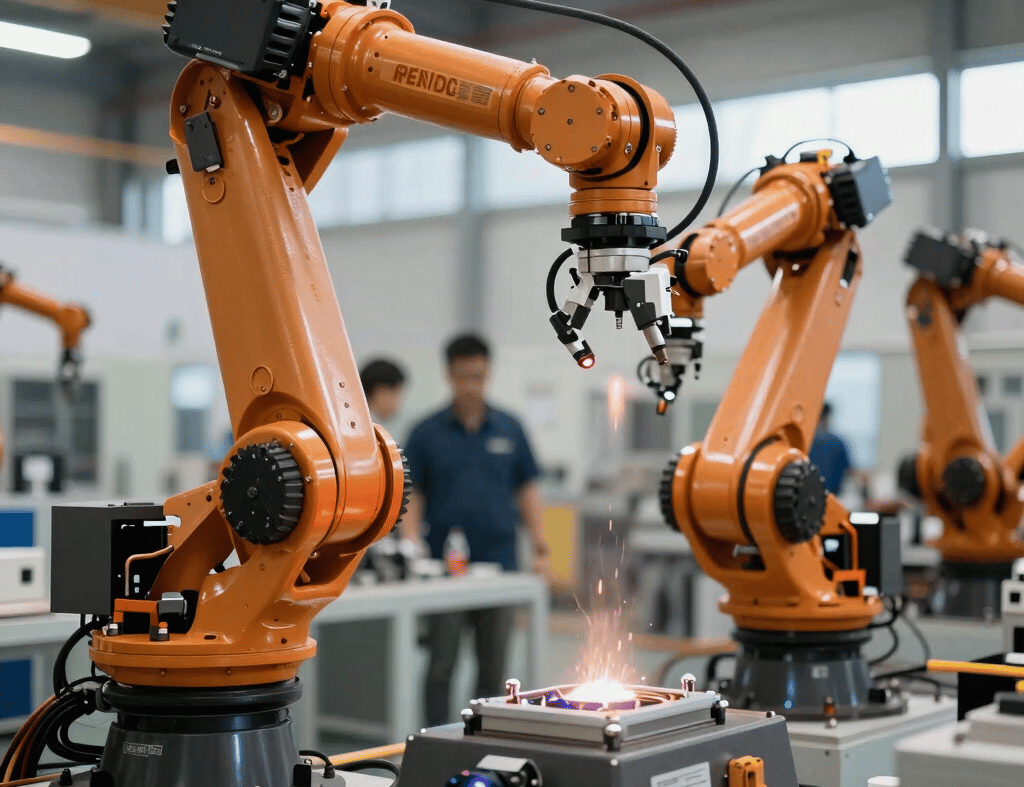
This guide was prepared by Tyche Robotic, a supplier of refurbished six-axis industrial robots serving integrators and resellers in Latin America, Southeast Asia, and Europe.
Additional resources: For specific model specifications and current availability, browse the KUKA inventory or view the ABB used robot listings.
Contact Us
As a professional supplier of used industrial robots, Jiangmen Tyche Robotic Co., Ltd. is committed to providing customers with integrated solutions—from hardware selection and configuration to software programming, debugging, and after‑sales maintenance.
© 2025. All rights reserved.

Mr. Victor Ismael