Motoman vs. ABB Industrial Robots: The Welding Specialist and the Precision Powerhouse
A practical comparison of Motoman and ABB industrial robots covering controller differences, precision, applications, and what each brand means on the used market. Includes inspection tips for used Motoman and ABB robots.
Tyche Robotic
5/27/20267 min read
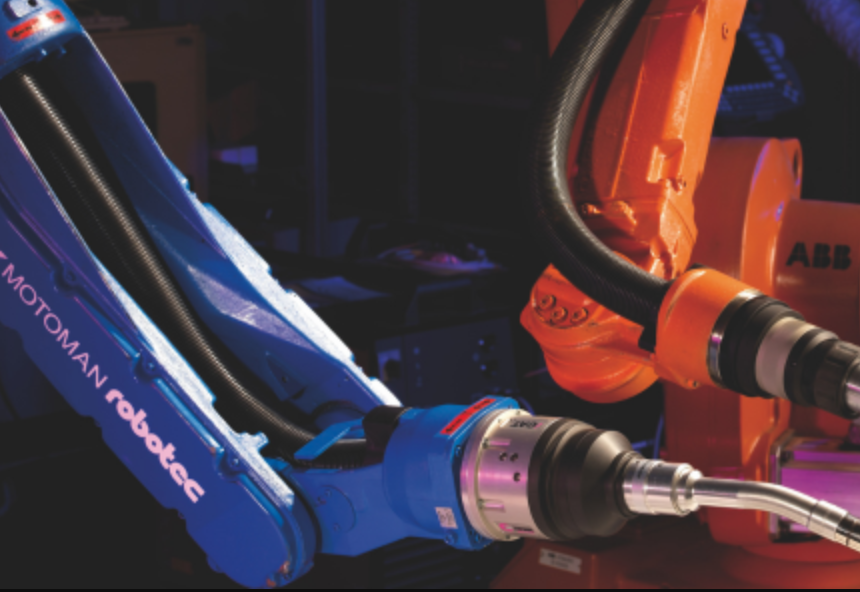
Motoman and ABB come at industrial robotics from almost opposite directions. Motoman, the robotics division of Yaskawa Electric, earned its place as the world's largest supplier of arc welding robots by a wide margin. The company ships roughly forty thousand welding robots every year, more than anyone else. ABB, the Swiss industrial giant, built its reputation on motion control, process automation, and heavy-payload handling in unforgiving environments. Together, the two brands account for roughly twenty-one percent of the global industrial robot market, Yaskawa at about eight percent and ABB at about thirteen percent. Their combined installed base tops one point one million units, over six hundred thousand for Motoman and over five hundred thousand for ABB. On the used market, both show up often enough that any serious buyer will encounter them. But the reasons a factory retires a Motoman are usually different from the reasons a factory retires an ABB, and the used buyer who understands why is the one who gets a good machine at a fair price.
The Brands at a Glance
Motoman is the welding house. The product line runs from half a kilogram to nine hundred kilograms of payload, with configurations from four to fifteen axes. Floor, wall, ceiling, tilted. If a mounting position exists, Motoman has a robot rated for it. The controllers, YRC1000 and the newer YRC1000micro, are compact and built around one idea: making it easy to run multiple robots from a single box. The arc welding portfolio is the deepest in the industry, with AR and MA series robots that pair seamlessly with power supplies from Lincoln, Fronius, Miller, and pretty much every other major brand. ABB is the precision and heavy-handling house. The product line covers half a kilogram to eight hundred kilograms. The IRB 6640 and IRB 7600 are the workhorses of foundries and automotive material handling cells. SafeMove2, ABB's safety-rated motion control software, is what sets the brand apart in applications where robots work near people or expensive equipment. ABB's robotics business was recently signed to be acquired by SoftBank in a deal valued at over five billion dollars, a signal of how valuable the brand's technology and installed base are to the broader automation market.
Controller Philosophy: YRC1000 vs. IRC5
The controller is where the two brands really go their own way, and it matters a lot on the used market because the controller is what the integrator has to live with every day. Motoman's YRC1000 is a compact unit, one hundred twenty-five liters in volume and seventy kilograms in weight. It handles up to eight robots and seventy-two axes of synchronized motion from a single controller, with sixteen concurrent tasks and thirty-two control groups. For a welding cell with multiple robots and positioners working the same part, that capability is not a nice-to-have. It is the reason a fabricator chooses Motoman in the first place. The I/O throughput is fast, four thousand ninety-six inputs and outputs, and the programming environment gives integrators enough flexibility to customize without feeling locked in. The YRC1000micro handles smaller robots with the same DNA in an even smaller package.
ABB's IRC5 takes a different approach. A control module handles the brains, a drive module handles the muscle, and the two talk over a dedicated link. Process modules can be added for spot welding, arc welding, or dispensing without redesigning the entire cabinet. TrueMove keeps the programmed path accurate no matter how fast the robot moves. QuickMove shaves cycle time by managing acceleration and deceleration. SafeMove2 is the safety layer that sits on top of all of it, letting the robot run at reduced speed near people or stop instantly when someone steps into a monitored zone. RobotStudio lets the programmer simulate the entire cell offline, which saves real time when the cell is complex and the parts are expensive.
ABB has since moved to the OmniCore controller, and Motoman has the YRC1000micro for its smaller arms. But on the used market, the YRC1000 and the IRC5 are the controllers you will actually run into. The newer hardware is years away from showing up in volume on the secondary market.
Applications: Where Each Brand Earned Its Reputation
Motoman owns arc welding. The AR and MA series are the go-to machines for fabricators who weld structural steel, agricultural equipment, automotive components, and pipe. MotoWeld, the brand's dedicated welding software, handles multipass weld scheduling and adaptive fill, the kind of features that matter when a single weld joint takes hours to complete. The SDA series dual-arm robots, with fifteen axes across two arms, handle assembly and material handling tasks that would normally require two separate robots or a human operator. In high-speed pick-and-place and packaging, the GP series competes directly with ABB and FANUC on speed and precision.
ABB owns heavy material handling and precision motion. The IRB 6640 and IRB 7600 series are the backbone of foundry handling, automotive press lines, and heavy palletizing. SafeMove2 makes ABB the default choice in applications where robots share space with people or where a collision with expensive tooling would be catastrophic. The IRB 5500 paint robots own a huge share of automotive finishing, where TrueMove and QuickMove deliver the consistent film thickness that paint shops demand. In general handling, palletizing, and machine tending, the two brands compete head-to-head, and the decision often comes down to which controller the integrator already knows. FANUC owns the spot welding and reliability end of the market, and KUKA dominates ultra-heavy payloads and open-controller integration. Each brand found its corner.
Precision, Speed, and the Numbers That Matter
The spec sheets are close enough that for most applications the difference will not change the outcome, but the numbers still tell a story. On the light end, the Motoman GP8 carries eight kilograms over seven hundred twenty-seven millimeters with repeatability of one hundredth of a millimeter. The ABB IRB 1200 carries seven kilograms over nine hundred one millimeters with repeatability of two hundredths of a millimeter. The Motoman is slightly more precise. The ABB reaches further. In arc welding, the Motoman AR1440 handles twelve kilograms over fourteen hundred forty millimeters with repeatability of six hundredths of a millimeter. The ABB IRB 1600 carries ten kilograms over fourteen hundred fifty millimeters with repeatability of five hundredths of a millimeter. The specs are nearly identical, and the choice between them usually comes down to welding software and power supply compatibility. On the heavy end, the Motoman MH250 carries two hundred fifty kilograms over two thousand seven hundred ten millimeters. The ABB IRB 6640-235 carries two hundred thirty-five kilograms over two thousand seven hundred fifty millimeters with repeatability of seven hundredths of a millimeter. The numbers are close. The ABB holds a slight precision advantage, but the Motoman carries more. For a foundry or a heavy fab shop, either machine will do the work. The decision usually tips on service, controller familiarity, and whether the buyer needs SafeMove2 for a collaborative setup.
What These Differences Mean on the Used Market
The used market is where the brand narratives either hold up or fall apart. Motoman arc welding robots are among the most sought-after used machines in the fabrication world. A used AR or MA series robot with the MotoWeld software package already installed and licensed is essentially a turnkey welding solution for a shop that knows what it is doing. The multi-robot coordination built into the YRC1000 means a used Motoman cell with multiple arms and positioners can be dropped into a new welding application without re-engineering the entire control setup. Motoman robots in comparable payload classes often price lower than equivalent ABB units, which makes them attractive for buyers who prioritize welding capability over general-purpose flexibility.
ABB robots hold their value differently. The IRC5 controller's ability to maintain path accuracy over years of service means used ABB machines often arrive with less performance degradation than robots from brands that prioritize mechanical simplicity over motion control. The IRB 6640 and IRB 7600 series show up regularly from foundry and material handling applications, and they tend to price at a slight premium in regions where ABB's service network is dense. ABB's paint robots are rare on the used market and command high prices when they do appear. The SafeMove2 software on a used ABB adds real value for buyers setting up cells where safety-rated motion control is a requirement, not a preference.
For both brands, the robot's previous life is a bigger pricing factor than the name on the arm. A Motoman from a clean fab shop and an ABB from a foundry lived completely different lives. A seller who knows the application history and can provide a loaded test report is the difference between buying a known quantity and guessing. Tyche Robotic and other established used equipment suppliers see this daily. The robots that hold up best on a used buyer's floor are the ones that were maintained properly and tested honestly, regardless of whether the arm is blue or white.
What to Check When Buying a Used Motoman or ABB
A used Motoman and a used ABB need different inspection checklists because they wear differently. For a Motoman, especially one retired from arc welding, wrist backlash is the first measurement to ask for. Path accuracy degrades as reducers wear, and in welding, that degradation shows up directly in the quality of the bead. The YRC1000 or DX200 battery is next. A dead battery means lost mastering, and re-mastering a multi-axis robot adds commissioning time. MotoWeld and any other application software need to be verified as installed, licensed, and transferable. The dress pack on a welding robot deserves extra scrutiny. Welding spatter burns pinholes in cable jackets, and heat exposure hardens the protective tubing. A dress pack that looks fine at a glance can fail within weeks if it was near the end of its life when the robot was retired. If the robot came from a multi-arm cell, the coordination files and external axis parameters need to be saved and transferable. Rebuilding a synchronized multi-robot setup from scratch is a major engineering effort.
For an ABB, the IRC5 battery is equally critical. TrueMove and QuickMove functions depend on proper servo tuning and gear condition, so a loaded test report showing path accuracy under real conditions is more valuable than a static repeatability number. Foundry Plus or Foundry Prime robots need every external seal inspected. Heat and chemical exposure degrade rubber and silicone. A robot that looks spotless on the outside can have moisture damage inside the controller if the seals failed years ago. SafeMove2 functionality should be verified if the robot was originally equipped with it. The safety configuration is stored in the controller, and confirming it is intact and transferable avoids re-commissioning a safety system from zero. For both brands, a loaded test report and a video of the specific robot running a test cycle are the minimum documentation to ask for before writing a check. The robot's previous life matters more than its paint color. An inspection that does not account for where the robot spent its first career is only half an inspection.
This article was prepared by Tyche Robotic, a supplier of refurbished six-axis industrial robots serving integrators and resellers in Latin America, Southeast Asia, and Europe.

Contact Us
As a professional supplier of used industrial robots, Jiangmen Tyche Robotic Co., Ltd. is committed to providing customers with integrated solutions—from hardware selection and configuration to software programming, debugging, and after‑sales maintenance.
© 2025. All rights reserved.

Mr. Victor Ismael