Motoman and the Big Four in Electronics Manufacturing: Speed, Precision, and Cleanroom Automation
A practical look at Motoman and Big Four robots in electronics, covering speed and precision demands, Motoman GP/MH/SDA series, FANUC, ABB, KUKA comparisons, and what to know about robots retired from electronics manufacturing.
Tyche Robotic
6/17/20265 min read
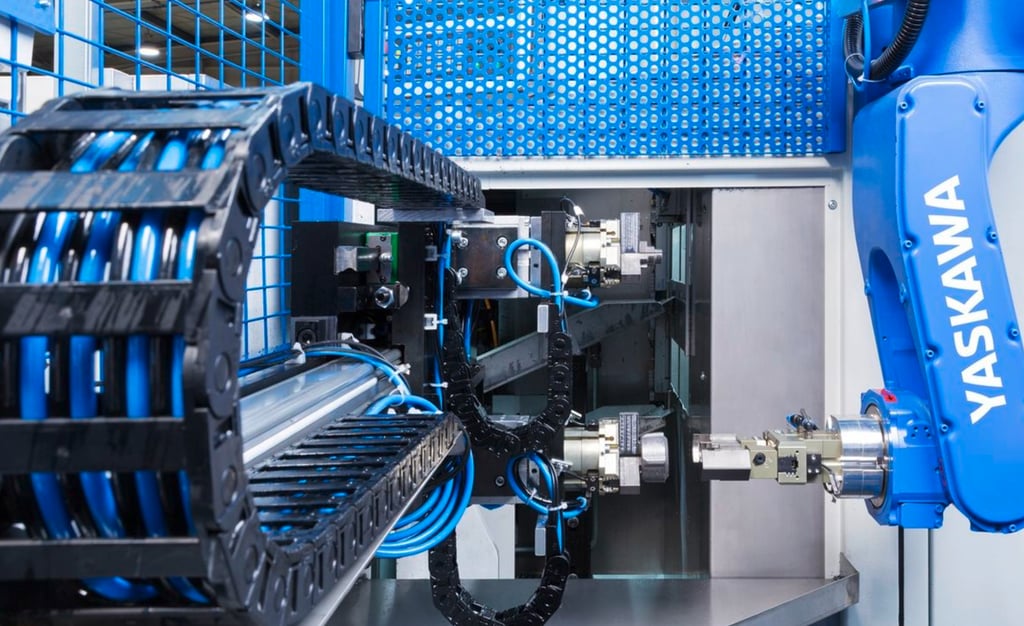
Electronics manufacturing is the second largest user of industrial robots in the world, behind only automotive. Roughly twenty-seven percent of all new industrial robots installed globally end up in factories that make phones, circuit boards, semiconductors, and the countless small components that fill every device we use. The work in these factories is different from anywhere else. The parts are measured in millimeters instead of meters. The cycle times are measured in fractions of a second. And the environments are often cleaner than a hospital operating room. Motoman, the robotics division of Yaskawa Electric, has a full lineup of robots built for these conditions. But understanding how Motoman fits into the electronics industry means looking at what the other major brands bring to the same table. This article walks through what electronics manufacturing actually demands from a robot, how Motoman's lineup addresses those demands, where the other Big Four brands compete, and what to check when buying a used robot that came out of an electronics plant.
What Electronics Manufacturing Demands from Robots
Three requirements drive every robot decision in electronics manufacturing, and none of them are optional. Speed is the first. The parts are small, the margins are thin, and the volumes are enormous. A robot placing surface-mount components on a circuit board needs to cycle in under a second. A Delta or SCARA robot at the end of a production line might pick and place hundreds of parts per minute. Speed is not a nice-to-have in electronics. It is the difference between a line that makes money and a line that does not.
Precision is the second requirement. The tolerances in electronics assembly are measured in hundredths of a millimeter. A FANUC LR Mate 200iD holds repeatability at one hundredth of a millimeter. A Motoman GP8 holds the same tolerance at eight kilograms of payload. A Yaskawa SCARA robot like the SR-3iA tightens that even further. When a misplaced component means a scrapped board, precision is not a specification on a sheet. It is the cost of quality.
Cleanroom compatibility is the third requirement. Semiconductors, flat panel displays, and medical electronics are manufactured in environments where a single dust particle can ruin a batch. Robots in these environments need sealed joints, low-particle lubricants, special coatings, and in the most demanding applications, ISO Class 4 or Class 5 certification. A robot that sheds particles is a robot that cannot work in half the electronics industry.
Motoman's Electronics Lineup: GP, MH, and SDA
Motoman's electronics offering is built around three robot families, each aimed at a different part of the factory floor. The GP series is the high-speed workhorse. The GP7 carries seven kilograms over nine hundred twenty-seven millimeters with repeatability at one hundredth of a millimeter. The GP8 matches that precision with a slightly longer reach. The GP12 handles twelve kilograms and still moves fast enough for high-speed pick-and-place. These are the robots that load and unload test fixtures, assemble connectors, and move parts between conveyors and inspection stations. They pair with the YRC1000 controller, which is compact enough to fit into the tight electrical cabinets common in electronics lines.
The MH series handles heavier work. When a robot needs to move a finished assembly, a test rack, or a pallet of packaged product, the MH series steps in with higher payloads and longer reaches. These robots run material handling and end-of-line packaging in electronics plants where the product is light but the packaging and the logistics equipment add weight.
The SDA series is Motoman's dual-arm robot. With fifteen axes across two arms, the SDA robots can handle assembly tasks that normally require a human operator. Flexible circuit board assembly, connector mating, and delicate part insertion are the applications where dual-arm robots make sense. The two arms work together in a coordinated way, which lets the robot handle parts the way a person would, one hand holding the workpiece and the other hand performing the operation.
MotoSight is Motoman's integrated vision system. It handles part location, orientation detection, and quality inspection directly through the YRC1000 controller. In an electronics line where every part needs to be verified, MotoSight eliminates the need for a separate vision PC and simplifies the cell. MotoLogix is the software suite that connects Motoman robots to PLCs and factory networks, which matters in electronics plants where every machine has to talk to the manufacturing execution system.
How the Other Big Four Brands Compete in Electronics
Electronics manufacturing is big enough that all four major robot brands have a stake in it. FANUC has the largest installed base. The LR Mate series and the SR SCARA line cover everything from precision assembly to high-speed pick-and-place. The iRVision system and the Force Sensor integrate directly into the R-30iB controller, which simplifies vision-guided and force-guided applications. FANUC also offers cleanroom and wash-proof versions that meet ISO Class 4 standards. ABB competes on motion control. The IRB 1200 is a compact six-axis robot that handles seven kilograms over nine hundred one millimeters with the path accuracy that TrueMove and QuickMove deliver. RobotStudio lets integrators program and simulate cells offline, which matters in electronics where the product lifecycles are short and the lines change over frequently. KUKA's KR AGILUS is a high-speed, compact six-axis robot designed for the same pick-and-place and assembly applications. The open PC-based KRC4 and KRC5 architecture appeals to integrators who want to integrate third-party vision and force systems without being locked into a proprietary ecosystem. Yaskawa Motoman competes on arc welding globally, but in electronics, the strength is the breadth of the GP line and the dual-arm SDA robots. The MotoSight vision and the MotoLogix software give Motoman a complete electronics offering, and the price point is often the most competitive of the four.
What to Know About Robots Retired from Electronics Manufacturing
Robots retired from electronics plants carry a different history than robots from automotive or heavy fabrication. The mechanical wear is often lower. The payloads in electronics are light, rarely above twenty kilograms, so the reducers, bearings, and joints have not absorbed the kind of forces that a spot-welding robot deals with every cycle. But the cycle counts are high. A SCARA or Delta robot in a high-speed line can accumulate millions of cycles in a few years. The reducers wear differently under high-frequency, low-load conditions than they do under low-frequency, high-load conditions. Backlash measurements should still be checked, but the pattern of wear is not the same as a robot from a body shop.
The precision requirement matters on the used market. Electronics robots hold tight tolerances, and any degradation in the mechanicals shows up faster when the application demands a hundredth of a millimeter. Ask for a recent repeatability test report. A robot that was maintaining precision in an electronics plant should have documentation to prove it. The vision system deserves attention. MotoSight, iRVision, or whatever vision package is installed on the robot needs to have its calibration data intact and its software license transferable. A vision system that lost its calibration or its license is a costly repair.
The cleanroom certification is the other piece. If the robot was operating in an ISO Class 4 or Class 5 cleanroom, the certification paperwork is part of the robot's value. Without it, the robot cannot be redeployed in a clean environment without re-certification. The seals, lubricants, and coatings that made the robot cleanroom-compatible are still there, but the paperwork is what proves it. Used robots from electronics manufacturing tend to be younger, cleaner, and mechanically less worn than robots from other industries. They also tend to be priced accordingly. The buyer who needs a precision, high-speed robot for a clean or light manufacturing environment will often find what they are looking for in a used electronics robot, as long as the precision data and the vision calibration check out.
This article was prepared by Tyche Robotic, a supplier of refurbished six-axis industrial robots serving integrators and resellers in Latin America, Southeast Asia, and Europe.
Contact Us
As a professional supplier of used industrial robots, Jiangmen Tyche Robotic Co., Ltd. is committed to providing customers with integrated solutions—from hardware selection and configuration to software programming, debugging, and after‑sales maintenance.
© 2025. All rights reserved.

Mr. Victor Ismael