Motoman and the Big Four: How Industrial Robots Run Automotive Manufacturing
A practical overview of Yaskawa Motoman and the Big Four industrial robots in automotive manufacturing. Covers welding, painting, assembly, EV battery production, and what to check when buying a used automotive robot.
Tyche Robotic
5/15/20265 min read
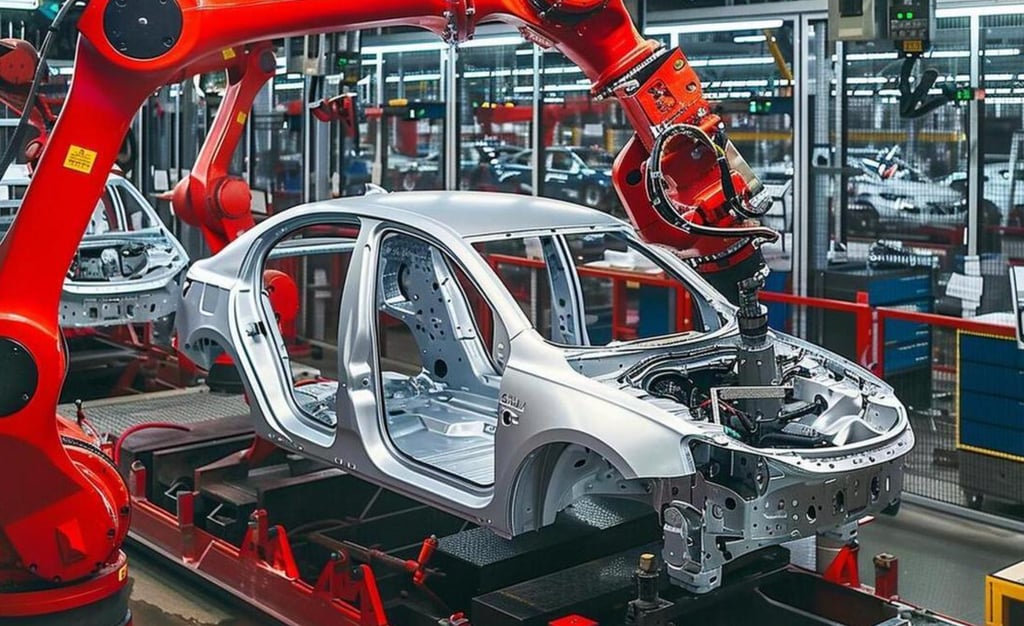
The automotive industry still buys more industrial robots than any other sector on the planet. Something like forty percent of all new robots shipped each year end up in a car plant or a parts supplier feeding one. The four major robot brands, FANUC, KUKA, ABB, and Yaskawa Motoman, supply the vast majority of those machines. Each one earned its place on the line in a different way. One might dominate the body shop with spot welding. Another might own the paint line. A third might be the default choice for press tending. Understanding which brand does what and which models keep showing up on the used market is the difference between buying a robot that fits your automotive application and one that just carries a familiar logo.
Welding: Where the Big Four Earned Their Place
Spot welding is the heartbeat of any body shop. Thousands of welds join stamped panels into a complete body-in-white, and the robots that do this work carry weld guns that can weigh well over a hundred kilograms. Motoman's SP series handles spot welding with payloads from 80 to 250 kilograms, built specifically for the high-duty, high-speed demands of automotive body assembly. KUKA's KR QUANTEC series is another body shop standard, with one recent order delivering 185 units to a single automaker for spot welding and heavy handling. ABB's IRB 6700 and IRB 6710 cover 150 to 310 kilograms of payload, doubling as spot welders and material handlers, and the OmniCore controller reduces energy consumption by 20 percent compared to previous generations. FANUC's R-2000iD series carries 165 to 210 kilograms with a hollow upper arm that routes cables internally, a design that extends dress pack life in the tight, high-cycle environment of a body shop.
Arc welding handles the lighter, more intricate work. Exhaust systems, suspension subframes, seat frames. Motoman's MA series is purpose-built for arc welding, running on components that demand tighter path accuracy than a spot welder needs. FANUC's Arc Mate series owns a large share of this space. ABB and KUKA both field arc welding packages built around their mid-payload robots. The programming environment and the integration with the power supply often decide which brand an integrator chooses, because the mechanical differences between a well-tuned arc welding robot from any of the Big Four are smaller than the software and service differences.
A newer development is friction stir welding for electric vehicle battery trays and enclosures. KUKA's cell4_FSW system uses a dedicated FSW head on a KR FORTEC robot to join aluminum battery housings with lower heat input and higher joint integrity than traditional fusion welding. This is the kind of application that barely existed a decade ago and is now a growing share of automotive welding.
Painting and Sealing
Painting a car body demands explosion-proof robots with smooth motion and consistent speed. Motoman's HP50 handles coordinated painting in multi-robot cells. FANUC's P-series is a long-reach, explosion-proof line built specifically for paint shops. ABB has deep roots in paint automation and supplies complete paint cells. Sealing robots apply structural adhesives and seam sealers to body panels, a process that depends on precise bead placement and consistent travel speed. KUKA's KR IONTEC series handles both sealing and compact welding applications across the body shop and trim line. The paint shop is one area where robots tend to be maintained meticulously, because downtime costs more per minute here than almost anywhere else in the plant.
Material Handling and Part Transfer
Heavy material handling in automotive covers press-to-press transfer, body-in-white handling between lines, and moving large castings and engine blocks through machining. Motoman's MH165 and MH215 handle body panels and heavy subassemblies throughout the plant. KUKA's KR TITAN ultra carries up to 1,500 kilograms, moving entire vehicle bodies or large dies. ABB's IRB 760PT is built for press shop automation, covering 3.18 meters of vertical reach and running up to 18 cycles per minute, which is about 25 percent faster than comparable solutions according to ABB's published data. FANUC's M-900iA/600 carries 600 kilograms and is common in foundry and powertrain handling where hot, heavy castings are the daily load. Part transfer is not glamorous work, but it is the kind of relentless movement that keeps a just-in-time plant running.
Assembly and Machine Tending
Assembly robots in automotive put together everything from instrument panels to door modules to powertrain components. Motoman's MH6 works with vision systems to guide screws into threaded holes, a task that sounds trivial until you try to do it thousands of times without cross-threading a single fastener. KUKA's KR IONTEC handles automated assembly of drive shafts on electric vehicle motor lines, where the tolerances are tight and the cycle rates are rising. ABB's IRB 6740, with 150 to 310 kilograms of payload, handles high-precision body marriage and battery pack assembly, where misalignment of a few millimeters can ripple through the entire vehicle. Yaskawa's GP10, a compact 10-kilogram robot with 1,101 millimeters of reach, covers light assembly and machine tending in powertrain machining cells.
Cutting and Material Removal
Not every robot in a car plant welds or paints. Some cut, trim, and deburr. Motoman's HP20D and MA2010 run waterjet and plasma cutting on formed panels, removing trim waste and cutting apertures in hot-stamped parts where a mechanical trim die would wear out quickly. FANUC's R-2000iD performs routing, drilling, and deburring on automotive composites and aluminum body panels. KUKA's KR 120 R2700-2 is a multi-purpose arm rated for spot welding, handling, and cutting, which makes it a flexible choice for tier-one suppliers who run mixed production. ABB's IRB 6760 is optimized for press tending and material removal, with a compact wrist that reaches into tight die spaces.
EV and Battery Manufacturing: The New Frontier
The shift to electric vehicles is adding new robot applications that barely existed ten years ago. Battery tray assembly requires dozens of joints that must be sealed against water and dust for the life of the vehicle. Friction stir welding, covered earlier, is one solution. Structural adhesive application and foam sealing are others, and KUKA has deployed robots on these applications at major EV programs. ABB's IRB 6710 and IRB 6740 handle battery module picking and placement, where the parts are heavy, the tolerances are tight, and the cycle rate has to keep up with a fast-moving assembly line. FANUC and Yaskawa have both fielded high-payload robots for battery pack handling and motor assembly. The broader trend for used equipment buyers is that as automakers retool existing plants for EV production, conventional engine and transmission machining robots are being retired in large numbers. Those machines still have years of service life left for general manufacturing and tier-one suppliers who do not need EV-specific features. The used market is absorbing that wave of equipment right now.
What to Know When Buying a Used Automotive Robot
A used robot from an automotive plant comes with a specific history, and that history tells you where to look for wear. Robots from body shops have absorbed millions of high-force spot-weld cycles. The wrist axes take the brunt of that, so backlash measurements on A4, A5, and A6 are essential for any spot welding robot, regardless of brand. Robots from paint shops tend to be in the best mechanical condition but are less common on the used market. Robots from press lines and assembly run high cycles at moderate loads, falling somewhere between the two extremes. Across all applications, check the controller battery condition. An R-30iB, KRC4, IRC5, or YRC1000 with a dead battery means lost mastering data and extra commissioning time. Verify that software options for welding, sealing, or vision are installed, licensed, and transferable, because automotive-spec robots often carry specialized software that the next owner will want to use. Ask for a loaded test report. A robot that spent its life in automotive production should come with documentation showing it was tested under conditions that reflect real work, not just powered on and jogged.
This article was prepared by Tyche Robotic, a supplier of refurbished six-axis industrial robots serving integrators and resellers in Latin America, Southeast Asia, and Europe.
Contact Us
As a professional supplier of used industrial robots, Jiangmen Tyche Robotic Co., Ltd. is committed to providing customers with integrated solutions—from hardware selection and configuration to software programming, debugging, and after‑sales maintenance.
© 2025. All rights reserved.

Mr. Victor Ismael