MIG vs. TIG Welding Robots: Two Processes, Two Different Tools
A practical comparison of MIG and TIG welding robots. Covers how each process works, what materials they weld best, speed vs. quality trade‑offs, and what to check when buying a used welding robot.
Tyche Robotic
5/11/20264 min read
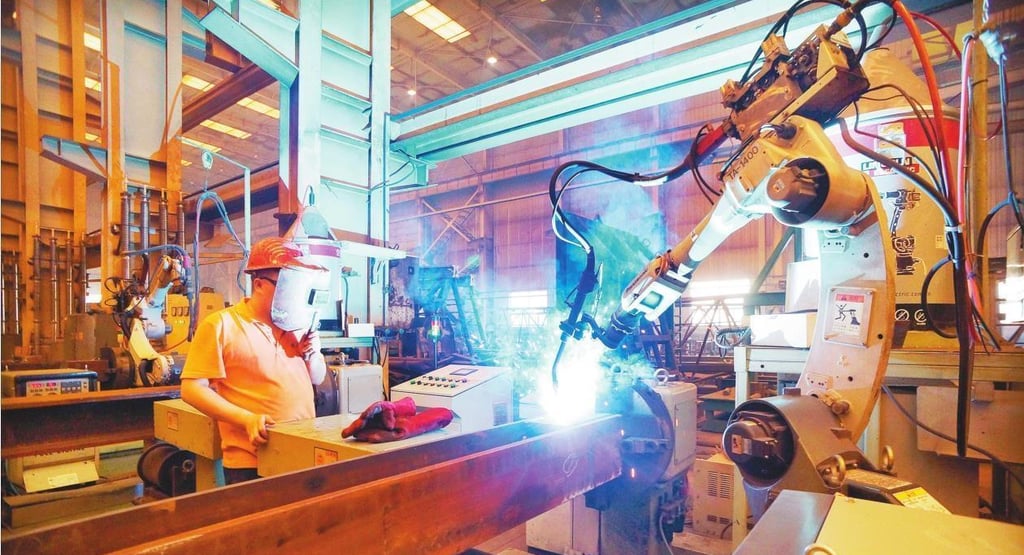
Walk through any factory that welds with robots and you will see two very different processes at work. One throws sparks and filler metal at high speed, laying down weld after weld on steel frames and heavy brackets. The other is quieter, slower, and precise enough to fuse thin-walled tubes for medical devices. The first is MIG welding. The second is TIG. Together, these two processes account for roughly three quarters of all robotic arc welding done globally. The global market for arc welding robots sat at just over four billion dollars in 2024, and it keeps growing because manufacturers have learned what each process does well and where it belongs. Understanding that distinction is what turns a generic welding robot purchase into a machine that actually fits the work.
How the Two Processes Actually Work
MIG welding feeds a continuous wire electrode through the torch. The wire melts in the arc and becomes the filler metal that joins the parts. A shielding gas flows around the arc to keep contaminants out. The whole thing happens fast, with high deposition rates and minimal stops to change consumables. TIG welding uses a non-consumable tungsten electrode. The arc forms between the tungsten and the workpiece. If filler metal is needed, the operator or the robot feeds a separate rod into the weld pool. The heat is precise and controllable. The arc is clean. The result is a weld with minimal spatter and excellent cosmetic appearance. These two approaches are not competitors. They solve different problems. MIG wins when the goal is to put down a lot of metal quickly. TIG wins when the weld itself is the product.
What Each Process Welds Best
MIG welding dominates structural steel, automotive frames, heavy equipment, and anything made of carbon steel, stainless steel, or aluminum in thicker sections. If the part is measured in meters and the tolerance is measured in millimeters, MIG is usually the call. TIG welding owns thin-walled stainless steel, aluminum, titanium, and exotic alloys. It is the go-to for aerospace components, medical instruments, food processing equipment, and any application where the weld bead has to be as clean and precise as the surrounding material. A MIG robot can weld a truck chassis. A TIG robot can weld a pacemaker housing. The difference is not just the material. It is the consequence of getting it wrong.
Speed, Quality, and the Trade-offs That Matter
MIG is fast. Deposition rates run high, and the robot can keep moving without pausing to change electrodes or trim tungsten. For high-volume production where cycle time drives cost, MIG is hard to beat. TIG is slow by comparison. The travel speed is lower, and the process demands tighter control of arc length and heat input. But what TIG gives up in speed it returns in quality. The welds are cleaner, stronger at the joint, and require less post-weld grinding or finishing. From a cost standpoint, MIG consumables are cheaper and the equipment is simpler. TIG consumables cost more, and the process demands a more rigid robot with better path accuracy. The return on that investment shows up in reduced rework and higher part quality. For high-value components, the math favors TIG even though the cycle is slower.
What All This Means for the Robot You Buy
The welding process dictates the robot. A MIG application needs a robot with enough reach to cover the part, enough payload to carry the torch and cable assembly, and a controller that integrates smoothly with the power supply. FANUC's Arc Mate 120iC handles payloads from 3 to 20 kilograms with reaches up to around 2.2 meters, making it a solid MIG platform for everything from small brackets to large structural weldments. KUKA's KR 16 arc HW carries 16 kilograms and is built specifically for arc welding, with a hollow wrist that routes the welding cable through the arm rather than dangling it outside. For TIG, precision is the priority. The robot needs smooth motion at low speed, tight path accuracy, and a wrist that can hold the torch steady through complex curves. ABB's IRB 1520ID carries 4 kilograms and reaches about 1.5 meters, with an integrated dress package that protects the gas lines and cables. Yaskawa's Motoman MA1400 is another frequent choice for TIG cells, valued for its repeatability on thin-gauge stainless parts. The robot you buy for MIG looks different from the robot you buy for TIG because the two processes ask for fundamentally different things from the arm.
Buying a Used MIG or TIG Welding Robot
The used market reflects production reality. MIG robots are everywhere. Automotive component lines, steel fabricators, and heavy equipment manufacturers retire MIG cells regularly, so supply is deep and pricing is transparent. Finding a used MIG welding robot in good condition is mostly a matter of filtering for the right reach and payload. TIG robots are scarcer. They tend to come from aerospace, medical device, and high-end stainless fabrication, industries that run equipment longer and retire it less often. When a used TIG robot does show up, it usually carries a higher price and deserves a closer inspection. The wrist axes on a TIG robot have to be tight. Any backlash in the final axes translates directly into arc wander and inconsistent weld quality. For MIG robots, pay attention to the wire feeder condition, torch cable wear, and whether the welding software is installed and licensed. For TIG, check the tungsten electrode holder, the gas line seals, and the controller's ability to manage precise heat input. For both, insist on inspection data from a supplier who has run the robot under load and can provide the test results.
This guide was prepared by Tyche Robotic, a supplier of refurbished six-axis industrial robots serving integrators and resellers in Latin America, Southeast Asia, and Europe.

Contact Us
As a professional supplier of used industrial robots, Jiangmen Tyche Robotic Co., Ltd. is committed to providing customers with integrated solutions—from hardware selection and configuration to software programming, debugging, and after‑sales maintenance.
© 2025. All rights reserved.

Mr. Victor Ismael