How Robots Are Used in Food Production: Key Models from FANUC, KUKA, ABB, and Yaskawa
A practical overview of industrial robots in the food industry. Covers food-grade design standards, packaging and processing applications, key models from the major brands, and what to check when buying a used food robot.
Tyche Robotic
5/14/20265 min read
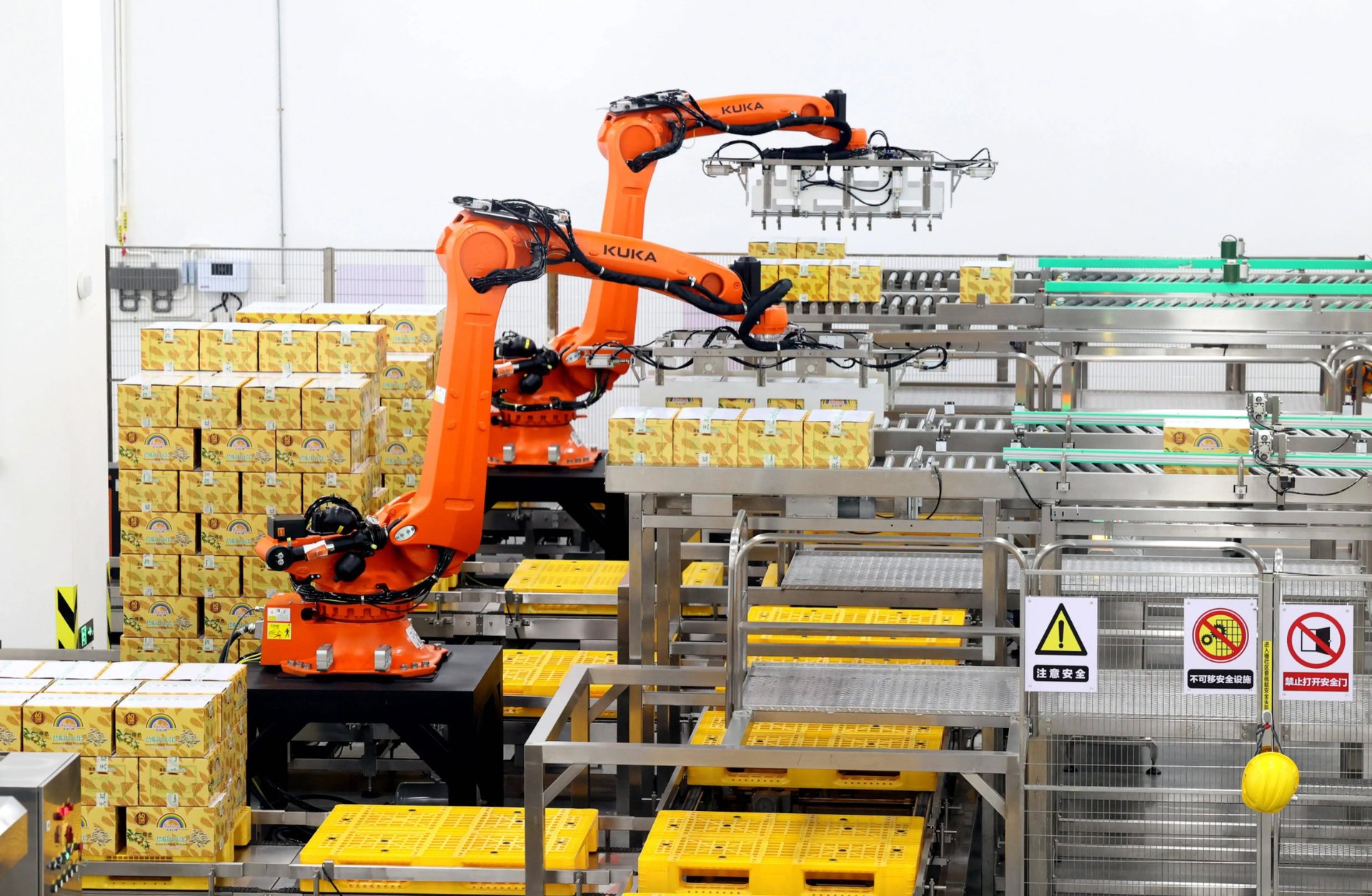
Walk through a modern food plant and you will see robots doing jobs that would have been unthinkable a generation ago. They pack cookies at speeds no human hand can match. They stack heavy pallets of bottled drinks in cold storage. They handle raw meat and fresh produce under conditions that would make a factory floor miserable for people. The global market for food robotics sat at roughly three point seven billion dollars in 2024 and is projected to climb past eleven billion by 2032. That growth is not just about replacing labor. It is about meeting food safety standards that get stricter every year, managing production volumes that keep rising, and handling products in environments where a simple bacterial contamination can shut down a line. The four major robot brands have each developed dedicated food-grade solutions, and understanding what sets them apart helps food manufacturers pick the right machine for a facility where the rules are different from any other industry.
Why Food Production Needs a Different Kind of Robot
A standard industrial robot will not survive long in a food plant. Three things make this environment uniquely demanding. The first is hygiene design. Food-grade robots need smooth, crevice-free surfaces that do not trap food particles or bacteria. Stainless steel exteriors, food-grade NSF-H1 lubricants, and sealed joints are not optional extras. They are the minimum standard. The second is washdown capability. Many food facilities are cleaned with high-pressure hot water and aggressive chemicals every day. A robot that cannot handle that will be dead within weeks. IP67 protects against immersion. IP69K protects against steam jet cleaning at one hundred bar of pressure and eighty degrees Celsius, and it is increasingly the benchmark for protein and dairy processing. The third is certification. USDA acceptance, EHEDG Guideline 62 compliance, and 3-A Standard 103-00 are the documents that tell a food safety auditor that the machine was designed for contact with food. Without them, a robot may function perfectly well but will never be allowed near an exposed product zone.
Food Packaging: Primary, Secondary, and Tertiary
Primary packaging puts the product into its first container. Robots pick wrapped bars, bagged snacks, or filled pouches and place them directly into cartons or trays. Speed is the currency here. Delta and SCARA robots dominate because they move a few hundred grams several times a second with repeatability that keeps the line flowing. ABB's IRB 360 FlexPicker is the reference point for high-speed picking, with a stainless-steel variant that meets IP69K washdown standards. KUKA's KR 3 D1200 HM is a stainless Delta with FDA-certified materials and an IP67 rating, built for direct food contact. FANUC's LR Mate 10-11A Food/Clean handles slightly heavier primary packaging tasks at ten kilograms of payload with IP67 protection and NSF-H1 grease. Yaskawa's Motoman HD7, launched in 2024, targets hygienic primary packaging environments with EHEDG compliance and IP69 protection built in from the start.
Secondary packaging groups primary packs into larger boxes, wraps them, and prepares them for distribution. The payloads are heavier, the speeds are slightly lower, and the robots are bigger. FANUC's M-20iA runs case packing and tray loading with twenty kilograms of payload and a reach of over eighteen hundred millimeters. KUKA's KR 10 R1100-2 HO meets EHEDG and 3-A standards for moderate-payload secondary packaging with food-grade grease on every axis. ABB's IRB 460 is a dedicated palletizing and case packing robot that runs up to two thousand cycles per hour. Yaskawa's Motoman MPL series handles secondary packaging for baked goods and snacks, with payloads that cover the transition from carton loading to case packing.
Tertiary packaging is palletizing, and the requirements here are similar to any other industry except that many food plants run their palletizing operations in cold rooms. ABB's IRB 6700 handles heavy pallets of bottled beverages in refrigerated warehouses. KUKA's KR QUANTEC PA is an Arctic variant rated for continuous operation at minus thirty degrees Celsius, built for frozen food palletizing. FANUC's M-410iC series offers payloads up to seven hundred kilograms for heavy palletizing at the end of high-speed beverage and snack lines.
Food Processing: From Raw Ingredients to Finished Products
Robots that handle unpackaged food enter a regulatory environment that packaging robots mostly avoid. USDA acceptance is the price of entry for meat, poultry, and dairy processing. FANUC's M-430iA was the first robot to earn USDA equipment acceptance for meat and poultry processing, running up to one hundred twenty picks per minute on high-speed sorting lines. Soft grippers and vacuum end-effectors handle delicate products like fresh fruit, raw fish fillets, and unbaked dough without damage. Vision-guided robots inspect, orient, and portion products before they reach the cooking or freezing stage. Ultrasonic cutting robots portion cakes, breads, and cheeses with clean edges and minimal debris. KUKA's KR 3 D1200 HM handles direct food contact processing tasks with its FDA-certified materials and IP67 rating. Yaskawa's Motoman HD8 extends the HD series into heavier processing applications with eight kilograms of payload and the same EHEDG and IP69 certifications. ABB's IRB 360 FlexPicker in its stainless-steel variant runs high-speed sorting of raw products under washdown conditions.
Palletizing and End-of-Line Automation
Palletizing in a food plant is not the same as palletizing in a general warehouse. Cold storage means the robot has to start up and run reliably at temperatures where standard grease thickens and standard electronics fog. Multi-SKU palletizing, where a single pallet carries several different products in a mixed stack, demands software that can calculate stable pallet patterns on the fly. KUKA's KR QUANTEC PA Arctic is purpose-built for this, running at minus thirty degrees without a heated enclosure. ABB's IRB 660 handles high-speed case palletizing at up to two thousand cycles per hour with payloads of one hundred eighty kilograms. FANUC's M-410iC series provides the heavy end of palletizing for full pallets of bagged flour, sugar, or bulk ingredients. Yaskawa's Motoman MPL series rounds out the end-of-line options for mid-weight palletizing.
What to Know When Buying a Used Food-Grade Robot
Used food-grade robots come from a different world than used automotive or general fabrication robots. A robot retired from a bakery has spent years in ambient heat and flour dust. A robot from a poultry processing plant has been washed down with hot water and sanitizers every single day. The mechanical wear on a food robot is often lower than on a welding robot, but the environmental toll is different. Check the IP rating certification and confirm it is still valid for your intended use. Inspect every external seal and gasket. Washdown chemicals degrade rubber and silicone over time, and a seal that looks fine on casual inspection may fail under pressure the first time the line gets cleaned. Look at the stainless steel surfaces for pitting or rust spots, especially around bolt heads and connector glands where water tends to pool. Ask for the lubrication records. A robot that was maintained with food-grade NSF-H1 grease throughout its life is worth more than one where the grease type is unknown, because a single application of the wrong lubricant can compromise the entire machine for food contact use. Verify that the controller has not been damaged by moisture. Open the cabinet and check for corrosion on connectors and circuit boards. A food robot that was stored improperly after decommissioning can have hidden damage that only shows up when you try to power it on. The documentation matters more in food than in almost any other industry. If the certification paperwork is missing, the robot is just a piece of stainless steel machinery with an uncertain past.
This article was prepared by Tyche Robotic, a supplier of refurbished six-axis industrial robots serving integrators and resellers in Latin America, Southeast Asia, and Europe.

Contact Us
As a professional supplier of used industrial robots, Jiangmen Tyche Robotic Co., Ltd. is committed to providing customers with integrated solutions—from hardware selection and configuration to software programming, debugging, and after‑sales maintenance.
© 2025. All rights reserved.

Mr. Victor Ismael