How Industrial Robots Reduce Cycle Times: Key Factors and Real-World Numbers
A practical look at how industrial robots reduce cycle times through speed, precision, continuous operation, offline programming, and quick changeovers. Covers Big Four optimization tech and why used robots deliver the same gains faster.
Tyche Robotic
6/11/20265 min read
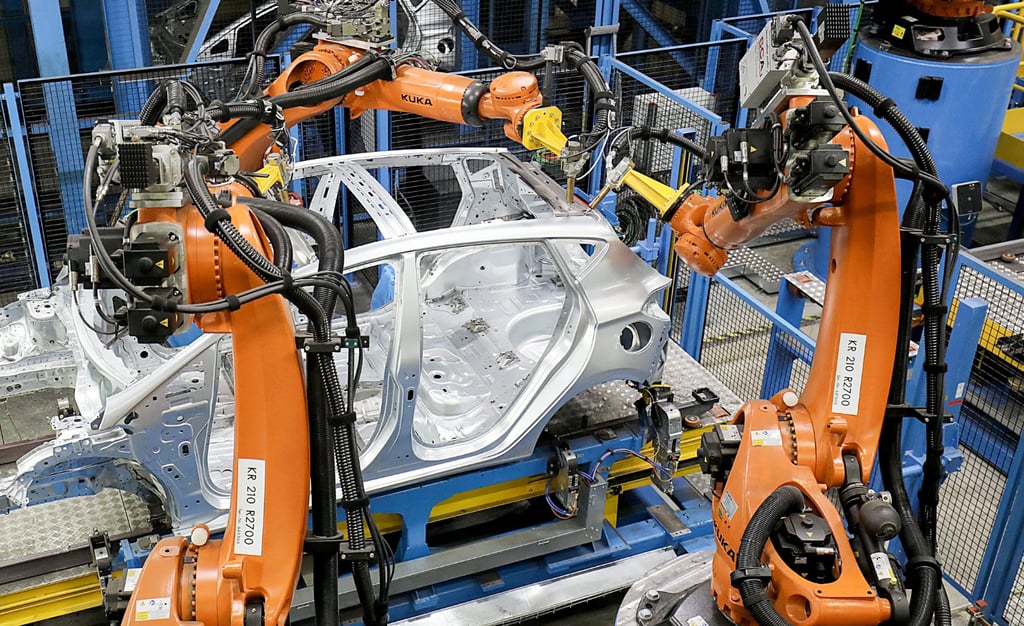
Cycle time is the number that separates a profitable production line from one that barely covers its costs. Shave a few seconds off every part, and over a year those seconds turn into thousands of extra units without adding a single shift or a single square foot of floor space. Industrial robots have been compressing cycle times for decades, and the reasons go beyond the obvious one of moving faster than a person. A robot does not slow down at hour seven. It does not pause to check a measurement because it already knows the measurement is right. It does not wait for a forklift or a shift change. The cumulative effect of all those small eliminations of wasted time is what turns a robotic cell into a machine that pays for itself in months instead of years. And for buyers who want that payback to come even faster, the used robot market offers the same cycle time performance at a fraction of the upfront cost.
Faster Speeds and Consistent Cycle Times
A robot moves faster than a person, but the real advantage is not peak speed. It is consistency. A manual welder might run a bead at a certain travel speed for the first hour of the shift, but that speed drifts as fatigue sets in. By the end of a ten-hour day, the same weld takes longer, and the quality shows the strain. A robot runs the same travel speed on the last part of the night as it did on the first part of the morning. Every cycle is the same duration. Every part takes the same number of seconds. The arc-on time in a robotic welding cell runs above ninety percent. A manual welder manages about thirty percent. The rest of the time goes to setup, repositioning, and the small pauses that happen when a person works. A palletizing robot can stack over a thousand cycles per hour. A manual operator stacking the same bags might manage four to six hundred. Those extra cycles are not from moving faster. They are from never stopping.
Higher Precision Means Less Rework Time
Rework is a cycle time killer that does not show up on the spec sheet. A part that comes out wrong has to be reworked or scrapped, and the time spent making it was wasted. Worse, the rework takes up machine time that could have been spent making good parts. Robots reduce rework by making the output predictable. A weld bead that is the same width, penetration, and appearance every time eliminates the variation that causes rejects. A dispensing robot applies exactly the programmed amount of adhesive, with no extra bead for safety and no skips that need touch-up. An assembly robot places parts with the same force and orientation every cycle. The time saved is not just the rework itself. It is the inspection time, the handling time, and the disruption to the production schedule that every rejected part creates. A robot vs manual cycle time comparison is not complete until it accounts for the time wasted on parts that cannot be shipped.
Continuous Operation: No Breaks, No Shift Changes
A robot does not take a lunch break, does not swap out at shift change, and does not call in sick. A robotic cell can run through the gaps in the schedule that manual stations lose every day. Over a twenty-four-hour period, a manual cell running three shifts might be actively producing for eighteen to twenty hours when breaks, shift changes, and slowdowns are factored in. A robotic cell can run for twenty-two to twenty-three hours, stopping only for scheduled maintenance. Those extra hours are not a small advantage. They are the difference between needing one cell and needing two. The continuous operation robot benefits compound over the life of the machine. A robot that runs an extra three hours a day produces over a thousand extra hours of production per year. That is capacity that does not require hiring, training, or adding floor space.
Offline Programming and Faster Changeovers
Cycle time is not just about how fast the robot moves while it works. It is also about how fast it can switch from not working to working. Traditional robot programming required the robot to be taken offline, taught point by point, and tested. That process could take days. Offline programming has changed that. The entire cell can be programmed and simulated on a computer while the robot keeps running production. When the new program is ready, it is uploaded, tested, and running in hours instead of days. Tool changers compress the changeover further. A robot that switches from a gripper to a weld gun to a deburring tool does it in seconds, not the minutes or hours it would take to manually swap end effectors. For high-mix shops that run multiple part numbers per shift, the cumulative time saved by fast changeovers can exceed the time saved by fast cycle times.
How the Big Four Optimize Cycle Times
Each of the major robot brands has its own approach to squeezing seconds out of a cycle. FANUC's R-30iB controller runs motion control algorithms that optimize acceleration and deceleration, reducing the time the robot spends getting from one point to the next without sacrificing path accuracy. ABB's TrueMove keeps the programmed path accurate at any speed, while QuickMove specifically targets cycle time reduction by managing the robot's acceleration profile so it spends less time slowing down and speeding up. KUKA's KRC4 and KRC5 controllers handle motion optimization through an open architecture that lets integrators fine-tune trajectories for specific applications. Yaskawa's YRC1000 takes a different route, using native multi-axis synchronization to coordinate the robot and positioner so the weld torch stays on the joint while the part rotates, eliminating the stop-and-reposition time that eats up cycles in a poorly coordinated cell. Each approach has the same goal: less time between the start of one part and the start of the next.
The Used Robot Factor: Same Cycle Time Savings, Faster Payback
A used robot does not run slower than a new one. A properly refurbished FANUC, ABB, KUKA, or Yaskawa robot delivers the same cycle time performance as a machine fresh off the factory floor. The difference is the price. Buying a used robot for faster cycle times cuts the upfront investment by forty to sixty percent, which means the payback period shrinks from eighteen to twenty-four months down to under a year in many applications. The refurbished robot productivity advantage is not about the robot working harder. It is about the investment paying off sooner. For a manufacturer who needs to increase throughput now but cannot justify new equipment prices, a used robot with a loaded test report is the fastest path from a bottleneck to a balanced line.
This article was prepared by Tyche Robotic, a supplier of refurbished six-axis industrial robots serving integrators and resellers in Latin America, Southeast Asia, and Europe.

Contact Us
As a professional supplier of used industrial robots, Jiangmen Tyche Robotic Co., Ltd. is committed to providing customers with integrated solutions—from hardware selection and configuration to software programming, debugging, and after‑sales maintenance.
© 2025. All rights reserved.

Mr. Victor Ismael