How Industrial Robots Improve Worker Safety: What First-Time Buyers Need to Know
A practical look at how industrial robots improve worker safety, covering common injury reduction, ISO 10218 safety standards, modern safety features, role transformation, hidden costs of unsafe workplaces, and the used robot advantage.
Tyche Robotic
6/5/20264 min read
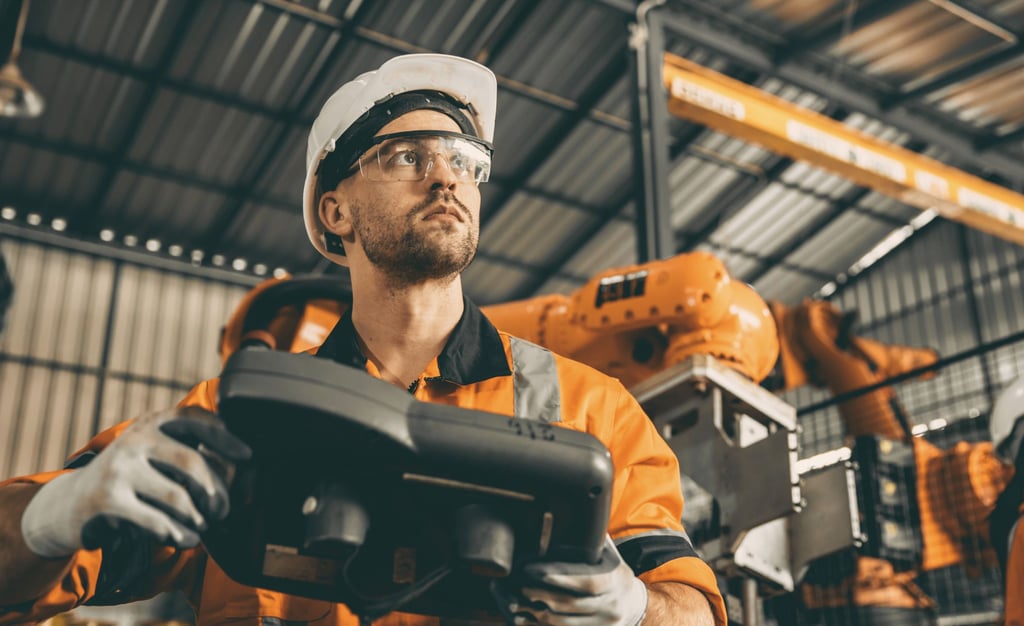
Manufacturing has come a long way from the days when a factory job automatically meant a bad back, burned hands, or lungs full of fumes. But even today, some of the most common tasks on a shop floor are the ones that hurt people the most. Lifting heavy parts. Repeating the same motion thousands of times a shift. Working next to a welding arc or inside a spray booth. These are not accidents waiting to happen. They are predictable outcomes of asking human bodies to do things human bodies were not built to do all day. Industrial robots change that equation. They take the most dangerous tasks off the floor and put them behind a fence, where a machine that does not get tired, does not get careless, and does not get injured handles the work instead.
Taking Humans Out of Harm's Way
The most direct way a robot improves safety is by removing the person from the hazard. Welding is the clearest example. A manual welder spends hours every day with their face inches from an electric arc, breathing fumes and risking burns from spatter. A robotic welding cell puts a fence between the welder and the arc. The welder becomes an operator who loads parts, programs the robot, and monitors the process from outside the cell. The same logic applies to machine tending, where a robot loads and unloads a CNC mill or an injection molder instead of a person reaching into a machine that could start moving at any moment. It applies to palletizing, where a robot stacks bags and cases instead of a worker lifting and twisting for ten hours. In every case, the hazard is still there. The person is not.
Reducing the Most Common Workplace Injuries
The injuries that robots prevent are not the dramatic ones that make headlines. They are the slow, cumulative ones that fill workers' compensation claims and drive people out of the trades. Repetitive strain injuries from performing the same motion thousands of times. Back injuries from lifting parts that weigh more than a person should lift alone. Respiratory problems from inhaling fumes, dust, and chemical vapors day after day. Eye damage from arc flash. Burns from hot parts and spatter. These are exactly the hazards that robotic automation removes. A robot does not develop carpal tunnel from cycling a gripper. It does not throw out its back palletizing. It does not inhale. The injury categories that dominate manufacturing, musculoskeletal disorders, overexertion, contact with objects and equipment, are the same categories that robots are best at eliminating. Facilities that automate report fewer recordable injuries, lower workers' compensation premiums, and less time lost to injury-related absenteeism.
Safety Standards and Modern Safety Features
The safety of a robotic cell is not an opinion. It is governed by international standards that spell out exactly what is required. ISO 10218 covers the safety requirements for industrial robots themselves. ISO/TS 15066 addresses collaborative robot safety. ANSI/RIA R15.06 is the American national standard for robot safety. These standards define everything from the stopping distance calculation to the required safety interlocks. The robot brands have built safety features that go beyond the standards. ABB's SafeMove2 lets the robot run at reduced speed when a person is nearby and stop instantly if someone steps into a monitored zone. It also provides safe position and orientation monitoring. FANUC's DCS, Dual Check Safety, runs a redundant safety check on every axis and stops the robot the moment any discrepancy is detected. KUKA's SafeOperation and Yaskawa's functional safety packages provide similar layers of protection. Collision detection systems have been shown to reduce collision-related incidents by roughly seventy percent. These are not optional add-ons on modern robots. They are built into the controller and activated as part of a properly designed safety system.
From Operator to Supervisor: How the Role Changes
When a robot takes over the physical work, the worker does not disappear. The role changes from one of physical labor to one of oversight, programming, and process control. A welder who used to spend the day hunched over a workbench now loads parts, monitors the robot's performance, and adjusts parameters to improve quality. A machine operator who used to stand at a press feeding parts now manages a cell of robots that feed themselves. These new roles are safer because the physical hazard has been removed. They are also higher-skilled, higher-paid, and more sustainable over a career. A person can be a robot programmer for decades. A person can only do heavy manual welding for as long as their body holds out.
The Hidden Cost of Unsafe Workplaces
The cost of an unsafe workplace goes far beyond the workers' compensation claim. High injury rates drive turnover. Every time an experienced worker leaves, the company pays to recruit, hire, and train a replacement, and loses productivity while that replacement gets up to speed. High injury rates drive up insurance premiums across the entire operation. They make it harder to recruit because word gets around about which shops are dangerous and which are not. They erode morale and create a culture where people feel disposable. These costs are harder to measure than a direct injury claim, but they are larger and they compound over time. A safer workplace is not just a compliance requirement. It is a competitive advantage in hiring, retention, and operational stability. Robots contribute to that advantage by systematically removing the hazards that cause the injuries that drive all those downstream costs.
The Used Robot Factor: Safety Without the Full Price Tag
The safety benefits of a robot do not depend on whether it was purchased new or used. A properly refurbished robot from a major brand provides the same safety capabilities as a new one. It can be integrated into a cell with the same safety fencing, the same light curtains, the same safety PLC, and the same controller-based safety functions. The used robot market makes these safety improvements accessible to manufacturers who could not justify the cost of a new installation. A small fabrication shop that cannot afford a new robotic welding cell can buy a refurbished FANUC Arc Mate or Motoman welder, build the cell, and give its welders the same protection from fumes and arc flash that a large factory provides. The safety improvement is the same. The price is forty to sixty percent lower.
This article was prepared by Tyche Robotic, a supplier of refurbished six-axis industrial robots serving integrators and resellers in Latin America, Southeast Asia, and Europe.
Contact Us
As a professional supplier of used industrial robots, Jiangmen Tyche Robotic Co., Ltd. is committed to providing customers with integrated solutions—from hardware selection and configuration to software programming, debugging, and after‑sales maintenance.
© 2025. All rights reserved.

Mr. Victor Ismael