How Industrial Robots Build Positive Cash Flow
Learn how industrial robots improve cash flow by reducing labor costs, cutting material waste, lowering operating expenses, and increasing throughput. Includes used robot payback strategies.
Tyche Robotic
4/24/20264 min read
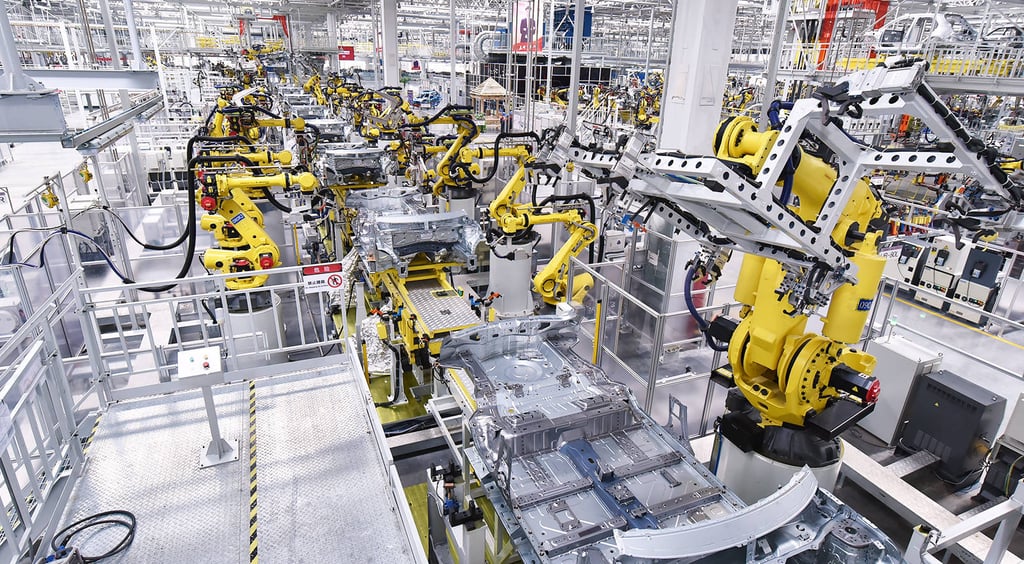
Ask any manufacturer what keeps them up at night, and cash flow usually makes the top three. You can have a full order book and still find yourself squeezed between rising labor costs, material waste, and the bills that never stop coming. Profit isn't just about what you sell. It's about what you keep. Industrial robots have been quietly improving that equation for decades, and not just in the ways most people assume. Yes, they reduce direct labor. But the real cash flow story runs deeper than headcount. It touches material costs, utility bills, throughput consistency, and the speed at which the equipment pays for itself. For plant owners watching their margins, understanding these levers is the difference between hoping for better numbers and actually seeing them.
Lower Labor Costs Without the Turnover Headache
The most obvious place robots help the cash flow statement is labor. A robot running a palletizing station doesn't call in sick, doesn't file a workers' comp claim after lifting boxes for ten years, and doesn't leave for a higher-paying job down the street. But the impact goes beyond the base wage. For every direct operator, there are indirect costs rolling underneath. Recruiting, training, overtime coverage, and the productivity dip while a new hire gets up to speed. Robots strip a big chunk of that out. A six-axis industrial robot handling heavy castings or loading CNC machines can do the work that might take two or three people across multiple shifts. The wages you're not spending go straight to the bottom line. And because robots don't quit, you stop burning money on the churn that makes manufacturing human resources departments groan.
Predictable Material Costs, Less Scrap
Here's a cash flow drain that doesn't get enough attention. Material waste. When a human welder lays down a inconsistent bead, you're throwing away filler metal and possibly the part. When an operator over-dispenses sealant or adhesive, the excess goes in the trash. These small losses accumulate into real money over months and years. Robots bring predictability. A robot welding cell runs the same bead profile every cycle. A robot dispensing adhesive applies the exact bead diameter and length, every time. The result is scrap rates that drop and material costs that stop surprising the accounting department. For manufacturers running thin margins on high-volume lines, this predictability alone can justify the investment. When you know to the penny what your material consumption will be, cash flow forecasting stops being guesswork.
Lower Operating Costs Beyond the Payroll
Talk to anyone who has run a factory floor, and they will tell you: it's not just the people who cost money. It's the building. Heating, cooling, lighting. Those costs run twenty-four hours a day even if production doesn't. Traditional industrial robots don't need the lights on. They run just fine in the dark, which means you can dial back climate control and lighting in automated cells during off hours. Modern robot controllers have also become more energy efficient, with regenerative braking systems that feed power back instead of wasting it as heat. None of these savings are dramatic on their own. But stacked together across multiple cells and multiple years, they show up in the bank account.
Higher Throughput Without Hiring
A robot doesn't slow down at hour seven. It doesn't have a bad Monday. The cycle time you program is the cycle time you get, from the first part of the morning to the last part of the night. That consistency unlocks throughput that manual stations struggle to match. More parts per shift means the fixed costs of the building, the equipment, and the overhead get spread across more units. The cost per part drops. That's where the cash flow leverage really kicks in. You're not just spending less. You're making more with the same footprint. And you're not chasing the labor market trying to find people willing to do repetitive heavy work. For a mid-sized manufacturer running near capacity, adding a robot cell can be the difference between turning away orders and booking more revenue.
Faster Payback with Used Equipment
One of the quiet shifts in industrial automation over the last decade is the maturity of the used robot market. A new six-axis robot is a capital commitment that can take eighteen to thirty-six months to pay back. The same model, properly refurbished, can pay for itself in half that time because the upfront cost is forty to sixty percent lower. That's not a compromise. It's a capital allocation decision. A well-maintained used robot from a major brand—KUKA, ABB, FANUC, or Yaskawa—delivers the same payload, the same reach, and the same repeatability as a new unit for applications like welding, palletizing, and material handling. The parts are available. The service knowledge is widespread. And the shorter payback window means the positive cash flow starts months earlier. For manufacturers who want the financial benefits of automation without the long wait, used equipment is often the straightest line between a cost center and a profit center.
The Bottom Line
Cash flow doesn't improve by accident. It improves when you lower the costs you can control and raise the output you can count on. Industrial robots do both. They shrink labor and material costs. They keep running when people go home. And when you look beyond new equipment prices, the path to positive cash flow gets a lot shorter. The manufacturers who figure this out early are the ones who stop sweating every payroll cycle and start investing in the next opportunity. Tyche Robotic and other suppliers who focus on proven equipment understand that the financial case has to work first. If the numbers don't add up, nothing else matters. When they do, the factory floor starts to look like an asset instead of a cost.
This guide was prepared by Tyche Robotic, a supplier of refurbished six-axis industrial robots serving integrators and resellers in Latin America, Southeast Asia, and Europe.
Contact Us
As a professional supplier of used industrial robots, Jiangmen Tyche Robotic Co., Ltd. is committed to providing customers with integrated solutions—from hardware selection and configuration to software programming, debugging, and after‑sales maintenance.
© 2025. All rights reserved.

Mr. Victor Ismael