How FANUC Robots Are Used in Medical and Pharmaceutical Manufacturing
A practical overview of FANUC robots in medical and pharmaceutical production. Covers cleanroom models, assembly, dispensing and inspection applications, and what to check when buying a used medical robot.
Tyche Robotic
5/13/20264 min read
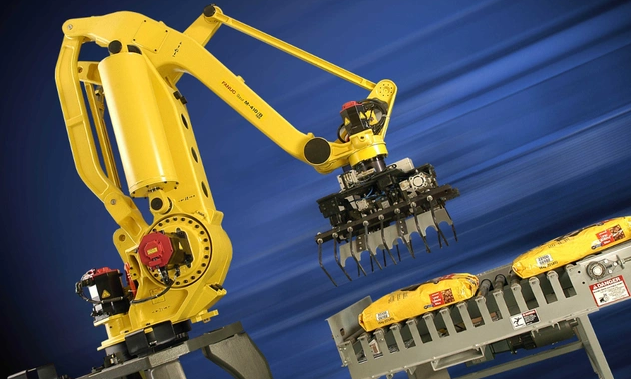
When people picture industrial robots, they usually think of automotive welding lines. Sparks, heavy steel, and machines that look like they belong in a foundry. That image does not fit the medical and pharmaceutical industries at all. A factory making surgical instruments, implantable devices, or sterile pharmaceutical packaging runs on a different set of rules. Cleanliness is non-negotiable. Consistency has to be documented. And the parts are often small enough to hold between two fingers. FANUC has a dedicated range of robots built specifically for these environments, and they show up in more medical manufacturing facilities than most people realize.
Why Medical Manufacturing Asks for a Different Kind of Robot
Medical and pharmaceutical production puts demands on automation that heavy industry never thinks about. First, the environment has to stay clean. A robot that sheds lubricant or generates particulates is a robot that can spoil a batch of injectable drugs or contaminate a sterile device tray. FANUC builds robots with sealed joints, food-grade and low-particle lubricants, and special coatings that meet ISO cleanroom classifications. Second, the work demands proof, not just performance. Medical manufacturers operate under regulations that require traceability. A robot inserting a needle into a syringe barrel needs to demonstrate that it applied the correct force, at the correct angle, on every single unit. Third, the parts are small and the margins for error are smaller. Repeatability measured in hundredths of a millimeter is standard, not optional. A misplaced component in a medical device is not just a reject. It is a liability.
Cleanroom Robots: Built for Environments Where Particles Matter
FANUC's cleanroom robot lineup covers the full range of medical and pharmaceutical applications, from handling tiny vials to palletizing sealed cases. The LR Mate 200iD/7LC is the workhorse for small-part handling in the tightest spaces. It carries seven kilograms over 717 millimeters of reach with an ISO Class 4 rating, meaning it can operate directly in sterile filling suites and device assembly lines without compromising the environment. For applications that demand slightly more reach and payload while keeping the same cleanroom standard, the LR Mate 10-11A Food/Clean steps up to 10 kilograms of payload at 1,101 millimeters of reach, also at ISO Class 4. On the heavier end, the M-20iB/25C handles 25 kilograms over 1,835 millimeters with an ISO Class 5 rating, built for tasks like moving sealed pharmaceutical cartons or handling heavier medical device subassemblies. The older LR Mate 200ic is still common on the used market and continues to serve reliably in facilities that do not require the latest generation's speed, though buyers should verify its cleanroom certification status and seal condition before purchasing.
What FANUC Robots Do in Medical and Pharmaceutical Plants
Assembly is the most common application. LR Mate series robots insert needles, position catheters, and assemble inhaler mechanisms. Force sensing is built into many of these cells because the robot needs to feel the insertion, not just hit a position. If the resistance is wrong, the cycle stops and the part is flagged. Dispensing comes next. Adhesives, sealants, and medical-grade lubricants are applied by robots like the M-20iA in precise, repeatable patterns. In pharmaceutical packaging, delta robots handle high-speed sorting and bottle orientation, while six-axis robots case-pack finished products and palletize them at the end of the line. Inspection runs alongside all of this. Vision-equipped robots check fill levels, cap placement, and label alignment in real time, documenting each inspection for batch records. Machine tending shows up in medical device machining, where robots load and unload CNC mills producing orthopedic implants and surgical tool components.
Key FANUC Models for Medical Manufacturing
The cleanroom lineup handles the sterile side of the business. The LR Mate 200iD/7LC covers small, fast, precise tasks like syringe assembly and vial handling at ISO Class 4. The LR Mate 10-11A Food/Clean takes on similar work with more reach and payload at the same cleanliness level. For heavier cleanroom applications, the M-20iB/25C moves large sealed containers and heavy device subassemblies at ISO Class 5. Outside the cleanroom, precision general-purpose robots handle tasks that still demand high accuracy but do not require sterile conditions. The M-10iA and the older M-6iB cover small-part precision assembly and machine tending for medical device components with payloads in the six to ten kilogram range and repeatability at or below eight hundredths of a millimeter. The M-20iA rounds out the lineup for dispensing and mid-weight handling, offering the flexibility to switch between tools without losing calibration.
What to Know When Buying a Used Medical Robot
A used FANUC robot that come out of a medical or pharmaceutical facility carries a unique history. Cleanroom robots from these environments typically have low mechanical wear. They have not been swinging heavy payloads or running three shifts of spot welding. What ages in a cleanroom robot is not the gears but the seals, gaskets, and lubricants. A fifteen-year-old robot that spent its life in a sterile suite may have perfect backlash readings but need every external seal inspected before it can hold a cleanroom classification again. The other consideration is documentation. Medical manufacturers operate under traceability standards like 21 CFR Part 11, which means the robot may still hold calibration records and production logs. If those files are available and transferable, they add real value. If the controller memory has been wiped, you lose that history. Ask about the application the robot performed. A robot that handled sealed packaging at the end of a line is a very different machine from one that inserted components into implantable devices. The closer the robot worked to the patient, the more documentation you should expect from the seller, and the more carefully you should verify the robot's condition before putting it into production.
This article was prepared by Tyche Robotic, a supplier of refurbished six-axis industrial robots serving integrators and resellers in Latin America, Southeast Asia, and Europe.
Contact Us
As a professional supplier of used industrial robots, Jiangmen Tyche Robotic Co., Ltd. is committed to providing customers with integrated solutions—from hardware selection and configuration to software programming, debugging, and after‑sales maintenance.
© 2025. All rights reserved.

Mr. Victor Ismael