How Are FANUC Robots Used in the Electronics Industry?
A practical overview of FANUC robots in electronics manufacturing. Covers cleanroom models, SCARA and delta robots, applications in assembly and inspection, and what to check when buying used electronics robots.
Tyche Robotic
5/12/20264 min read
This article was prepared by Tyche Robotic, a supplier of refurbished six-axis industrial robots serving integrators and resellers in Latin America, Southeast Asia, and Europe.
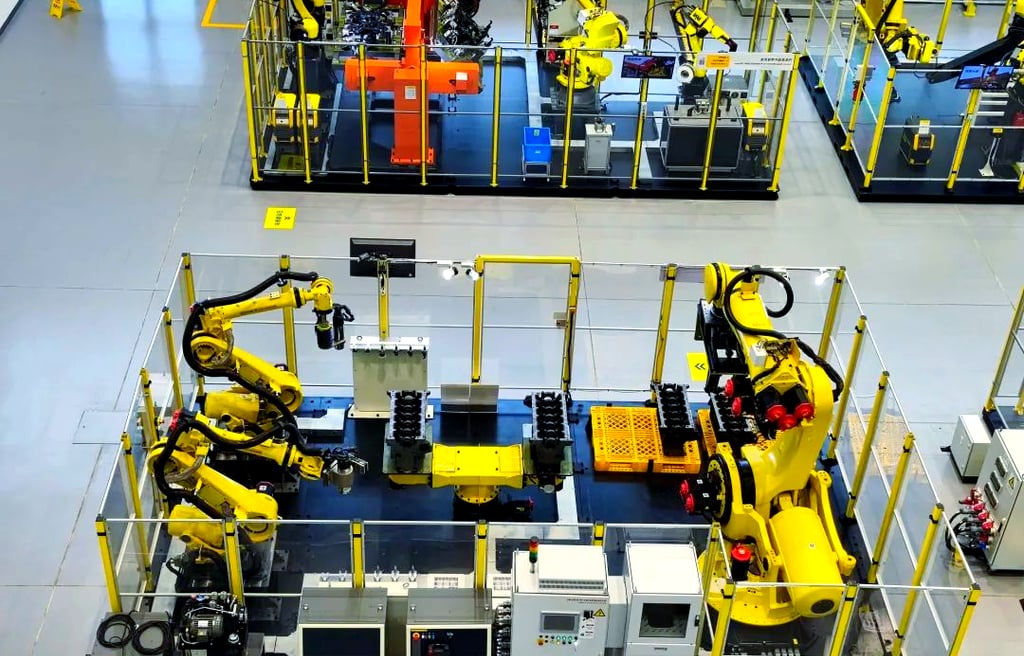
The electronics industry is the second largest user of industrial robots on the planet, behind only automotive. About twenty-seven percent of all new robot installations globally go into factories that make phones, circuit boards, semiconductors, and the countless small components that fill every device we use. FANUC has a strong foothold here, and it is not just because the robots are reliable. Electronics manufacturing asks for things that heavy industry does not. Smaller parts. Tighter tolerances. Cleaner environments. And speeds that have to keep up with production volumes measured in millions of units. A welding robot from a car plant is not going to drop into a circuit board line and work. The requirements are different, the robots are different, and understanding that difference is what separates a machine that fits from one that just takes up floor space.
Why Electronics Manufacturing Demands a Different Kind of Robot
Three factors set electronics robotics apart from the rest of the industrial world. The first is cleanliness. A speck of dust invisible to the eye can ruin a microchip or a display panel during assembly. Robots that work in these environments need sealed joints, low-particle lubricants, and surfaces that do not shed. FANUC builds dedicated cleanroom models with special coatings that meet the standards for semiconductor and flat panel production. The second factor is precision. Parts measured in millimeters instead of meters require robots with repeatability at the hundredth-of-a-millimeter level. This is not a nice-to-have. A misplaced component on a circuit board is scrap. The third factor is speed with small payloads. Heavy industry cares about kilograms. Electronics cares about cycles per minute. A robot that moves a few grams several times a second creates value that a slow, heavy lifter never can.
The Robot Types and Models That Fit Electronics Work
FANUC covers electronics manufacturing with four distinct types of robots, and each one earns its place on the line. Compact six-axis robots like the LR Mate 200iD series handle precision assembly and inspection. These are desktop-scale machines with seven kilograms of payload and over seven hundred millimeters of reach, holding repeatability at around two hundredths of a millimeter. They fit into tight cells where a full-size industrial arm would be overkill. SCARA robots take over when the job is vertical assembly or high-speed pick-and-place on a flat plane. The SR-3iA and SR-6iA models carry three and six kilograms respectively, with reach up to six hundred and fifty millimeters and repeatability at the one-hundredth-of-a-millimeter level. Circuit board stuffing, screw driving, and small-part insertion are SCARA territory. Delta robots like the M-2iA series go even faster for lightweight pick-and-place at high cycles. The M-2iA uses a four-axis hollow wrist design that allows high-speed rotation in tight spaces, pushing line speeds well past what manual stations can achieve. Finally, cleanroom-specific six-axis robots like the M-20iB/25C handle wafer handling and flat panel display manufacturing where particle emissions would otherwise stop production. These are not modified standard robots. They are built from the ground up with seals, coatings, and lubricants chosen for environments where contamination is the enemy.
Assembly, Inspection, and Dispensing
Assembly is where FANUC robots do their most visible electronics work. An LR Mate 200iD equipped with force sensing and iRVision can pick a connector from a tray, orient it, and insert it into a housing with consistent pressure. SCARA and delta robots run alongside, placing surface-mount components on printed circuit boards or snapping together small plastic assemblies at high speed. Inspection runs in parallel with assembly on many lines. A robot that just placed a part can immediately check it with a vision system, catching defects in real time rather than downstream where rework is more expensive. This dual-task capability is one of the reasons FANUC robots are so common on high-volume electronics lines. Dispensing and conformal coating come next. Robots apply adhesives, thermal paste, sealants, or waterproof coatings in precise patterns. The M-20iA and similar models handle this work with controlled bead width and consistent travel speed, two variables that matter when the material being dispensed costs more per gram than the robot's payload suggests.
What to Know When Buying a Used Electronics Robot
Used FANUC robots from electronics factories behave differently from their automotive cousins, and the market for them works differently too. Car plants churn through robots on predictable retooling cycles, which floods the used market with R-2000iB and Arc Mate models. Electronics factories tend to run robots longer and retire them in smaller batches. Supply is thinner, but the machines that do come out often have lower mechanical wear. A cleanroom robot that spent its life handling wafers in a filtered environment may look almost new mechanically. The trade-off is that seals, gaskets, and lubricants age over time regardless of use. On the other end, a delta or SCARA robot that ran millions of high-speed pick cycles may have worn reducers even though the payload was light. Speed, not weight, is what wears these machines. When evaluating any used electronics robot, ask for repeatability test results specific to that unit. Check the condition of the cable carriers and flex lines, because small, fast robots cycle their dress packs more aggressively than a heavy palletizer ever does. Verify that the vision system calibration is intact and that any dispensing or inspection software is installed, licensed, and transferable. Electronics-spec robots often carry application software that is more specialized than what you would find on a general-purpose handling arm. If those licenses are missing, the robot is not ready for electronics work, even if the mechanical side is perfect.
Contact Us
As a professional supplier of used industrial robots, Jiangmen Tyche Robotic Co., Ltd. is committed to providing customers with integrated solutions—from hardware selection and configuration to software programming, debugging, and after‑sales maintenance.
© 2025. All rights reserved.

Mr. Victor Ismael