How AI Is Changing Industrial Robotics: Smarter Vision, Self-Learning, and What It Means for Used Buyers
A practical look at how AI is improving industrial robots through smarter vision, self-learning, AI navigation, and collaborative intelligence. Covers the Big Four's AI strategies and what AI capabilities mean for used robot buyers.
Tyche Robotic
6/22/20265 min read
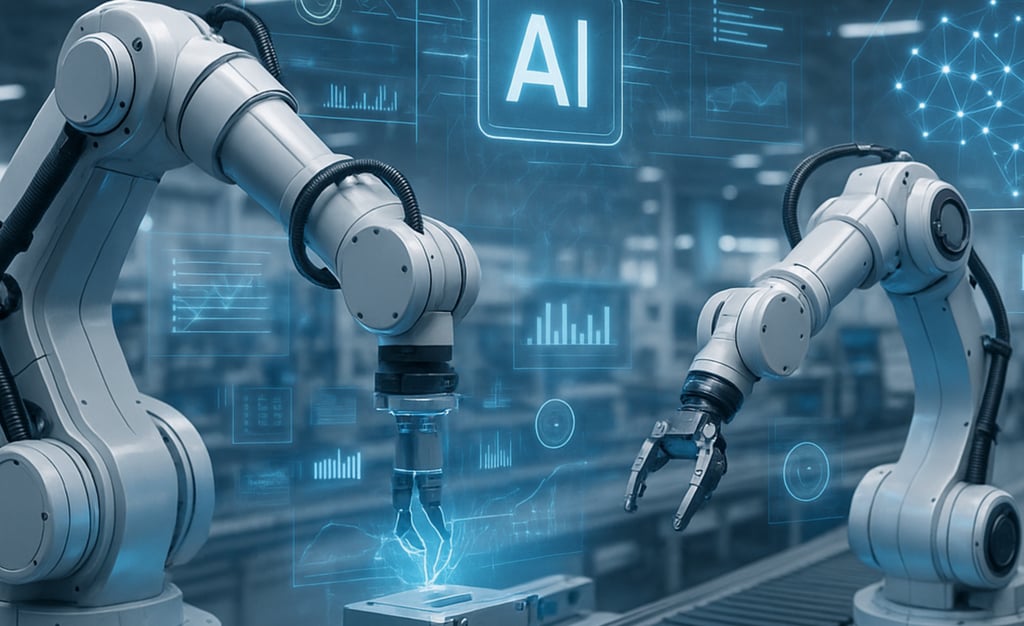
Artificial intelligence is working its way onto factory floors. It is not the distant, theoretical AI of research papers. It is embedded in robot controllers, vision systems, and software packages that are running production right now. A robot with AI can look at a bin of random parts and pick the right one without being told its exact position. It can learn from its own mistakes and adjust its path to reduce cycle time. It can navigate a warehouse without following tape on the floor. For an industry that has spent decades programming robots to follow exact paths and repeat exact motions, AI is the biggest shift in how robots are taught and how they adapt. For a used robot buyer, understanding which AI capabilities are real, which brands offer them, and what they mean for the equipment that is showing up on the secondary market is the difference between buying a machine that is ready for the next decade and one that is stuck in the last one.
AI-Powered Vision: Seeing What Was Never Programmed
Traditional robot vision works by matching a template. The programmer shows the system a picture of the part and defines a few key features, an edge, a hole, a corner. The robot looks for those features and acts when it finds them. If the lighting changes, or the part is dirty, or a new variant of the part comes down the line, the vision system fails. AI-powered vision does not need a template. It is trained on thousands of images of the part in different orientations, under different lighting, with different backgrounds. It learns what the part looks like, not just what a few features look like. The result is a vision system that can pick a casting out of a bin in random orientation, inspect a weld bead for porosity, or read a serial number on a curved surface, all without being reprogrammed. AI vision systems have reduced false rejection rates by over twenty percent compared to traditional template-based approaches, which means fewer good parts end up in the scrap bin and fewer manual inspections are needed.
Self-Learning Robots: Getting Better Over Time
A traditional robot runs the same program the same way until a programmer changes it. A self-learning robot collects data from every cycle and uses AI to optimize its own performance. In arc welding, the robot monitors the weld pool in real time and adjusts the current, voltage, and travel speed to maintain a consistent bead. It learns which parameter combinations produce the best results for different joint geometries and applies that knowledge to the next part. In material handling, the robot analyzes its own motion data and adjusts acceleration and deceleration profiles to reduce cycle time without exceeding the safe limits of the motors and reducers. AI-driven path optimization has been shown to reduce cycle times by ten to twenty percent in some applications, not by moving faster, but by moving smarter. The robot finds the shortest path, eliminates unnecessary pauses, and coordinates its axes to avoid the bottlenecks that a human programmer might not see.
AI Navigation: Moving Through Dynamic Environments
Mobile robots, the platforms that move materials through factories and warehouses, rely on AI to navigate spaces that were not designed for them. Older automated guided vehicles follow magnetic tape or fixed routes and stop when anything blocks their path. AI-driven mobile robots build a map of their environment, locate themselves within it in real time, and plan routes around obstacles as they appear. A forklift parked in the wrong spot, a pallet left in an aisle, a person walking through the area, the robot sees these things and reroutes itself without stopping. AI navigation is what makes autonomous mobile robots viable in environments that are too dynamic for traditional AGVs.
Collaborative Intelligence: Multiple Robots Working Together
In a cell with multiple robots, the challenge is not just programming each robot individually. It is coordinating them so they do not collide, do not wait for each other longer than necessary, and share the workload in a way that maximizes throughput. AI can manage that coordination in real time. The robots share a common task queue, and the AI assigns work based on which robot is available, which one is closest to the next part, and which one is running at the lowest duty cycle. If one robot slows down because of a process variation, the AI shifts tasks to the other robots to keep the line balanced. In automotive welding lines and electronics assembly cells, AI-driven coordination is reducing the idle time that accumulates when robots wait for each other.
How the Big Four Are Adopting AI
The four major robot brands have each invested in AI, but the approaches reflect their different engineering philosophies. FANUC integrates AI into its existing controller ecosystem. The R-30iB controller supports AI vision and self-learning functions that run directly on the robot without an external PC. The Zero Down Time cloud-based AI platform collects data from connected robots and predicts maintenance needs before a failure occurs. ABB builds AI into the OmniCore controller and the RobotStudio programming environment. The AI assists with path planning, suggesting optimized trajectories that a programmer can accept or modify. ABB's AI also powers the vision and force-control functions that let robots handle parts they have never seen before. KUKA relies on the open architecture of the KRC4 and KRC5 controllers to let integrators plug in third-party AI solutions. The controller's Windows-based environment makes it straightforward to connect AI vision systems, AI path planners, and AI quality inspection tools from different vendors. Yaskawa Motoman has focused its AI development on welding. The MotoWeld AI software monitors the weld pool and adjusts parameters in real time. The YRC1000 controller supports AI-driven seam tracking and parameter optimization. Each brand has taken a different path, but the common direction is toward robots that sense, learn, and adapt rather than simply repeat.
What AI Means for Used Robot Buyers
AI capability is not something that can be added to any robot. It is tied to the controller generation and the software version. For a used robot buyer, this has practical implications. The first is the controller generation. AI features like FANUC's self-learning functions or ABB's AI path planning require controllers from the R-30iB, IRC5, KRC4, or YRC1000 generation or newer. A robot with an older RJ3iC or S4C controller cannot be upgraded to run AI software. The second is software licensing. AI vision, AI welding optimization, and AI path planning are all licensed features. When buying a used robot, confirm that the AI software is installed, activated, and transferable. A robot advertised as having AI capability but missing the software license is just a standard robot with a nice story. The third is hardware. AI vision requires cameras, and AI functions that rely on data collection need working network interfaces and controller memory that is intact and uncompromised. Check that the hardware is present and functional. The fourth is future value. Robots with controllers that support AI hold their value better on the used market because they can be redeployed into more applications. A buyer who pays a premium for an AI-capable controller is buying flexibility that will still matter years from now.
This article was prepared by Tyche Robotic, a supplier of refurbished six-axis industrial robots serving integrators and resellers in Latin America, Southeast Asia, and Europe.
Contact Us
As a professional supplier of used industrial robots, Jiangmen Tyche Robotic Co., Ltd. is committed to providing customers with integrated solutions—from hardware selection and configuration to software programming, debugging, and after‑sales maintenance.
© 2025. All rights reserved.

Mr. Victor Ismael