A Guide to FANUC Robot Controllers: R-30iB, R-30iA, and What to Check When Buying Used
An overview of FANUC robot controllers covering RJ3iC, R-30iA, R-30iB variants, and how they compare to ABB, KUKA, and Yaskawa controllers. Includes a used controller inspection checklist.
Tyche Robotic
6/5/20264 min read
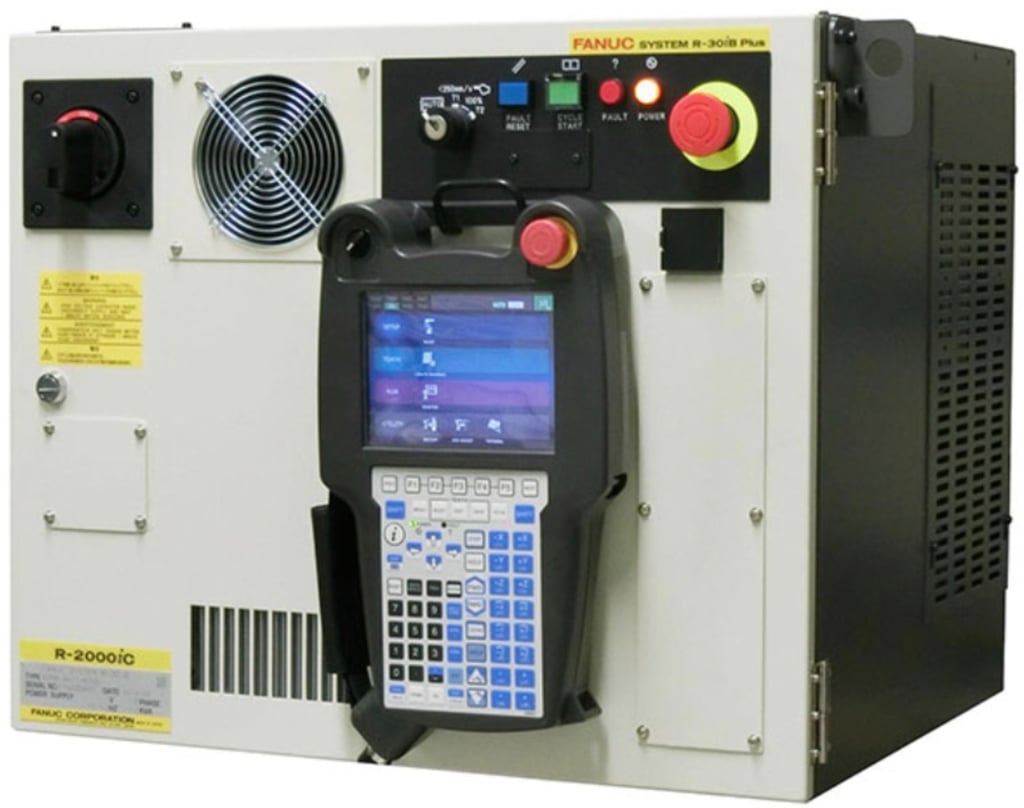
FANUC has been building robot controllers for decades, and the progression from one generation to the next tells a pretty clear story. Each version got a little more capable, a little more compact, and a little more integrated with the software tools that make a robot useful. The RJ3iC was the workhorse of the 2000s. The R-30iA bridged the gap to the modern era. The R-30iB is the controller you will find on most used FANUC robots today. A newer R-50iA has since been announced, but it will be years before it shows up on the secondary market in any real volume. If you are buying a used FANUC robot, understanding which controller it comes with and what that controller can and cannot do is not optional knowledge. It determines how easily the robot will integrate, what software features are available, and whether the machine is ready to run or needs work before it can earn its keep.
The FANUC Controller Family: RJ3iC, R-30iA, R-30iB, and R-50iA
The RJ3iC was the standard controller for FANUC robots through much of the 2000s. It handled the LR Mate 200iC and the early Arc Mate and R-2000iB series robots that are still common on the used market today. It is a capable controller that runs the same fundamental motion control architecture as its successors, but it lacks the processing speed and the native support for modern communication protocols that later generations added. The R-30iA was the transitional step. It upgraded the hardware, added faster processing, and introduced the smaller form factor that would define the R-30iB. Robots shipped with the R-30iA can run most of the software that the R-30iB runs, though some of the newer iRVision features and safety options require the later hardware. The R-30iB is the current standard. It is more compact than its predecessors, which makes it easier to install multiple controllers in a tight cell. iRVision integrates directly into the controller without a separate PC, which simplifies vision-guided applications. It supports a range of safety functions including DCS, FANUC's Dual Check Safety, which runs a redundant safety check on every axis. The R-30iB ships in several variants. The R-30iB Mate is the compact version for smaller robots. The R-30iB Plus adds processing capacity for more complex applications. An open-air cabinet version and a standalone cabinet version cover different installation environments. The R-50iA was announced more recently, with faster processing and more advanced motion control. It is the future, but it is not yet the present on the used market.
How FANUC Controllers Compare to the Other Big Four
Every robot brand builds its controller around a different philosophy, and the choice matters more than most first-time buyers realize. FANUC's R-30iB is a closed, purpose-built system. The hardware and software are designed together, which makes the system stable and resistant to viruses and cyber threats. The trade-off is that the user cannot modify the system beyond what FANUC has built into it. ABB's IRC5 and the newer OmniCore are built around motion control. TrueMove keeps the programmed path accurate regardless of speed, and QuickMove optimizes acceleration to reduce cycle time. The OmniCore tightens repeatability and cuts energy consumption. ABB's SafeMove2 software provides safety-rated motion control that FANUC matches with its own DCS. KUKA's KRC4 and KRC5 run on a Windows-based open architecture. Integrators who want to plug in third-party sensors, cameras, and custom software get more freedom, but the controller needs the same IT maintenance as any industrial PC. Yaskawa's YRC1000 is compact and handles multi-robot coordination natively, up to eight robots and seventy-two axes from a single unit. For a used buyer, the controller is often the deciding factor between two otherwise similar robots. It determines which integrators will work on the machine, how hard it is to find someone who can troubleshoot it, and whether the software features you need are already installed or will cost extra to add.
What to Check When Buying a Used FANUC Controller
A used FANUC controller needs a specific inspection, and most of it has nothing to do with whether the robot arm moves. The battery is the first thing to check. Every FANUC controller uses batteries to maintain the mastering data that tells the robot where each axis is. When those batteries die, the mastering is lost, and re-mastering a six-axis robot takes time and costs money. A controller with a recent battery replacement is worth more than one running on the original batteries from a decade ago. The software licenses are next. ArcTool for welding, HandlingTool for material handling, and iRVision for vision guidance are all licensed features. They are not automatically included with the controller, and they are not automatically transferable. Verify what is installed, confirm the licenses are active, and make sure they can be transferred to a new owner. A robot without its software licenses is just an arm that moves, and the cost of repurchasing those licenses can wipe out the savings from buying used. The physical condition of the controller cabinet matters. Open the door and look for dust buildup. Fine metallic dust from grinding or casting environments is conductive and settles on circuit boards. Check that the cooling fans spin freely and the heat sinks are not packed with debris. An overheated controller degrades components faster and is more likely to suffer intermittent faults. Finally, power up the controller and watch the boot sequence. Error codes that appear during startup should be investigated, not ignored. The teach pendant screen should be clear and responsive. The membrane keys should register every press. A controller that boots cleanly and shows no persistent errors is the minimum standard before buying.
This article was prepared by Tyche Robotic, a supplier of refurbished six-axis industrial robots serving integrators and resellers in Latin America, Southeast Asia, and Europe.
Contact Us
As a professional supplier of used industrial robots, Jiangmen Tyche Robotic Co., Ltd. is committed to providing customers with integrated solutions—from hardware selection and configuration to software programming, debugging, and after‑sales maintenance.
© 2025. All rights reserved.

Mr. Victor Ismael