Cobots and Traditional Industrial Robots: When Each One Makes Sense
A practical comparison of cobots and traditional industrial robots. Covers what cobots are, key manufacturers, where cobots excel, their limitations, how to decide between them, and what to check when buying a used collaborative robot.
Tyche Robotic
5/25/20266 min read
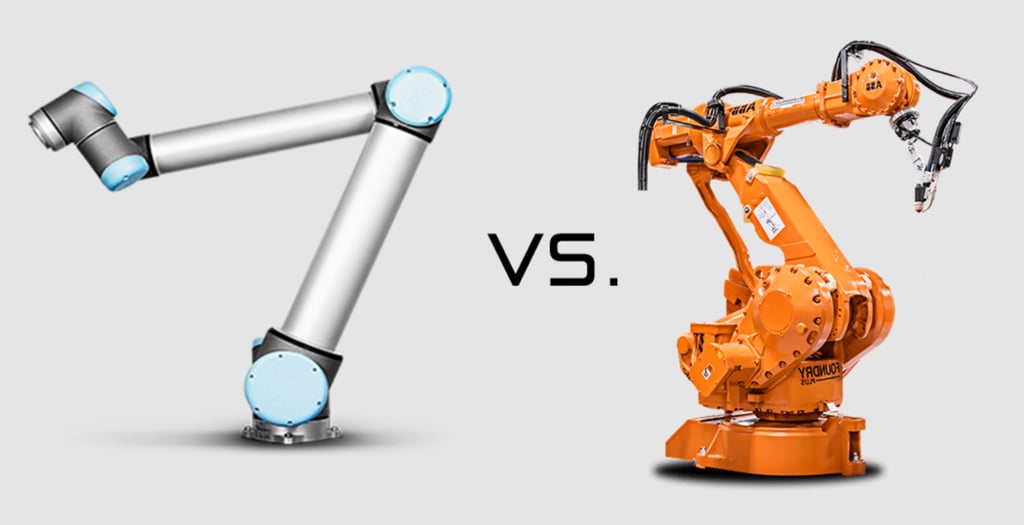
A collaborative robot, or cobot, is a machine designed to work next to people without a safety fence. That is the short definition. The longer one is that a cobot trades speed and payload for the ability to stop when it touches something unexpected, which means it can share a workspace with a human operator and not put that operator at risk. The cobot market has been growing fast. Depending on whose numbers you use, it sat somewhere between one hundred forty million and five hundred twenty million dollars in 2025, with growth rates north of sixteen percent a year. That growth is real, but it does not mean cobots are replacing traditional industrial robots. It means more factories are automating tasks that were never automated before, and cobots happen to fit a lot of those first-automation jobs. Understanding where a cobot makes sense and where a traditional six-axis industrial robot is still the right call is the difference between a smart automation investment and an expensive experiment.
What Is a Collaborative Robot?
A cobot has four safety features that a standard industrial robot does not need. The first is collision detection and force sensing. The cobot measures the torque at each joint in real time. If it feels a sudden resistance that should not be there, like bumping into a person's arm, it stops or reverses. The second is limited power and force. A cobot's motors and gearing are sized so that even at full speed, the impact energy stays below the threshold that causes injury. The third is a smooth exterior with no pinch points. The arm has rounded edges and no exposed motors or cables to catch a sleeve or a finger. The fourth is internal cable routing. Everything runs inside the arm, which eliminates the hanging dress packs that can snag on things and cause their own hazards.
One thing worth understanding early: there is no such thing as an inherently collaborative robot. The latest revision of ISO 10218, the international safety standard for industrial robots, makes this clear. A robot is only collaborative in the context of a specific application that has been risk-assessed and found to meet the requirements for collaborative operation. The same cobot that runs safely next to a person in a light assembly cell may need guarding if it is fitted with a sharp tool or handling a hazardous material. The application defines the safety, not the robot's marketing brochure.
Key Cobot Manufacturers and What They Offer
The cobot landscape is dominated by a handful of names, and they do not all play by the same rules. Universal Robots, based in Denmark, is the one that started the category and still holds roughly forty-six percent of the global market. The UR series spans payloads from three to thirty kilograms across the UR3e, UR5e, UR10e, UR16e, UR20, and UR30. UR runs an open ecosystem called UR+, where third-party grippers, vision systems, and software plug directly into the controller. ABB offers the YuMi in single-arm and dual-arm versions, plus the GoFa and SWIFTI lines that push deeper into industrial-speed collaborative applications. ABB's SafeMove software handles the safety-rated motion control. FANUC builds the CR series, with green foam-padded arms running from four to thirty-five kilograms of payload. The CRX series is the newer generation, designed to be programmed with tablet-style ease. KUKA fields the LBR series, including the LBR iisy for entry-level applications and the LBR iiwa with joint torque sensors that enable force-sensitive assembly work. Outside the robot manufacturers, companies like OnRobot and Robotiq build grippers, sensors, and tool changers designed specifically for collaborative applications.
Where Cobots Shine
Cobots earn their keep in applications where the payload is light, the cycle time is forgiving, and the value of having a person and a robot sharing the same space is real. Pick-and-place and packaging are the biggest volume. A cobot can move small parts from a conveyor to a box all day without tiring, and because it does not need guarding, it can be wheeled up to a line and put to work in hours instead of weeks. Dispensing and sealing are another strong fit. The cobot's force control lets it lay down a consistent bead of adhesive or sealant, and the collaborative rating means an operator can step in to adjust the part without stopping the cell. Machine tending is where cobots replace the human loading and unloading CNC machines, injection molders, and press brakes. One cobot can serve several machines if they are laid out within its reach. Inspection is the fourth area, especially with vision-equipped cobots that can spot defects too small or too subtle for a human eye to catch consistently. ABB's YuMi, for example, has been used in electronics assembly to find microscopic flaws that manual inspectors miss.
The Trade-Offs: Where Cobots Fall Short
Cobots have hard limits, and those limits are designed in, not something that can be engineered away with a software update. Payload tops out around thirty to thirty-five kilograms for most models, with a few reaching fifty. A cobot cannot lift an engine block, swing a heavy weld gun, or stack a full pallet of bagged cement. The power and force limitations that make a cobot safe also make it incapable of heavy grinding, stamping, or any process that demands sustained high forces. Speed is the second ceiling. Cobots run slower than traditional industrial robots by design, because the kinetic energy has to stay low enough that a collision does not cause harm. In a high-volume production line where cycle time is measured in seconds, a cobot will not keep up. Precision is the third trade-off. A cobot's repeatability usually lands somewhere between two and ten hundredths of a millimeter, which is fine for packaging and light assembly but not for high-precision tasks like laser cutting or precision machining where industrial robots hold tolerances at half that or better. Cost is the fourth surprise. The arm itself runs twenty to sixty thousand dollars, but when you add the integration, the end-of-arm tooling, the safety assessment, and the programming, the total project cost can push past seventy thousand dollars. A cobot is not automatically a budget option. It is a trade-off, and the trade only makes sense when the application needs what a cobot is good at.
Cobot or Traditional Industrial Robot: How to Decide
The decision between a cobot and a traditional industrial robot comes down to four questions, and the answers point in one direction or the other pretty quickly. How heavy is the part and the tool together? If the combined weight is over thirty kilograms, a cobot is probably out of the running. How fast does the cycle need to be? If the line runs at high throughput with cycle times measured in single-digit seconds, a traditional robot is the tool for the job. How precise does the process need to be? If the tolerance is tighter than a few hundredths of a millimeter and the robot has to hold it over thousands of cycles, a well-maintained traditional industrial robot will deliver that more consistently. How often does the cell need to be reconfigured? If the production mix changes every few months and the robot needs to be moved between stations, the cobot's portability and simplified programming give it a real edge.
For heavy payload applications where the part weighs more than the robot, a traditional six-axis industrial robot is not a compromise. It is the only option. The used robot market makes that option more accessible because a properly refurbished KUKA, ABB, FANUC, or Yaskawa robot costs forty to sixty percent less than new and delivers the same mechanical performance. In applications where a cobot would be running near its limits every cycle, a traditional robot working well within its rated capacity will last longer, require less maintenance, and pay for itself faster.
What to Know When Buying a Used Cobot
Used cobots are still rare compared to used traditional industrial robots, but the market is growing as early adopters upgrade to newer models. The inspection checklist for a used cobot is different from a traditional robot because the safety features are the core of the machine. The first thing to check is the force sensor calibration. Cobots rely on joint torque sensors to detect collisions and stop safely. Those sensors drift over thousands of operating hours, and a sensor that has drifted out of calibration can trigger false stops that slow production, or worse, fail to detect a real contact. Ask for a recent calibration report and a functional test log showing that the collision detection triggers at the correct thresholds. The second thing is the collision history. Most cobot controllers log every impact event. A few accidental bumps over years of service are normal. A log full of frequent, hard collisions suggests the robot worked in a poorly designed cell or was operated by untrained personnel. Either way, the mechanical structure and the joint reducers have absorbed forces they were not designed to take repeatedly. The third thing is software. Cobot software is more tightly tied to the manufacturer than traditional robot software, and licenses for advanced features like vision or force-guided assembly may be tied to the original owner. Verify that the licenses are transferable and that the software version can still receive updates. The fourth thing is the end-of-arm tooling. If the cobot comes with a gripper or sensor, check it the same way you would on a traditional robot. Seals, moving parts, and electrical connections all wear. A cobot is only as collaborative as the tool attached to it.
This article was prepared by Tyche Robotic, a supplier of refurbished six-axis industrial robots serving integrators and resellers in Latin America, Southeast Asia, and Europe.
Contact Us
As a professional supplier of used industrial robots, Jiangmen Tyche Robotic Co., Ltd. is committed to providing customers with integrated solutions—from hardware selection and configuration to software programming, debugging, and after‑sales maintenance.
© 2025. All rights reserved.

Mr. Victor Ismael