Closing the Welding Skills Gap with Robotics: How Automation Fills the Void
A practical look at how robotic welding automation addresses the growing welder shortage, with data on the skills gap, Big Four welding solutions, used robot advantages, and what to check when buying a used welding robot.
Tyche Robotic
6/12/20265 min read
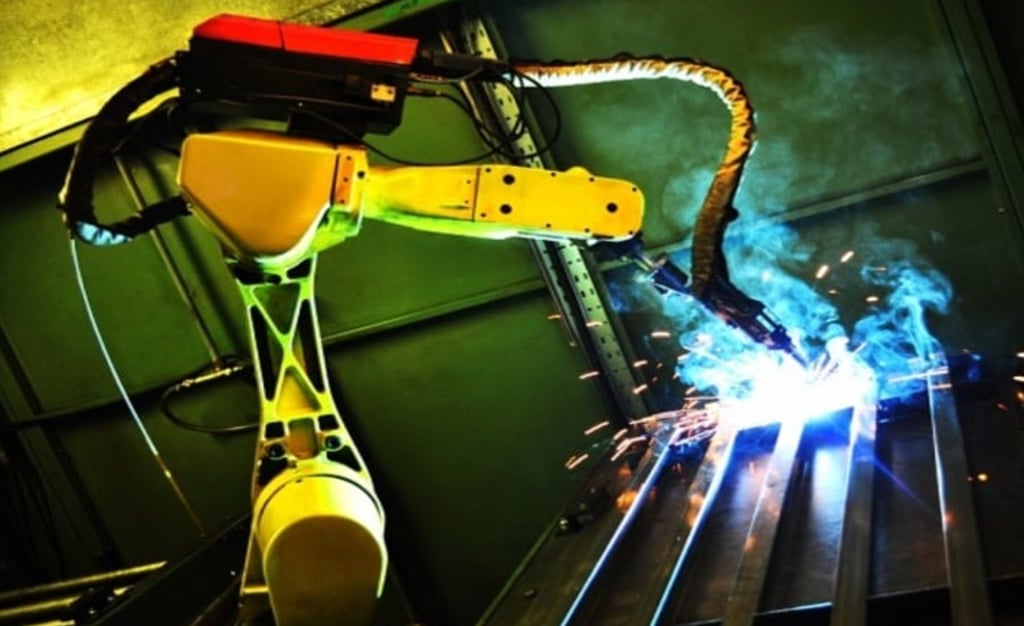
The average welder in the United States is fifty-five years old. Every year, more experienced welders retire than enter the trade. The American Welding Society projects a shortage of roughly three hundred thousand welding professionals by 2025. Industry surveys consistently show that over seventy percent of manufacturers cite the skilled labor shortage as their biggest challenge. This is not a problem that is coming. It is a problem that is already here, and it is getting worse. The solution is not to find more welders who do not exist. It is to let robots handle the welding that robots do best, and let the welders who remain do the work that still requires human judgment and skill.
The Welding Skills Gap: A Growing Problem
The numbers tell a story that any shop owner already knows from experience. The welders who built the industry are retiring, and young people are not lining up to replace them. Welding is seen as dirty, dangerous, and physically punishing. The hours are long, the environment is hot, and the work takes a toll on the body over time. The result is a shrinking labor pool and rising wages for the welders who remain. A shop that needs five welders to meet its production schedule might only have three. The work gets backed up, delivery dates slip, and the business either turns down orders or loses customers. The welding skills shortage is not just a hiring problem. It is a capacity problem that limits how much work a shop can take on and how fast it can grow.
How Robots Fill the Welding Void
A welding robot does not get tired, does not call in sick, and does not retire. It runs the same weld parameters on every cycle. Travel speed, wire feed rate, voltage, torch angle. Those variables stay locked from the first part of the shift to the last. Arc-on time in a robotic welding cell runs above ninety percent. A manual welder manages about thirty percent, with the rest of the time going to setup, part handling, and repositioning. The robot does not replace the welder. It changes what the welder does. Instead of spending the day hunched over a fixture breathing fumes, the welder becomes a robot operator and programmer. The physical work is handled by the machine, and the human handles the setup, the quality checks, and the complex welds that still need a skilled eye and a steady hand.
What Welding Robots Can Do That Manual Welders Struggle With
Robots bring a few specific capabilities to welding that are hard for manual welders to match over long production runs. Multipass welds on thick plate are the first example. A robot can be programmed to run dozens of passes with the same bead profile on every pass, layering weld metal predictably from root to cap. A manual welder doing the same work has to maintain focus and consistency for hours on a single joint. Long seam welding is the second example. A robot runs a multi-meter seam at a constant travel speed from start to finish. A manual welder slows down as fatigue sets in, and the bead profile changes along the length of the seam. Tight-space welding is the third example. A robot with a slim wrist can snake into corners and around obstacles that a human welder with a torch and a helmet cannot physically reach. High-volume repeat production is the fourth. When the same part needs to be welded thousands of times, the robot delivers the same weld every single cycle. The manual welder, no matter how skilled, cannot match that consistency over an eight-hour shift.
How the Big Four Tackle the Welding Skills Gap
Each of the major robot brands has its own approach to welding automation, and the differences matter when a shop is trying to fill a welding gap. FANUC's Arc Mate series, running on the R-30iB controller with the ArcTool software package, covers spot welding and arc welding across more installed robots than any other brand. The support network is extensive, and the used market is deep. ABB's IRB 1520ID, with a hollow wrist that routes the torch cable internally, pairs with the IRC5 or OmniCore controller and TrueMove and QuickMove to deliver the path accuracy that high-quality TIG and precision welding demand. KUKA's KR CYBERTECH nano and KR 16 run the ArcTech welding software on the open KRC4 and KRC5 architecture, which gives integrators flexibility to match the robot with power supplies from multiple manufacturers. Yaskawa's Motoman AR and MA series ship more arc welding robots than any other brand. The MotoWeld software package and the YRC1000 controller handle multi-robot coordination and multipass scheduling natively. Each brand has its strengths, and the choice often comes down to local service, integrator familiarity, and which welding power supplies the shop already uses.
The Used Robot Factor: Affordable Welding Automation for Small Shops
Closing the welding skills gap does not require a brand-new robot. A properly refurbished arc welding robot delivers the same weld quality, the same arc-on time, and the same consistency as a new machine. The difference is the price. A used welding robot costs forty to sixty percent less than a comparable new unit, which means the payback period shrinks from eighteen to twenty-four months down to under a year in many applications. For a small fabrication shop that cannot fill its welding positions, a used FANUC Arc Mate or Motoman AR series robot with the welding software already installed and licensed is the fastest path from a labor shortage to a running welding cell. The used welding robots for small shops are not a compromise. They are a practical answer to a problem that is only getting worse.
What to Know When Buying a Used Welding Robot
A used welding robot needs a specific inspection that goes beyond the standard robot checks. The torch cable is the first thing to look at. Spatter burns pinholes through the cable jacket, and the constant flexing near the wrist work-hardens the copper conductors inside. A torch cable that looks intact can still cause intermittent arc faults that take hours to trace. The wire feeder is the second thing. Open it up and check the drive rollers for wear. A polished or grooved roller will slip and cause erratic wire feed. Check that the guide tubes are aligned and not clogged with wire shavings. The welding software license is the third thing, and it is the one that catches buyers off guard more than any other. ArcTool, ArcTech, and MotoWeld are all licensed features. Verify that the software is installed, active, and transferable. A welding robot without its welding software is just a handling robot with a torch bolted to it. The controller battery is the fourth thing. A dead battery wipes the mastering data, and re-mastering a robot adds commissioning time. The dress pack is the fifth thing. The protective tubing around the torch cable and air lines takes spatter and heat damage. Look for pinholes, cracks, and hardened sections near the wrist. A damaged dress pack causes intermittent faults that are expensive to diagnose and simple to prevent.
This article was prepared by Tyche Robotic, a supplier of refurbished six-axis industrial robots serving integrators and resellers in Latin America, Southeast Asia, and Europe.

Contact Us
As a professional supplier of used industrial robots, Jiangmen Tyche Robotic Co., Ltd. is committed to providing customers with integrated solutions—from hardware selection and configuration to software programming, debugging, and after‑sales maintenance.
© 2025. All rights reserved.

Mr. Victor Ismael