Assembly Robots in Manufacturing: What They Are, How They Work, and What to Check When Buying Used
A practical guide to assembly robots covering SCARA, Delta, and 6-axis types, force sensing and vision technology, industry applications, Big Four assembly solutions, and what to inspect when buying a used assembly robot.
Tyche Robotic
6/10/20266 min read
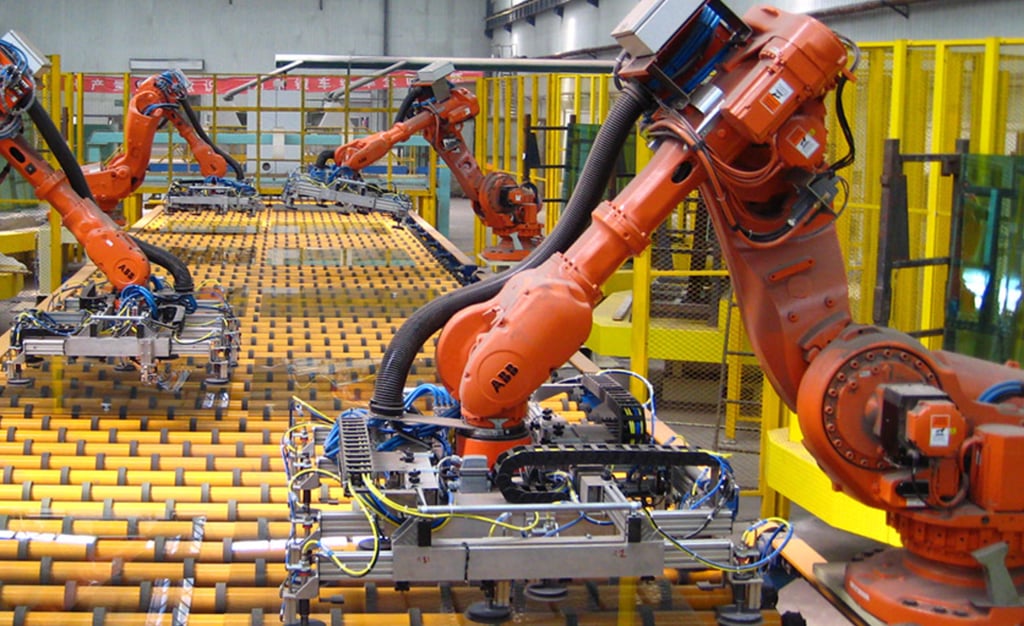
Assembly is one of the hardest things to automate. Welding follows a seam. Palletizing follows a pattern. Assembly follows a feeling. A pin has to slide into a bore with just enough force to seat it but not so much that it galls the surface. A connector has to click into place with the right orientation, and the robot has to know it clicked. These are tasks that human fingers do without thinking, and for a long time robots could not do them at all. That has changed. Force sensors, vision systems, and smaller, more precise robots have turned assembly from a manual job into an automated one. The types of assembly robots on factory floors today, SCARA, Delta, and six-axis arms, each solve a different piece of the puzzle. For a buyer looking at the used market, understanding which type fits which job and what to check on each one is the difference between a cell that assembles and a cell that jams.
Types of Assembly Robots: SCARA, Delta, and 6-Axis
SCARA robots are built for speed on a flat plane. They have four axes and move in a horizontal reach pattern that makes them unbeatable for pick-and-place assembly of small parts. The FANUC SR-3iA carries three kilograms and holds repeatability at one hundredth of a millimeter. It is the machine you see stuffing components onto circuit boards, driving screws, and inserting pins into plastic housings. The cycle times are measured in fractions of a second, and the precision is tight enough that a misplaced part is almost always a programming error, not a mechanical one.
Delta robots are even faster. The FANUC M-1iA and M-2iA use a parallel-link design with a compact wrist that can rotate at high speed in tight spaces. These are the robots that pick components from a moving conveyor and snap them into assemblies without stopping the line. They handle very light payloads, a few kilograms at most, and they move in three dimensions with a speed that looks sped up even in real life. Delta robots dominate high-speed sorting, light assembly, and packaging applications where the part is small and the volume is enormous.
Six-axis robots handle the assembly tasks that are too complex for SCARA and Delta machines. A FANUC LR Mate 200iD carries seven kilograms over seven hundred seventeen millimeters and holds repeatability at one hundredth of a millimeter. An ABB IRB 1200 matches that payload and adds a longer reach with the same precision. A KUKA KR AGILUS is another compact six-axis machine purpose-built for high-speed assembly. These robots can approach a part from any angle, which matters when the assembly involves inserting components at odd orientations or reaching into tight spaces. Six-axis assembly robots work with force sensors and vision systems to do the tasks that feel almost human: fitting a bearing onto a shaft, inserting a gasket, aligning two parts and pressing them together.
Force Sensing and Vision: The Technologies That Make Assembly Possible
A robot that can only move to a programmed position is a robot that can only assemble parts that are perfectly made and perfectly presented. That world does not exist. Parts vary. Fixtures shift. Tolerances stack up. Two technologies close the gap between the programmed path and the real world. Force sensing lets the robot feel what it is doing. A force sensor mounted between the robot wrist and the end effector measures the resistance at the point of contact. When the robot inserts a pin into a bore, the force sensor tells the controller whether the pin is aligned, whether it is binding, and when it has reached the correct depth. The robot is not just moving. It is responding. The same technology handles tasks like gear meshing, bearing pressing, and snap-fit assembly where the forces involved are small but the margin for error is smaller.
Vision gives the robot the ability to see the part before it touches it. FANUC's iRVision, ABB's integrated vision tools, KUKA's VisionTech, and Yaskawa's MotoSight all let the robot locate a part on a conveyor or in a tray, determine its orientation, and adjust the pick approach accordingly. Vision also closes the loop after assembly. The robot can inspect the part it just assembled and confirm that all the components are present, seated, and oriented correctly. This is not optional in industries like medical device and electronics manufacturing, where a single misassembled part is a recall waiting to happen.
Industries Where Assembly Robots Are Taking Over
Electronics manufacturing was the first to adopt robotic assembly at scale, and it is still the biggest user. Circuit boards, connectors, sensors, and displays all come together under SCARA and Delta robots that work at speeds no human hand can match. The precision requirement is extreme, and the cleanliness requirement rules out manual handling in many cases. Medical device and pharmaceutical assembly followed close behind. Syringes, inhalers, catheters, and implantable devices are assembled in cleanrooms by six-axis robots that are sealed against particle emission. The force sensing capability matters here because the robot can document every insertion force, every press, and every snap, creating the traceability that regulators demand. Automotive component assembly is a different world. Engine subassemblies, transmission components, headlights, and seat mechanisms are assembled by mid-payload six-axis robots that handle heavier parts at lower speeds but with the same consistency. Consumer goods assembly rounds out the picture. Toys, appliances, electronics, anything that snaps, screws, or glues together on a production line now has a robotic assembly option.
How the Big Four Handle Robotic Assembly
Each of the major robot brands has its own approach to assembly, and the differences show up in the software and the sensor integration. FANUC pairs the LR Mate series and the SR SCARA line with the Force Sensor and iRVision. The R-30iB controller manages the force and vision inputs natively, which simplifies integration for assembly cells that need both. ABB builds its assembly offering around the IRB 1200 and the YuMi collaborative robot. Integrated Force Control and RobotStudio simulation let integrators program and test force-guided assembly sequences offline before the robot ever touches a part. KUKA uses the KR AGILUS for high-speed assembly, paired with the ForceTorque sensor and VisionTech. The open KRC4 architecture gives integrators the freedom to integrate third-party sensors and software. Yaskawa fields the GP series and the Motoman robots for assembly, with MotoSight vision and force sensing running through the YRC1000 controller. Each brand's assembly ecosystem is built around the same core technologies, force and vision, but the integration path differs. The choice often comes down to which controller the integrator already knows.
What to Know When Buying a Used Assembly Robot
A used assembly robot needs a different inspection than a used welding or material handling robot. The reason is precision. Assembly robots operate at tighter tolerances, and any degradation in the mechanicals shows up directly in the assembled product. The first thing to check is the repeatability. Ask for a recent calibration report and a repeatability test log. A robot that was used for assembly should have these records, and if it does not, treat the missing data as a warning. The second thing is the force sensor. Force sensors drift over time. A sensor that has lost calibration will either trigger false stops that slow production or fail to detect a misaligned part, which leads to scrap. Ask for calibration records and, if possible, a functional test video showing the force sensor responding to a known load. The third thing is the vision system. Check the camera lens for scratches or haze from chemical exposure. Confirm that the vision calibration is intact and that the software license is transferable. A used assembly robot with a dead vision system is just a robot that moves, it cannot find parts. The fourth thing is the reducer condition. SCARA and Delta robots run at very high cycle rates with light payloads. The reducers wear differently than on a heavy palletizing robot. High-frequency, low-load cycling produces different wear patterns than low-frequency, high-load work, and backlash measurements should be evaluated with that in mind. The fifth thing is the controller battery and software licenses. Assembly robots often run with specialized software for force-guided insertion, vision part location, or assembly sequence programming. Verify that all of it is installed, licensed, and transferable. A used assembly robot without its software is just a fast arm with nothing to tell it what to do.
This article was prepared by Tyche Robotic, a supplier of refurbished six-axis industrial robots serving integrators and resellers in Latin America, Southeast Asia, and Europe.
Contact Us
As a professional supplier of used industrial robots, Jiangmen Tyche Robotic Co., Ltd. is committed to providing customers with integrated solutions—from hardware selection and configuration to software programming, debugging, and after‑sales maintenance.
© 2025. All rights reserved.

Mr. Victor Ismael