Are Robots on Tracks Worth It? What a 7th Axis Does for Your Automation
A practical overview of robot tracks and 7th axis systems. Covers what they do, where they add value, what to check when buying used robots on tracks, and how to match a robot to a track.
Tyche Robotic
5/9/20264 min read
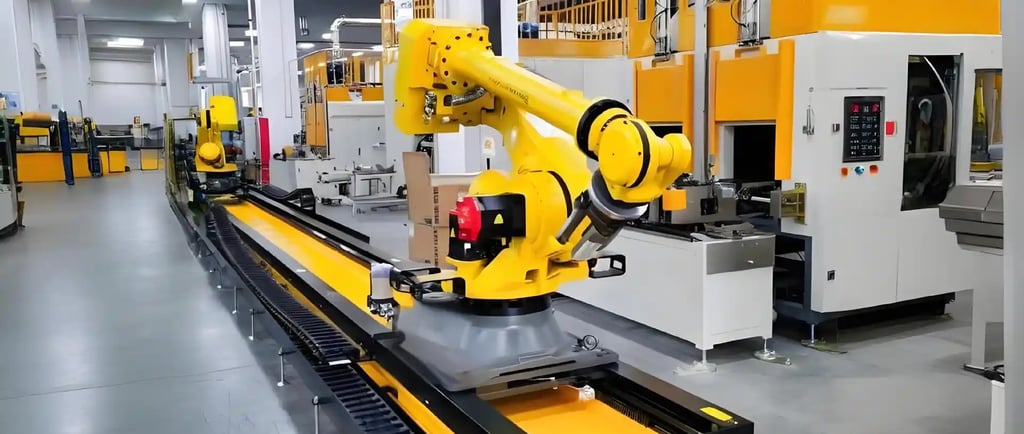

A standard six-axis industrial robot is a machine that reaches as far as its arm will stretch. On a fixed pedestal, that envelope is finite. You place the robot where it can reach everything it needs, and if it cannot, you add another robot or redesign the cell. A robot on a track changes that logic entirely. By mounting the arm on a linear rail or gantry, you add a seventh axis of motion. The robot can now travel along a workpiece that is longer than its reach, service multiple machines in a line, or shuttle parts between stations without a conveyor. The concept is not new. Automotive plants have used robot transfer units for decades to move heavy spot welding robots along entire body-in-white lines. What has changed is that the technology has become more accessible, and the used robot market now sees more robots with integrated tracks than ever before.
What a Robot Track Actually Does
A robot track, also called a seventh axis or robot transfer unit, is a motorized linear rail that the robot base rides on. Some systems mount the robot upright on a floor-level track. Others suspend the robot upside down from an overhead gantry. Both configurations solve the same problem: giving a single robot access to a much larger work zone than a fixed mount allows. Floor-mounted tracks are common in welding, palletizing, and large-part machining. Overhead gantry setups often appear in injection molding and press tending, where the robot needs to move freely above the equipment without taking up floor space. A well-engineered track can run at speeds of several meters per second while holding positioning accuracy within fractions of a millimeter over spans of tens of meters. That capability is what makes a single robot on rails capable of doing the work of two or three fixed robots in the right application.
Where the 7th Axis Adds Real Value
The clearest case is large workpieces. A robot welding a ten-meter beam or palletizing across multiple bays cannot stay in one spot. The track lets the robot follow the work, not the other way around. This is often cheaper and simpler than buying a robot with an extra-long arm, which becomes heavier, slower, and more expensive as reach increases. Another strong case is multi-machine tending. A row of CNC lathes or injection molding machines can be serviced by one robot on rails that moves down the line, loading and unloading as it goes. Compared to installing a dedicated robot at each machine, the track solution cuts equipment and integration costs. Space savings matter too. In tight plants, a robot on a track can work above existing equipment or along a narrow aisle where multiple fixed robots simply would not fit. And when production needs change, a robot that can move is easier to reconfigure than a fixed cell. The flexibility is built into the layout from day one.
Used Robots on Tracks: What to Know Before Buying
A used robot with a track is not just a used robot. It is a used robot and a used linear motion system, and both need inspection. The track itself demands attention. Rails wear unevenly if the robot spent most of its life in one section of the stroke. Check for play in the drive mechanism and look at the condition of the gear rack or ball screw. The cable carrier, or drag chain, carries the robot's power and signal cables along the track. A damaged drag chain leads to intermittent electrical faults that are hard to diagnose. If the track was a third-party retrofit rather than an OEM installation, confirm that the controller has the correct software option for an additional external axis. A robot that moves but cannot synchronize its motion with the track loses most of the productivity benefit. Also, verify that the mounting interface between the robot base and the track carriage is intact and free of fatigue cracks. Used robot tracks are not commodity items like a used teach pendant. Each one is application-specific, and the inspection has to be specific too.
Matching the Right Robot to a Track
The robot and the track have to be sized together. Heavy payload robots on long stroke tracks require rigid rail sections and powerful drive motors. A FANUC M-900iA carrying large castings on a thirty-meter line demands a fundamentally different track than a KUKA KR 16 handling small parts on a six-meter rail. Medium payload machines like the ABB IRB 4400 or a FANUC M-710iC are popular on track systems for machining cell tending because they are stiff enough for precision work but light enough to move quickly between machines. For heavy palletizing or foundry material handling, the ABB IRB 6640 and KUKA KR 210 on heavy-duty floor tracks are proven configurations. On the other end, Yaskawa Motoman MH series robots on tracks are common in large-part welding, especially for structural steel and agricultural equipment. Whatever brand and model you choose, the robot and track need to be validated as a system, not as separate purchases. A track that looks fine in isolation will magnify any instability in the robot's base, and at speed that instability translates directly into lost accuracy.
This guide was prepared by Tyche Robotic, a supplier of refurbished six-axis industrial robots serving integrators and resellers in Latin America, Southeast Asia, and Europe.
Contact Us
As a professional supplier of used industrial robots, Jiangmen Tyche Robotic Co., Ltd. is committed to providing customers with integrated solutions—from hardware selection and configuration to software programming, debugging, and after‑sales maintenance.
© 2025. All rights reserved.

Mr. Victor Ismael