The ABB IRB 7600: ABB's Heavy-Duty Powerhouse and What It Means for Used Buyers
A detailed look at the ABB IRB 7600 heavy payload robot. Covers five main variants, SafeMove2 safety features, foundry and automotive applications, IRB 7710 comparison, and used buying tips.
Tyche Robotic
5/19/20265 min read
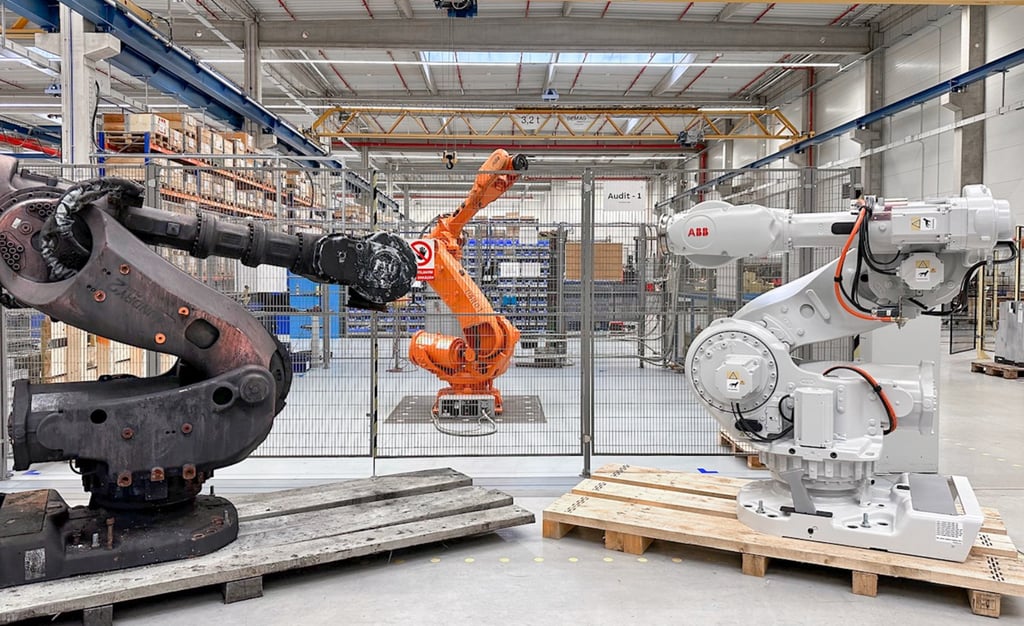
When you need a robot that can lift half a ton and do it reliably for years, the number of machines that qualify shrinks considerably. The ABB IRB 7600 is one of them. With payloads spanning 150 to 500 kilograms and reaches from 2.55 to 3.5 meters, this is the heavyweight class where the work is punishing and the cost of getting it wrong is measured in broken parts and lost production days. ABB has since moved on to the newer IRB 7710 and 7720 series, but the 7600 remains a fixture on the used market. These robots come out of foundries, automotive body shops, and heavy fab plants where they earned their keep lifting engine blocks, turning car bodies, and handling red-hot castings. For a used buyer, understanding the 7600's five main variants, what each one was built to do, and where to look for wear after years of heavy service is the difference between a smart capital purchase and a costly mistake.
The IRB 7600 Family: Five Models for Different Heavy Lifting Jobs
The IRB 7600 lineup is built around a common platform, but the five main variants push payload and reach in different directions. The IRB 7600-150/3.5 is the long-reach specialist. It carries 150 kilograms out to 3.5 meters, which makes it the press shop and large-part handling variant. The IRB 7600-325/3.1 is the balanced workhorse, running 325 kilograms over 3.1 meters. The IRB 7600-340/2.8 steps payload up to 340 kilograms at 2.8 meters. The IRB 7600-400/2.55 is the most common variant on the used market, carrying 400 kilograms over 2.55 meters. This is the one that shows up in foundries and heavy material handling cells more than any other. The IRB 7600-500/2.55 is the load champion, pushing payload to 500 kilograms at the same 2.55-meter reach. If the job involves turning a car body or lifting a massive diesel engine block, this is the model that gets the call.
What Makes the IRB 7600 Stand Out
ABB packed a few capabilities into the IRB 7600 that separate it from the pack. The first is SafeMove2, ABB's safety system that runs on the IRC5 controller. It monitors speed, position, and orientation in real time, and it can keep the robot within a defined safe zone without hard stops or physical barriers. The second is collision detection, which ABB claims reduces collision-related incidents by roughly 70 percent. That matters when the robot is swinging a 400-kilogram part near expensive tooling or, worse, near people. The third is high-inertia handling. The 7600 was designed to move big, awkward parts smoothly through position changes without overshooting or vibrating. The fourth is the compact footprint. Despite the payload, the robot does not sprawl across the factory floor. It is dense and rigid rather than wide and heavy, which helps in retrofits where floor space is already spoken for. Controllers vary by age. Early 7600 units shipped with the S4C or S4Cplus, while later ones run on the IRC5. The IRC5 is preferred for easier integration with modern PLCs and access to current ABB software. Foundry Plus and Foundry Prime options extend the robot's sealing and protection for environments where heat, dust, and washdown are part of the daily routine.
Where the IRB 7600 Does Its Work
The IRB 7600 ends up in jobs where the part itself is the limiting factor. In automotive body shops, the 400 and 500 variants rotate entire car bodies on hanger systems or transfer them between framing stations. This is not a fast pick-and-place job. It is a heavy, coordinated move that has to happen hundreds of times per shift without losing position. In foundries and forge shops, the 325 and 340 variants handle hot castings and forgings, loading die-casting machines and transferring parts through trim presses. The Foundry Plus and Foundry Prime protection is not optional here. It is the reason the robot survives more than a few months. In heavy fabrication, the 150/3.5 long-reach variant moves large weldments and structural steel sections through multi-station welding lines. The 400 and 500 variants palletize heavy bags, cases, and building materials at the end of production lines where the load is constant and the cycle is relentless. The 7600 has also been used in high-precision milling of large parts, where its rigidity and path accuracy produce better surface finishes than a lighter robot could hold.
IRB 7600 vs. the New IRB 7710/7720: Phased Out But Still Everywhere
ABB phased out the IRB 7600 and replaced it with the IRB 7710 and 7720 series, which cover 150 to 620 kilograms of payload with the OmniCore controller, improved repeatability, and up to 20 percent better energy efficiency. That generational shift is good news for used 7600 buyers. As plants upgrade, the older machines hit the secondary market at prices that reflect their age, not their remaining capability. A used IRB 7600-400 in decent condition with an IRC5 controller can deliver years of productive service for applications that do not demand the last word in cycle speed or precision. The 7600 is not obsolete. It is just no longer the latest thing on the showroom floor, and that is exactly the kind of pricing opportunity that makes the used heavy-payload market work.
What to Know When Buying a Used IRB 7600
Used IRB 7600 robots come from tough environments, and the inspection has to match the application they came from. Wrist backlash is the first thing to check on any heavy-payload robot, and the 7600 is no exception. The A4, A5, and A6 axes take the brunt of the load, especially on robots that spent their lives turning car bodies or handling heavy castings. Ask for backlash measurements before and after the most recent service. Seals degrade faster in foundry and forge environments. If the robot has a Foundry Plus or Foundry Prime rating, verify that the positive-pressure air system still works. If it does not, the robot may have been running without its primary defense against particle ingress for an unknown period. Open the controller cabinet and check for dust or moisture intrusion regardless of the robot's protection rating. The controller is usually an IRC5 on later units, but older ones may have an S4C or S4Cplus. The IRC5 is worth the premium for integration ease. Check the battery condition on any controller. A dead battery means lost mastering, and re-mastering a robot of this size and weight class is a non-trivial commissioning task. Verify that SafeMove2 and collision detection are functional if the robot was originally equipped with them. These are software features tied to the controller, and they should be present and licensed. Application software such as handling or foundry packages needs to be installed, licensed, and transferable. Finally, inspect the base mounting points for fatigue cracks. A robot in this payload class transmits substantial forces into the floor, and any cracking at the base is a sign that the machine has been running beyond its rated duty cycle or on an inadequate mounting structure. A loaded test report showing the robot running under conditions that reflect real work is the minimum standard before purchasing. The 400/2.55 is the most common used variant and pricing tends to be transparent. The 500 and the long-reach 150/3.5 appear less often and trade at higher prices when they do.
This article was prepared by Tyche Robotic, a supplier of refurbished six-axis industrial robots serving integrators and resellers in Latin America, Southeast Asia, and Europe.

Contact Us
As a professional supplier of used industrial robots, Jiangmen Tyche Robotic Co., Ltd. is committed to providing customers with integrated solutions—from hardware selection and configuration to software programming, debugging, and after‑sales maintenance.
© 2025. All rights reserved.

Mr. Victor Ismael