
6 Ways Material Handling Robots Move Your Factory Forward
A practical guide to material handling robots. Covers machine tending, palletizing, pick and place, key specs, ROI, and why used material handling robots can deliver faster payback.
Tyche Robotic
4/30/20264 min read
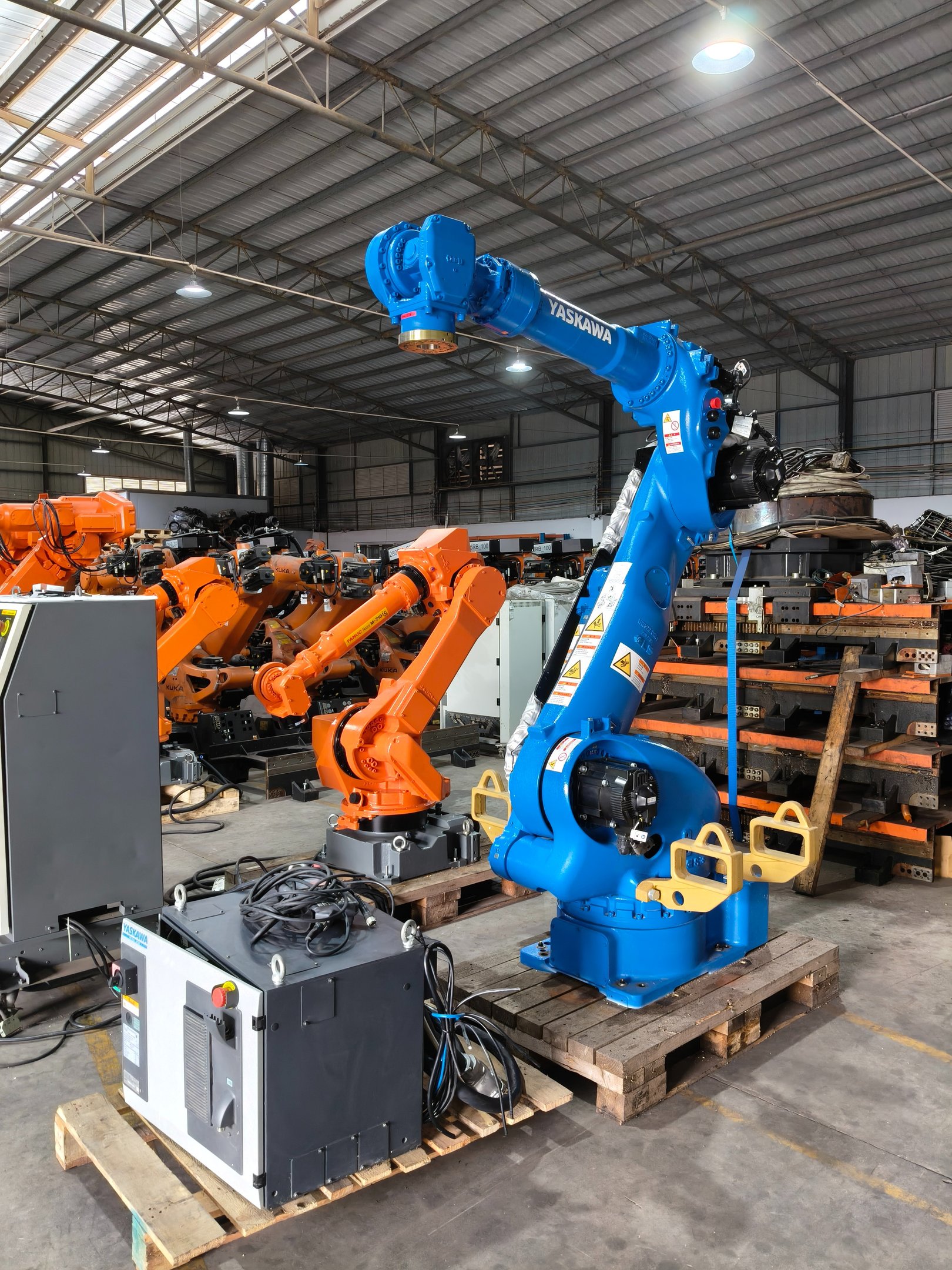
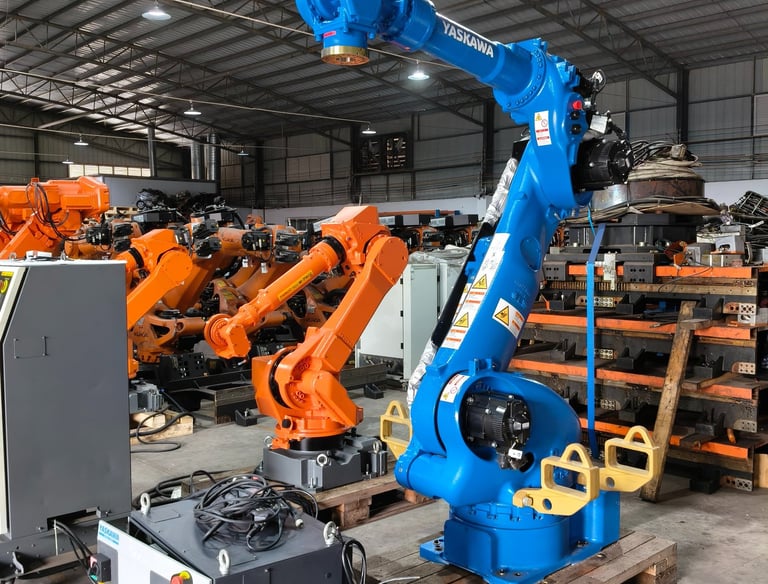
If you walk through any busy factory and look past the obvious stuff like welding sparks and paint booths, you will notice something else. A lot of the movement on the floor is just that. Movement. Parts going into machines. Finished pieces coming out. Boxes stacking onto pallets. Someone picking up a heavy casting, turning around, and putting it down again. None of it looks dramatic, but all of it costs time and labor. Material handling robots do exactly this kind of work, and they do it around the clock. They are not the flashiest machines in the catalog, but they might be the ones that pay for themselves the fastest.
What Material Handling Robots Actually Do
The category is broad, but it breaks down into a handful of specific jobs that show up in almost every industry. Machine tending means loading and unloading CNC mills, lathes, or injection molding machines. The robot keeps the machine fed and running while the operator handles multiple cells. Pick and place is faster and lighter. Think of picking parts off a conveyor and placing them into trays or boxes. Palletizing is at the heavy end of the spectrum. A robot stacks bags, cases, or cartons onto a pallet in a stable pattern, layer after layer. Part transfer covers moving pieces between stations, especially heavy or hot ones that nobody wants to handle manually. Packaging robots load products into containers, seal them, and prepare them for shipment. Sorting robots use vision or sensors to separate parts by type, size, or quality. An industrial robot material handling application can be just one of these or a combination, but the core task is the same. Move something from A to B reliably.
The Specs That Matter for Material Handling
Not every material handling robot needs the same thing. The application drives the spec. For palletizing or moving heavy castings, payload is the headline number. The robot has to lift the part plus the gripper, with some headroom. Reach matters too, especially on palletizing cells where the arm has to cover a full pallet stack. For machine tending, reach and compactness both count. The robot needs to fit inside or next to a machine enclosure and still get the part where it needs to go. Pick and place robots care more about speed and repeatability. A light part moving fast needs a robot that accelerates smoothly and stops on a dime. One thing that makes material handling more forgiving than welding or assembly is the precision requirement. Most handling jobs do not need sub‑millimeter accuracy. That means a well‑maintained used robot can handle the work just as well as a new one for a lot of these applications.
Six Ways Robots Transform Material Handling
First, they keep machines running longer. A robotic machine tending cell can load parts through breaks, shift changes, and lights‑out hours. The spindle keeps turning while the operator handles higher‑value tasks. Second, they stabilize labor costs in roles that are hard to fill. Heavy lifting, repetitive motions, and hot environments do not attract a long line of applicants. Robots fill those gaps. Third, they reduce product damage. A robot places parts with the same motion every cycle. Fewer dropped castings, fewer scuffed cases, fewer bent edges. Fourth, they improve safety. Moving a 200‑pound mold or a hot forging by hand carries risk. Taking the operator out of that equation is the right thing to do. Fifth, they make output predictable. A robot palletizing line runs at a consistent rate all shift. That makes scheduling and shipping a lot simpler. Sixth, material handling automation ROI is measurable fast. Payback periods for these cells often land between ten and eighteen months. Some operations see it sooner. When the numbers are that clear, the investment case tends to write itself.
The Used Robot Advantage in Material Handling
Because material handling applications tend to be more forgiving with precision and run at moderate speeds compared to something like arc welding, a used material handling robot can be a particularly smart buy. A properly inspected and tested unit from one of the big four industrial robot brands will handle most palletizing, machine tending, and part transfer jobs without hesitation. The upfront savings are significant, and for a cost‑sensitive application like this, that shorter payback window matters. Refurbished industrial robots have become a large enough market that finding a specific model with the right reach and payload is no longer a guessing game. It is a sourcing decision.
How to Choose the Right Robot and Supplier
Start with the job. Define the task, the payload, and the work envelope. Then look for a robot that meets those needs without over‑specifying. An oversized robot costs more and takes up extra floor space. Once you know the spec, think about brand and availability. A common model from the Big Four means easier access to spare parts and integrator support. Finally, choose a supplier who tests their equipment properly. Ask for inspection data, not just a description. Tyche Robotic and other established names in the used equipment space understand that a robot sold with real test results is a robot that will run when it gets installed. That is what makes a machine a safe investment, not a gamble.
This guide was prepared by Tyche Robotic, a supplier of refurbished six-axis industrial robots serving integrators and resellers in Latin America, Southeast Asia, and Europe.

Contact Us
As a professional supplier of used industrial robots, Jiangmen Tyche Robotic Co., Ltd. is committed to providing customers with integrated solutions—from hardware selection and configuration to software programming, debugging, and after‑sales maintenance.
© 2025. All rights reserved.

Mr. Victor Ismael